1.0 The Overview
Psalm 15, a Psalm of David, asks and answers the question: “Who may dwell in God’s Presence?” It describes the characteristics of a righteous, trustworthy Person, including walking blamelessly, speaking truth, keeping promises even when costly, showing integrity (no slander, lending without Interest, not accepting bribes), despising evil, and honouring the godly. Psalm 15 Promises that those who live this way will be stable and “never be shaken”.
First, the Key Themes & Characteristics
- The Question: Who is worthy to be God’s Guest (v. 1)?
- Integrity in Speech: Speaking truth from the heart, not slandering, and not spreading rumours. (v. 2-3): Walks uprightly, works righteousness, speaks truth, does not slander, does not harm neighbour or friend.
- Righteous Conduct: Doing what is right, not wronging a neighbour, and showing mercy (no usury/interest on loans to the poor).
- Moral Character: Despising vile people but honouring those who fear the LORD; keeping promises and oaths, even when difficult.
- Stability in God: The ultimate reward for this blameless life is a secure, unshakable Presence with God, reflecting the permanence of God’s own Interest.
- Justice & Generosity (v. 5): Doesn’t take bribes, doesn’t exploit the poor, lends money without interest.
- The Promise (v. 5): Those with these qualities “shall never be moved”.
Second, the Deeper Meaning of Psalms 15
- A Liturgical Guide: Used by Ancient Israelites as they approached the holy Temple to determine if they met God’s Standards for Fellowship.
- Reflection of Christ: Jesus perfectly embodies these qualities, offering His righteousness to Believers, enabling them to meet God’s Perfect Standard.
- Enduring Standard: While Christ provides the way, the Psalm’s ethical demands remain relevant, showing how a Believer’s life should reflect their relationship with God.
Third, New Testament Application
- While Old Testament law forms the basis, Christians see Jesus as perfectly fulfilling these requirements, granting access to God through His Grace.
- Psalm 15’s Moral Teachings remain relevant, guiding Believers to live lives that reflect God’s Character in their daily conduct, even as specific laws (like usury/interest for fellow Jews) are understood in light of Christ’s broader teachings.
Fourth, striking similarity between Psalm 15 and Psalm 24:3-6
Those who are acquainted with the Psalms will at once notice the striking similarity between Psalm 15 and Psalm 24:3-6.
Psalm 15 of 5 verses, composed of “A Question (Psalm 15:1)” and “the Answers (Psalm 15:2-5),” and the sentiments expressed bear the close resemblance to the question and answers of Psalm 24:3-6.
- Psalm 15:1“LORD, who may abide in Your tabernacle? Who may dwell in Your holy hill?”
- Psalm 24:3 “Who may ascend into the hill of the LORD? Who may stand in His holy place?”
References to the Holy Hills (at Mount Zion) and to the House (Tabernacle – at Mount Zion) of the LORD are found in Psalm 15 & Psalm 24:3-6. The description of the moral fitness of the LORD’s People in His House (Tabernacle) is also very much alike, in Psalm 15 & Psalm 24:3-6.
Also, observe though, that there is also a sharp contrast in Psalm 15 to that of Psalm 14. In Psalm 14, there is the character of the Atheistic Fool. There is also the moral corruption and the carnal opposition to God and to His Saints (God’s People). In Psalm 15, the character of the upright Person, God’s Saint.
- Psalm 15 teaches us that the Person who may dwell in the Lord’s Secret Place and cannot be moved is one who will “speak out passionately against evil and evil workers” (Verse 4). They are not silent or passive. They stand for what is right.
- Psalm 15, The message of Psalm 15 to the church is thus a hopeful rather than an exclusionary one: Those who regularly enter the God’s Presence by coming to the place of worship are enabled, more and more, to walk in righteousness, to do what is right, and, more specifically, to strive to display the ethical marks set forth
- Psalm 15 presents a conundrum. David tells of the man who can dwell in the holiness presence of the Lord. But what man passes the test? He must be a man of absolute integrity, filled with righteousness and truth, with no evil intent toward his neighbour, nor any reproach against his friend
- In Psalm 15:4 the term appears in contrast with “those who fear the Lord.” The righteous person stands outside the influence of the wicked, those who act in ways that bring Divine rejection, but stands with and under the influence of those who submit to God’s rule (see Psalm 1:1)
- Psalm 15 is written by David. Although Psalm 15 has no “Dedicatory Title,” nevertheless, it could be titled: “The Person who abides with God.”
- Psalm 15 shows 9 ways to live an unshakeable life – Live with Integrity | “Walk is blameless” “Don’t accept a bribe” We start off the list and end the list with a call to walk with honesty and integrity before God and others. Make wise Choices | “Do what’s righteous” This is about Doing the right thing no matter what.
- Psalm 15:1-5, the similarity with Psalm 24:3-6 may suggest that Psalm 15 is written about the same time of the bringing back of the Ark of the Covenant (God’s Presence) to His (God’s) Dwelling Place, in Mount Zion (2Samuel 6:12-17).
- Psalm 15 tells us that one who follows God “speaks truth from his heart,” (v. 2) “does not slander with his tongue,” (v. 3) “does no evil to his friend,” (v. 3) and “honours those who fear the Lord,”
- Psalm 15’s Lesson – “Lord, who shall abide in thy tabernacle? who shall dwell in thy holy hill?” Who shall be permitted to have fellowship with You? The heavens are not pure in Your sight, and You even charged some of Your angels with folly; who then, among mortal man, can dwell with You?”
- Psalm 15 Define Integrity – Integrity here does not mean sinless, but it does describe the Person who by God’s Grace “sins less.” It refers to one who is whole, complete, sound. Second, this Individual does what is right (15:2). The emphasis here is on doing what is righteous, rather than merely talking about it.
- Psalm 15 involves 5 short verses, are divided equally into two Sections. Psalm 15:1 is the First Section, which involves the question: Psalm 15:1“LORD, who may abide in Your House (Tabernacle)? Who may dwell in Your Holy Hill?” The remainder, Psalm 15:2-5 is the Second Section, which provides the Answers.
- Psalm 15 is the Didactic (Educational) Wisdom Literature “Establishing Guidelines for Living,” that ushers the Believer into God’s Presence.
- Psalm 15’s Message – The message of Psalm 15 to the church is thus a hopeful rather than an exclusionary one: Those who regularly enter God’s Presence by coming to the Place of Worship are enabled, more and more, to walk in righteousness, to do what is right, and, more specifically, to strive to display the ethical marks set forth in …
- Psalm 15 is a Commentary on the Individual Personal Responsibility to God and to his Fellowman as set forth in Deuteronomy 6:5 and Leviticus 19:18.
- Psalm 15, shows forth the blameless character, but not sinless perfect, is assessed by Personal and Social Conduct, that is, “the standard,” to be expected of the Person in God’s Presence.
- Psalm 15 is called the Flawless Gem of religious ethics, unmatched in all the treasures of heathen literatures.
- Psalm 15 is a sufficient proof that the moral failures which surprise and distress us in many of the Old Testament Saints were due to human moral weakness.
- Psalm 15 shows the imperfect character of the People and of the times, and not to deficient revelation of God’s truth and responsibility.
- Psalm 15 shows the People has more of God’s Word, than the People exercise their Faith. What God’s Word has taught for morality is:
- Firstly, to give us the Model of Holiness – in the Person and Life of Our Lord Jesus Christ. The Pattern life, which human imagination could never have framed,
- Secondly, to supply understanding to God’s Holiness, given in God’s Word, the Holy Scriptures. The description in similar terms found in Psalm 24:3-5 and in Isaiah 33:14b-16.
- Psalm 15’s Lessons we can learn:
- Walk Uprightly. “He who walks uprightly, and works righteousness, and speaks the truth in his heart.” –Psalm 15:2 (NKJV) …
- Refuse to Speak Against Others. …
- Stand Against Evil, Honor the Godly. …
- Keep our Word. …
- Refuse to Misuse Money.
- Psalm 15 – Most Theologians seem to agree that David wrote this Psalm after he oversaw the work of moving the Ark of the Covenant to the holy hill of Zion (2Samuel 6). He had been confronted with the weight and glory of the holiness and magnificence of the very Presence of God.
1.1 Psalms 15’s Purpose
The end purpose of our Salvation, through the Finished Work of the Lord Jesus Christ (“It is Finished” {John 19:30}) is not that we might escape from hell but that we might live righteous lives, here on earth. Scripture states that God condemned sin in Christ “in order that the righteous requirements of the Law might be fully met in us, who do not live according to the sinful nature but according to the Spirit.” (Romans 8:4). The questions are:
- “What is the righteous requirement of the Law that are expected of us to meet?”
- “And exactly is required of us?”
These two questions are partially addressed by the teaching of Psalm 15. The Law is the Law given to us in the O.T., and the righteous requirements of the Law are what we normally call the Moral Law.
The Moral Law is summarised in the Ten Commandments, interpreted by the rest of the Bible. The best explanation of the Moral Law is given by Jesus who spoke of it in terms of the First and the Second Great Commandments:
- The First: “Love the LORD our God with all our heart, with all our soul, and with our mind. This is the First and Great Commandment.” (Matthew 22:37; Mark 12:30; Luke 10:27; Deuteronomy 6:4-5).
- The Second: “We shall love the neighbour as ourselves.” (Mark 12:31; Luke 10:27; Leviticus 19:18).
1.2 The Unshakeable Life
Ways to live an Unshakable life via Psalm 15 – Written By Samuel Deuth I don’t know about you, but I want to live the kind of life that no matter the circumstances that come my way, I won’t be shaken and taken off course from God’s Plan for my life. In Psalm 15 we find a list that helps us build that kind of life. Lord, who may dwell in your sacred tent? Who may live on your holy mountain? “The one whose walk is blameless, who does what is righteous, who speaks the truth from their heart; whose tongue utters no slander, who does no wrong to a neighbour, and casts no slur on others; who despises a vile person but honours those who fear the Lord; who keeps an oath even when it hurts, and does not change their mind; who lends money to the poor without interest; who does not accept a bribe against the innocent.” Whoever does these things will never be shaken. (Psalm 15:1-5 NIV) – What a powerful lineup of verses and what an incredible promise of “an unshakable Life!” Let’s break down this chapter of Psalms so we can live an unshakable life in often-shaky times. How to Build an unshakeable Life via Psalm 15:
1.2.1 Live with Integrity
“Walk is Blameless” “Do not accept a bribe” We start off the list and end the list with a call to walk with honesty and integrity before God and others. I like it says, your walk is blameless. I do like you see this saying that everywhere you walk needs to be right with God. Do not just think of honouring God or integrity being when you are in the Church building but in every area of our life. Integrity needs to be a way of life.
1.2.2 Make Wise Choices
“Do what’s righteous” This is about Doing the right thing no matter what. I think we all want to make the right choices, but we do not always do it. To help us make consistently better choices try getting better input into our choices and spend more time reading God’s Word. It is near impossible to do what is right if we do not know what is right. Then once we know what is right, listen and do it.
1.2.3 Speak Truth
“Speak the truth from the heart, with sensitive” In a world that dodges truth and avoids needed confrontation, we need to be people who are honest. Speak the truth in love (Ephesians 4:15a). If we want to be a true friend, we will speak the truth, but we will also do it in a way that expresses love for people. We will get ahead by speaking truth with love and not avoiding it.
1.2.4 Avoid Gossip
“whose tongue utters no slander” Not “slandering” others is about avoiding gossip. Use what is said behind closed doors to be constructive and add value to people not to tear them down. Gossip destroys our life. A great rule of thumb is, if you are not able to be a part of the solution than you should not be talking about it.
1.2.5 Respect Others
“Does no wrong to a neighbour.” The classic golden rule of treating others you would want to be treated comes into play here. When you treat others with respect you will invite and reciprocate the same respect back into your life. Remembering that it is not just what we say but also how we say it that communicates respect for people.
1.2.6 Encourage Others
“Casts no slur on others.” In a world that is often discouraging and dragging us down, be that friend or coworker that chooses to use your words to speak life into others. Do not tare others down but build others up with what you say. Like the Bible also says, the power of life and death are in the tongue and those who love it will eat its fruit.
1.2.7 Align Yourself with the Right People
“Despises a vile person but honours those who fear the Lord “Do not settle for key relationships that you know are not going in the direction that you are going. Who you surround yourself will determine your direction. And what you honour determines what you attract. So, honour God and you will attract those who honour God in their lives.
1.2.8 Live with Commitment
“Keep an oath even when it hurts.” Commitments and decisions move us forward. Often in the world we live in no one wants to make a commitment because they feel like they are going to miss out on “the next best thing” that may come along. But true fulfilment comes from total commitment. And the Bible says that a “Good Name” is better than riches, and a Good Name is built through keeping your commitments even when it hurts. Often the rewards of commitments are not experienced until we get past the point that it hurts as well. It is true in a physical workout, and it is true in life.
1.2.9 Be Generous
“Lend to the poor without interest.” God Himself has given us grace and forgiveness, and we are expected to give and love in that same way. Let’s not only give when we can get a return. Let’s serve and love those around us no matter if we can get a profit from it or not. Every part of our lives gets better when we apply generosity. Like the Bible says,
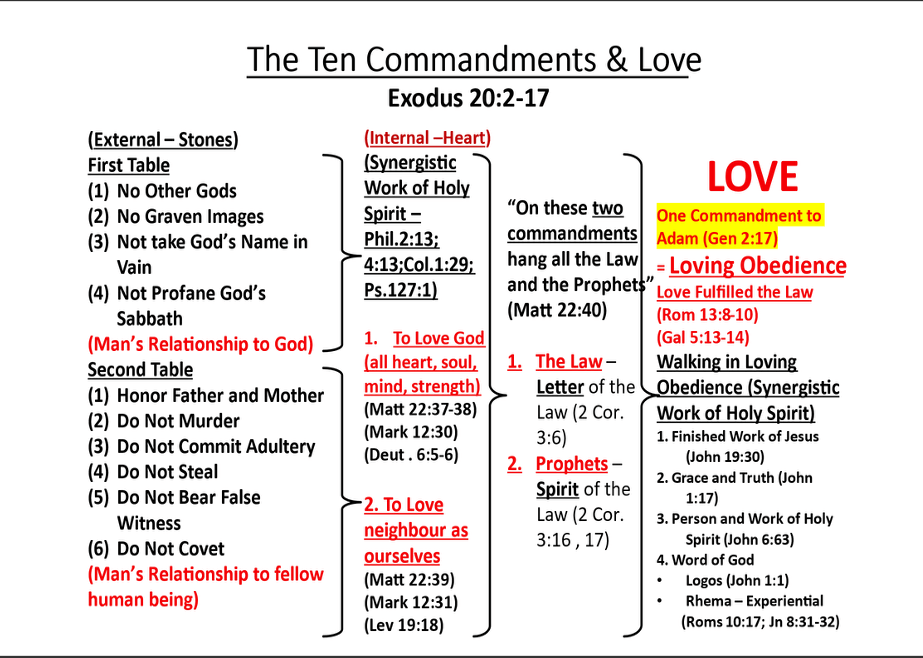
“On these two Great Commandments hang all the Law and the Prophets.” (Matthew 22:40).
This is “God’s Standard” to which God is leading His People, of what God desires for us is that we might be in the Image and Likeness of Christ – 2Corinthians 3:18 “But we all, with unveiled face, beholding as in a mirror the glory of the Lord Jesus, are being transformed into the same image from glory to glory, just as by the Spirit of the Lord.”
It is important to understand that the Person is not made righteous with God by keeping the Moral Law. Justification is by the Finished Work of the Lord Jesus Christ (“It is Finished” {John 19:30}; Ephesians 2:8-9; Ephesians 1:7; Colossians 1:14; 1Peter 1:18-19; 2Corinthians 5:21). Having been justified by the Finished Work of the Lord Jesus Christ, then, keeping the Moral Law, in conformity to the Christ’s Character (2Corinthians 3:18), becomes important.
 Morning Dew . Life