10. Money Matters
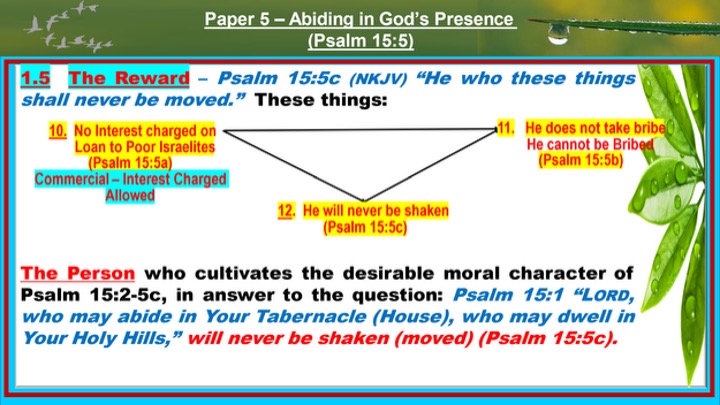
No Interest Charged, on Loan – Psalm 15:5a (NIV) “Who lends money without interest” – Psalm 15:5a (NKJV) “He who does not put out his money at usury (interest).”
First, David in Psalm 15:5a highlights the importance of financial integrity, fairness, and compassion!
- He who does not: The Hebrew Phrase “ʾăsher lōʾ” means he who does not, emphasising the idea of refraining from or avoiding a particular behaviour.
- Put out his money: The Hebrew Phrase “nōtēn bəyādō” means to lend his money, highlighting the idea of financial transactions and lending.
- At usury: The Hebrew word “nəśhek” means at usury or with interest, emphasising the idea of charging excessive or unfair interest rates.
Second, the themes of Psalm 15:5a (NKJV) “He who does not put out his money at usury (interest).”
- Financial Integrity: Psalm 15:5a emphasizes the importance of financial integrity, fairness, and compassion in financial transactions.
- Avoiding Exploitation: The Phrase “does not put out his money at usury” highlights the need to avoid exploiting or taking advantage of others through unfair or excessive interest rates.
- Qualifications for Worship: Psalm 15:5a is part of the larger Psalm that outlines the qualifications for Worshiping God, emphasizing the importance of living the life of integrity, fairness, and compassion.
Third, the Biblical Parallels of Psalm 15:5a (NKJV) “He who does not put out his money at usury (interest).”
- Exodus 22:25 “If you lend money to any of My People who are Poor among you, you shall not be like a moneylender to him; you shall not charge him interest.”
- Leviticus 25:35-37 “If one of your brethren becomes Poor, and falls into poverty among you, then you shall help him, like a stranger or a sojourner, that he may live with you. Take no usury or interest from him; but fear your God, that your brother may live with you.”
Fourth, the implications of Psalm 15:5a (NKJV) “He who does not put out his money at usury (interest).”
- Practice fair and compassionate Lending: Believers should strive to practice fair and compassionate lending, avoiding excessive or unfair interest rates that can exploit or harm others.
- Prioritize the well-being of others: Psalm 15:5a encourages Believers to prioritize the well-being of others, particularly those who are poor or vulnerable, and to act with fairness, compassion, and integrity in financial transactions.
Fifth, the concern is not with receiving interest for money loaned, though it seems to indicate that, but rather with whom the interest for the money loaned is taken from. In other words, Psalm 15:5a addresses that justice should not be circumvented by greed. The Person does not have a covetous spirit, and he does not take advantage of the Poor or less Privileged, lending his money and not exacting interest. The Person “who abides in God’s dwelling Place (tabernacle)” (Psalm 15:1a), refuses immoral financial gain.
- Exodus 22:25 “If you lend money to one of My People among you who is needy, do not be like a Moneylender; charge him no interest.”
- Leviticus 25:35-37 “If one of your countrymen becomes poor and is unable to support himself among you, help him as you would an alien or a temporary resident, so he can continue to live among you. Do not take interest of any kind from him, but fear your God, so that your countrymen may continue to live among you. you must not lend money at interest or sell him food at a profit.”
- Deuteronomy 23:19-20 (NIV) “Do not charge your brother interest, whether on money or food or anything else that may earn interest. You may charge a foreigner interest, but not a brother Israelite, so the LORD your God may bless you in everything you put your hand to in the land you are entering to possess.”
It is not without cause that God has in Leviticus 25:35-36, forbidden interest, adding this reason: “And if one of your brothers become Poor, and falls in poverty among you, then you shall help him, like a Stranger or a Sojourner, that he may live with you. Take no interest from him; but fear your God, that your brother may live with you.” We see that the end for which the Law is framed is that man should not cruelly oppress the Poor, who ought rather to receive sympathy and compassion.
- The Hebrew word for interest is “Neshek” which David employs, being derived from another word which signifies “to bite,” significantly shows that interests are condemned in so far as they involve in them, or lead to, a license of robbing or plundering their fellowmen, those that are Poor/Needy.
- God’s Law allows reasonable interest of acceptable commercial practice, entered to the mutual advantage of Lender and Borrower alike, but the heartless and cruel grinding of the Poor amongst God’s People is detected (Deuteronomy 23:19-20).
Whence it follows, that the gains which the Person who lends his money upon interest acquires without doing injury to anyone, is not to be included under the head of unlawful interest.
Sixth, the Person is not he who loves money lending but is willing to help the Poor from a generous heart (Exodus 22:25). He is not interested in profiting financially at the expense of others; and thus – “He puts not out his money to lending.”
- In relation to material wealth, he rejects the typically grasping practices of interest (Leviticus 25:36,37; Proverbs 28:8).
- Open generosity is more the mark of the children of God (Matthew 10:8). Interest, when one Israelite borrowed of another, was strictly forbidden by the Law (Exodus 22:25; Leviticus 25:36; Deuteronomy 23:19).
- When the borrowed was a Foreigner, it was lawful (Deuteronomy 15:3); and no discredit can attach to the practice so long as the rate of interest charged is moderate (Matthew 25:27).
The Puritanic Divines are almost all of them against the taking of any interest upon money and go to the length of saying that one penny per cent per annum will shut a man out of heaven if persisted in. The demanding of excessive and grinding interest is a sin to be detested; the taking of the usual and current interest in a commercial country is not contrary to the law of love.”
11. No Bribe
He Does Not Take Bribe – Psalm 15:5b “Nor does he take a bribe against the innocent.” – Psalm 15:5b (NIV) “And does not accept a bribe against the innocent.”
First, David in Psalm 15:5b highlights the importance of justice, fairness, and integrity in all aspects of life!
- Nor: The Hebrew word “wəlōʾ” means nor or and not, emphasising the contrast between the previous phrase and this one.
- Does he take: The Hebrew Phrase “yiqqāḥ” means does he take or does he accept, highlighting the idea of receiving or accepting bribe.
- A bribe: The Hebrew word “šōḥad” means a bribe or a gift, emphasising the idea of receiving something in exchange for favours or influence.
- Against the Innocent: The Hebrew Phrase “ʿal nāqî” means against the Innocent or against the Blameless, highlighting the idea of harming or exploiting those who are Innocent or without Fault.
Second, the themes of Psalm 15:5b “Nor does he take a bribe against the innocent.”
- Justice and Fairness: Psalm 15:5b emphasises the importance of justice and fairness in all aspects of life, highlighting the need to protect the Innocent and avoid exploiting or harming them.
- Integrity and Moral Uprightness: The phrase “nor does he take a bribe” highlights the importance of integrity and moral uprightness, recognising that accepting bribes or gifts can compromise one’s values and principles.
- Qualifications for Worship: Psalm 15:5b is part of the larger Psalm that outlines the qualifications for worshipping God, emphasising the importance of living the life of justice, fairness, and integrity.
Third, the Biblical Parallels of Psalm 15:5b “Nor does he take a bribe against the innocent.”
- Exodus 23:8 “And you shall take no bribe, for a bribe blinds the wise and perverts the words of the righteous.”
- Proverbs 17:23 “A wicked man accepts a bribe from the bosom to pervert the ways of justice.”
Fourth, the implications of Psalm 15:5b “Nor does he take a bribe against the innocent.”
- Uphold Justice and Fairness: Believers should strive to uphold justice and fairness in all aspects of life, recognizing the importance of protecting the Innocent and avoiding exploitation or harm.
- Maintain Integrity and Moral Uprightness: Psalm 15:5b encourages Believers to maintain integrity and moral uprightness, recognizing that accepting bribes or gifts can compromise one’s values and principles.
Fifth, allied to the covetous spirit is the practice of taking bribes to pervert the course of justice.
- The Person does not stoop to bribery in taking a reward against the Innocent.
- The Person refuses to take a bribe, either as Judge or a witness, when a charge is made against an Innocent Person.
The contrary conduct was practised by Israelites in later times (Isaiah 1:23; 5:23). He will be clear as light, bright as day, true as steel, firm as rock.
12. The Reward
Psalm 15:5c (NKJV) “He who does these things shall never be moved.”
First, David in Psalm 15:5c makes the powerful conclusion to Psalm 15, emphasising the stability and security that come from living the life of integrity, righteousness, and obedience to God:
- “He who”: The Hebrew Phrase “ʾăsher” means he who, emphasising the idea of Someone who consistently lives out the qualities described in Psalm 15.
- “Does these things”: The Hebrew Phrase “ʿōśeh ʾēlleh” means does these things, highlighting the idea of putting into practice the principles and qualities described in Psalm 15.
- “Shall never be moved”: The Hebrew Phrase “lōʾ yimōṭ” means shall never be moved or shall never be shaken, emphasising the idea of stability, security, and firmness.
Second, the themes of Psalm 15:5c (NKJV) “He who these things shall never be moved.”
- Stability and Security: Psalm 15:5c emphasises the stability and security that come from living the life of integrity, righteousness, and obedience to God.
- The Blessings of Obedience: The Phrase “he who does these things” highlights the idea that obedience to God’s Commands and Principles brings blessings and benefits, including stability and security.
- The Character of the Righteous: Psalm 15:5c concludes the Psalm’s description of the Character of the Righteous, emphasising the importance of living the life of integrity, righteousness, and obedience to God.
Third, the Biblical Parallels of Psalm 15:5c (NKJV) “He who does these things shall never be moved.”
- Psalm 16:8 “I have set the LORD always before me; because He is at my right hand I shall not be moved.”
- Psalm 112:6 “Surely he shall not be moved forever; the righteous shall be in everlasting remembrance.”
Fourth, the implications of Psalm 15:5c (NKJV) “He who these things shall never be moved.”
- Live a life of integrity and obedience: Believers should strive to live a life of integrity, righteousness, and obedience to God, recognizing the stability and security that come from doing so.
- Trust in God’s Sovereignty and Care: Psalm 15:5c encourages Believers to trust in God’s Sovereignty and Care, recognizing that He (God) is the Person who provides stability and security in times of uncertainty and challenge.
Fifth, the Person who cultivates the desirable moral character of Psalm 15:2-5b, in answer to the question: Psalm 15:1 “LORD, who may abide in Your Tabernacle (House), who may dwell in Your Holy Hills,” will never be shaken (moved). The Person is well-founded and firmly anchored in the Lord Jesus Christ. He is like Mount Zion, which cannot be removed but abides forever. Thus, the teaching of Psalm 15 ends with a Postscript: Psalm 15:5c “He who does these things shall never be moved.”
Sixth, the Reward in this Life for the Person who lives according to the twelve requirements in Psalm 15 is that the Person will never be shaken under any circumstances. The Person will not be shaken when God arises to judge the People. In effect, he will be permitted to remain in the House of the LORD all the days of his life and has an abundant entrance into God’s Presence.
Summary
David’s concern as shown in Psalm 15 is with the totality of life determined by God’s Character. This includes right speech with our neighbour and integrity in legal and financial matters. God’s Promises are to stand. Money is to honour God. The Innocent are to be protected. We see these “standards” fulfilled in Christ and then fulfilled in the Individual’s life, who abides and dwells in God’s Presence and Walk “not…according to the flesh but according to the Spirit.” (Romans 8:4).
When the Person lives righteously, there is no storm that can uproot him from God’s Assurance from His Word. God’s Promise – “He that does” (Psalm 15:5c) – The Person who meets God’s Expectations is the Person who “does these things.” (Psalm 15:5c).
The Person not only knows what God expects of him, but he puts these 12 Principles into Practice. The note of stability of Psalm 15:5c “He who these things shall never be moved,” gives the Proper Climax to Psalm 15.
On the other hand, it is to have security and steadiness or consistency of Character and Conduct, whatever the circumstances, so that, he shall never be moved, that is, he will enjoy safety and display stability:
- No convulsions can disturb such Person. His Rest in Divine Love is Person who is secure against any catastrophe whatever (Romans 8:38,39).
- Time is on the side of such the Person. For both the Graces of Faith and Obedience will strengthen with Age; while God who is his Stronghold is the same “Yesterday, and Today, and Forever” (Hebrews 13:8). Such Characters, moreover, can never get out of date.
- No discoveries in science nor in any department can dim the lustre of such a life. To trust in the Great Eternal God and to aspire to His Likeness (2Corinthians 3:18), is surely that of which no advance in human thought can ever make us ashamed.
- The faithful God will never desert such the Person. Whosoever clings to God in faith, love, and obedience will never find His love unreciprocated or his trust unrecompensed.
- The Promises made to such the Person will never fail. They are all Yea and Amen in Christ (2Corinthians 1:20); they are sealed by “the Blood of the Everlasting Covenant” (Hebrews 13:20). And hence the Person who reposes his trust in them can never be moved.
- Bishop Perowne remarks: “Faith in God and spotless integrity may not be sundered. Religion does not veil or excuse petty dishonesties. Love to God is only then worthy the name, when it is the life and bond of every social virtue.”
1.4 Application
Much for the Christian to ponder here 12 Moral Principles are unchanging. Here is the Standard for the Saints. If God be among the Generation of the Righteous (Psalm 15) then the Character must be conformed to His requirements of Holiness.
- Psalm 14 shows the Natural Person; Psalm 15, the Spiritual Person.
- Psalm 14 God with His People; Psalm 15 God’s People with Him.
Fellowship with God and the “Fruit of the Spirit” (Galatians 5:22-23) go together. Righteousness has the Negative aspect as well as the Positive: it not only consists in what the Person does, but what he does not do.
God’s Grace alone makes the Believer the Guest of God, but the Guest is bound by the Laws of hospitality no less than the Host: While Security is recognised, Sincerity is required. Holiness in God (1Peter 1:16) is exhibited not by emotion, but by Character; it affects feet, hands, heart (Psalm 15:2), tongue, ears (Psalm 15:3) and eyes (Psalm 15:4).


