
1.0 The Overview
Those who are acquainted with the Psalms will at once notice a striking similarity between Psalm 15 and Psalm 24:3-6.
- Psalm 15 of 5 verses, composed of “A Question (Psalm 15:1)” and “the Answers (Psalm 15:2-5),” and the sentiments expressed bear a close resemblance to the question and answers of Psalm 24:3-6.
- Psalm 15:1“LORD, who may abide in Your tabernacle? Who may dwell in Your holy hill?”
- Psalm 24:3 “Who may ascend into the hill of the LORD? Who may stand in His holy place?”
- Psalm 15 is written by David. Although Psalm 15 has no “Dedicatory Title,” nevertheless, it could be titled: “The Person who abides with God.”
- Psalm 15:1-5, the similarity with Psalm 24:3-6 may suggest that Psalm 15 is written about the same time of the bringing back of the Ark of the Covenant (God’s Presence) to His (God’s) Dwelling Place, in Mount Zion (2Samuel 6:12-17).
- Psalm 15 is the Didactic (Educational) Wisdom Literature “Establishing Guidelines for Living,” that ushers the Believer into God’s Presence.
- Psalm 15 is a Commentary on the Individual Personal Responsibility to God and to his Fellowman.
1.1 The Question
Psalm 15:1 “LORD, who may abide in Your Tabernacle (House), who may dwell in Your Holy Hills.” – Psalm 15:1 is David’s profound question asking which type of Person is fit to live in God’s Sacred Dwelling (Tabernacle/Tent) and on His holy mountain (Zion/Heavenly presence), setting up the rest of the Psalm which details the character of such a Person: one who lives with integrity, speaks truth, avoids slander, honours God’s people, keeps promises, and acts righteously, promising that such a person “shall never be moved” or shaken.
First, the meaning of the terms:
- Tabernacle/Tent: Represents God’s Presence and Dwelling Place, historically the portable sanctuary, symbolizing communion with God.
- Holy Hill: Refers to Mount Zion, the location of the Temple in Jerusalem, symbolizing God’s Kingdom and Heavenly Presence.
Second, the Question’s Significance
- It highlights God’s Holiness and the unworthiness of sinful humans to approach Him.
- It is a call for spiritual readiness and a desire for a genuine relationship with God, not just outward ritual
Third, the Answer (Psalms 15:2-5)
The answer describes the Person of Integrity who:
- Walks uprightly and practices righteousness.
- Speaks truth from the heart.
- Does not slander or harm their neighbour/friend.
- Despises the vile but honours those who fear the Lord.
- Keeps their Promises, even to their own disadvantage.
- Does not engage in usury (lending at high interest) or take bribes.
Fourth, the Promise
“He who does these things shall never be moved” (or shaken). This signifies stability, security, and an eternal dwelling with God.
Fifth,
David in Psalm 15:1 makes the beautiful and profound question that gets to the heart of what it means to live in close relationship with God:
- LORD: The Hebrew word “YHWH” (Yahweh) is used, emphasizing the Personal and Covenantal relationship between God and His People.
- Who may Abide: The Hebrew Phrase “mî yāgûr” means who may abide or dwell, highlighting the idea of living in the place of safety, security, and intimacy with God.
- In Your Tabernacle (House): The Hebrew word “mishkān” (Tabernacle) refers to the portable Sanctuary where God dwelled among the Israelites, symbolizing God’s Presence and Holiness. The Phrase “Your House” emphasizes God’s Ownership and Sovereignty over the Sanctuary.
- Who may Dwell: The Hebrew Phrase “mî yiškōn” means who may dwell, highlighting the idea of making One’s home or abode in the place of safety, security, and intimacy with God.
- In Your Holy Hills: The Hebrew Phrase “bəhārê qōdesh” means in Your Holy Hills, referring to Mount Zion, the location of the Temple in Jerusalem, which symbolized God’s Presence and Dwelling Place.
Sixth, the Themes
Psalm 15:1 “LORD, who may abide in Your Tabernacle (House), who may dwell in Your Holy Hills.”
- Intimacy with God: Psalm 15:1 expresses David, the Psalmist’s desire to live in close relationship with God, to abide or dwell in His Presence.
- Holiness and Purity: The emphasis on God’s Presence and Dwelling Place highlights the importance of living the life of relationship with God and the approach to God.
- Qualifications for Worship: David, the Psalmist’s question implies that there are certain qualifications or requirements for Worshiping God, which are explored in the rest of the Psalm 15.
Seventh, the Biblical Parallels
Psalm 15:1 “LORD, who may abide in Your Tabernacle (House), who may dwell in Your Holy Hills.”
- Psalm 24:3-4 “Who may ascend into the hill of the LORD? Who may stand in His holy place? He who has clean hands and a pure heart, who has not lifted up his soul to an idol, nor sworn deceitfully.”
- Leviticus 11:44-45 “For I am the LORD your God. You shall therefore consecrate yourselves, and you shall be holy; for I am holy.”
Eighth, the Implication
Psalm 15:1 “LORD, who may abide in Your Tabernacle (House), who may dwell in Your Holy Hills.”
- Pursue intimacy with God: Believers should pursue intimacy with God, seeking to live in close relationship with Him (God) and to abide in His Presence.
- Strive to fulfil God’s Requirements of Psalm 15:2-5b: Psalm 15:1 encourages Believers to strive for fulfilment of God’s Requirements of Psalm 15:2-5 in our lives, recognizing that God desires His People in Psalm 15:2-5.
Nineth, David’s question
Is addressed to the LORD (Jehovah), and this is important. The two words “abide” (SC1481) and “dwell” (SC7931) are different.
- The word “abide” (situational) suggests the sojourning, a lodging. There is a temporary aspect to it, corresponding with the temporary (situational) nature of the tabernacle or tent itself.
- The word “dwell” (life-long) has the thought of dwelling more permanently, residing, settling down, remaining. This is in keeping with the permanence of the holy hills at Mount Zion.
Tenth, Psalms 15
Psalms 15 suggests that there is an opportunity wherein the Person may abide in God’s House and God’s Presence. The Person who comes into God’s Presence must face squarely this twofold question – Psalm 15:1 “LORD, who may abide in Your Tabernacle (God’s House)? Who may dwell in Your Holy Hills (God’s Presence)?”
- The Parallel Questions (“Who may abide? Who may dwell?”) emphasise that God’s Requirements of Psalm 15:2-5b must be met if the Person is to enjoy His (God’s) House and His (God’s) Presence.
- The “Tabernacle” and the “Holy Hills” of Zion are not wholly the figure of speech, but the meeting-places with God, pointing to the Divine House and Divine Presence, and the blessedness of abiding & dwelling in them. For us Christ is the “Tabernacle” (John 1:14).
1.2 The 12 Requirements
Psalm 15:2-5 “He who walks uprightly, and works righteousness, and speaks the truth in his heart; he who does not backbite with his tongue, nor does evil to his neighbour, nor does he take up a reproach against his friend; in whose eyes a vile person is despised, but he honours those who fear the LORD; he who swears to his own hurt, and does not change; he who does not puts out his money at usury (interest), nor does he take a bribe against the innocent. He who does these things shall never be moved.”
David’s Question in Psalm 15:1“LORD, who may abide in Your Tabernacle (House), who may dwell in Your Holy Hills.” Is answered by the Revelation of the Holy Spirit with Twelve Requirements (Psalm 15:2-5b).
- Psalm 24:3-6 gives an additional Four Requirements, making a total of Sixteen Requirements to abide in God’s Presence and Dwell in His (God’s) Holy Hills (God’s Presence).
- God’s Assurance – Concluding with God’s Assurance in Psalm 15:5c “He who does these things shall never be moved.”
There are 12 Requirements of Psalm 15:2-5b and 4 Requirements of Psalm 24:3-6 = 16 Requirements to abide & dwell in God’s Holy Hills? Psalm 15:2-5b and Psalm 24:3-6 outline specific requirements for those who desire to abide and dwell in God’s Holy Presence. The breakdown is:
Psalms 15:2-5b (12 Requirements)
- Walk uprightly (Psalm 15:2).
- Work righteousness (Psalm 15:2).
- Speak the truth in his heart (Psalm 15:2).
- Not backbite with his tongue (Psalm 15:3).
- Not do evil to his neighbour (Psalm 15:3).
- Nor take up a reproach against his friend (Psalm 15:3).
- In whose eyes a vile person is despised (Psalm 15:4).
- But he honours those who fear the LORD (Psalm 15:4).
- He who swears to his own hurt and does not change (Psalm 15:4).
- He who does not put out his money at usury (Psalm 15:5).
- Nor does he take a bribe against the innocent (Psalm 15:5).
- He who does these things shall never be moved (Psalm 15:5).
These 16 Requirements emphasize the importance of living a life of integrity, righteousness, and purity in order to approach God and dwell in His Holy Presence. What a great reminder of the high standards of God’s Presence and the importance of living a life that reflects His (God’s) Character!
1.2.1 Character
First, He Walks Uprightly – Psalm 15:2a (NKJV) “He who walks (behaviour and conduct) uprightly (blameless).” First, David in Psalm 15:2a highlights the importance of living the life of integrity and moral uprightness:
- He who walks: The Hebrew Phrase “hāʾōlēk” means he who walks, emphasizing the idea of one’s behaviour and conduct in daily life.
- Uprightly: The Hebrew word “tāmîm” means uprightly or blamelessly, highlighting the importance of living a life of moral integrity and uprightness.
Second, the themes of Psalm 15:2a (NKJV) “He who walks (behaviour and conduct) uprightly (blameless).”
- Integrity and Moral Uprightness: Psalm 15:2a emphasizes the importance of living a life of integrity and moral uprightness, where one’s behaviour and conduct are blameless and upright.
- Consistency between Faith and Practice: Psalm 15:2a implies that there should be consistency between the Individual’s Faith and Practice, where the Individual’s behaviour and conduct reflect their commitment to God.
- Qualifications for Worship: Psalm 15:2a is part of the larger Psalm that outlines the qualifications for Worshiping God, emphasizing the importance of living the life of integrity and moral uprightness.
Third, the Biblical Parallels of Psalm 15:2a (NKJV) “He who walks (behaviour and conduct) uprightly (blameless).”
- Proverbs 10:9 “He who walks uprightly walks securely, but he who perverts his ways will be found out.”
- Matthew 5:48 “Therefore you shall be perfect, just as your Father in heaven is perfect.”
Fourth, the implications of Psalm 15:2a (NKJV) “He who walks (behaviour and conduct) uprightly (blameless).”
- Strive for Integrity and Moral Uprightness: Believers should strive for integrity and moral uprightness in our daily lives, recognizing that this is the fundamental aspect of Worshiping God.
- Reflect on your Behaviour and Conduct: Psalm 15:2a encourages Believers to reflect on our behaviour and conduct, ensuring that we are living the life that is blameless and upright.
Fifth, the term “uprightly {blameless – NIV}” is (SC8549) and is translated as: “Without blemish; without spot; sincere; complete; perfect.”
- The Term “who walks uprightly” does not mean “sinless perfection.”
- Behaviour refers to actions usually measured by commonly accepted standards.
- Conduct refers to actions viewed collectively according to principles of ethnics.
Sixth, the Person of Psalm 15 walks in God’s Presence. Walk in Scripture means:
- The Person’s Behaviour is the immediate interaction/reaction, especially as regards himself, and as in God’s Sight – the inward, even more than the outward, life (Luke 1:6).
- The Person’s Conduct (behavioural) attributes, the way the Person behaves, outwardly, toward other People.
Seventh, Psalm 15:2a (NKJV) “He who walks (conduct and behaviour) uprightly (blameless).”
The Person’s Conduct and Behaviour is with integrity, with an undivided purpose of heart and mind. The Person upright Walk (Conduct and Behaviour) is the First Requirement of Psalm 15:2a (Genesis 17:1; Psalm 23:3, 11; Isaiah 33:15). The Person’s entire life and bearing will be of unswerving integrity.
Eighth, the Person does not walk with the Wicked, and he is led and directed by the Holy Spirit. He Walks in the Light of God’s Word (“the Wise Man” of Matthew 7:24-25). His Path of Life is “As the shining light that shines brighter and brighter unto the perfect day” (Proverbs 4:18).
Ninth, the Person’s integrity and righteousness relate to the personal responsibility to God, while truthfulness and the remaining virtues refer to the personal responsibility toward Others.
Tenth, Combining the similar uprightness and integrity (AV “Righteousness”), it is possible to discover an ethical decalogue in the phrases of this Section of Psalm 15. On the Positive side he is blameless in manner of life (Genesis 6:9; 17:1):
- Bishop Perowne renders the word “Uprightly,” “Perfectly,” which in the Scriptural sense is equivalent to “Sincerely,” with an incorruptible aim at God’s Glory.
- C.H Spurgeon – “Observe the accepted Person’s Walk (Conduct and Behaviour), Work (Righteousness) and Word (Speech). Walking (Conduct and Behaviour) is of far more importance than talking. He only is right who is upright in walk and downright in honesty. His Faith shows itself by Good Works and therefore is no dead Faith. God’s House is the Hive for Workers, not the Nest for Drones.”
- William Secker: “When the wheels of the clock move within, the hands on the dial will move without. When the heart of the Person is sound in conversion, then the life will be fair in profession. When the conduit is walled in, how shall we judge of the spring but the waters which run through the pipes?”
2.0 Character
He Works Righteousness – Psalm 15:2b “And works righteousness.” – Psalm 15:2b, “And works righteousness,” describes a key characteristic of someone worthy to dwell in God’s Presence: they do not just talk about being good, but actively do what is right and just in their actions, living a life of integrity and fairness, alongside walking uprightly and speaking truth from the heart. It emphasises practical, ethical living, showing a sincere heart through deeds rather than mere outward appearance.
First, Meaning & Context
- Part of a Larger Description: This phrase is part of a description in Psalm 15:1-2 of the person who can “abide in your tabernacle” (live in God’s Presence).
- Integrity in Action: It means living a blameless life, practicing justice, and showing integrity in daily conduct, not just having good intentions.
- Complements Other Virtues: It is paired with walking uprightly (living with integrity) and speaking truth in the heart (sincerity), showing that righteousness involves your whole being—walk, inner truth, and actions.
In simpler terms: This Person does not just say they are good; they consistently do what is right and fair to others.
Second, David in Psalm 15:2b makes the powerful statement in addition to the previous phrase, emphasizing the importance of living a life of righteousness and justice:
- And Works: The Hebrew Phrase “wəʿōśeh” means and works or and does, emphasizing the idea of putting One’s Faith into Action.
- Righteousness:” The Hebrew word “ṣedāqāh” means righteousness or justice, highlighting the importance of living a life that is characterized by righteousness, fairness, and justice.
Third, the themes of Psalm 15:2b “And works righteousness.”
- Righteous Living: Psalm 15:2b emphasizes the importance of living a life of righteousness, where One’s actions and decisions are guided by the commitment to justice and fairness.
- Faith in Action: The Phrase “and works righteousness” highlights the importance of putting One’s faith into action, demonstrating the commitment to righteousness and justice in daily life.
- Qualifications for Worship: Psalm 15:2b is part of the larger Psalm that outlines the qualifications for Worshiping God, emphasizing the importance of living the life of righteousness and justice.
Fourth, the Biblical Parallels of Psalm 15:2b “And works righteousness.”
- Matthew 5:6 “Blessed are those who hunger and thirst for righteousness, for they shall be filled.”
- James 2:24 “You see then that a man is justified by works, and not by faith only.”
Fifth, the implications of Psalm 15:2b “And works righteousness.”
- Strive for righteousness in daily life: Believers should strive for righteousness in their daily lives, recognizing that this is a fundamental aspect of worshiping God.
- Put faith into Action: Psalm 15:2b encourages Believers to put their Faith into action, demonstrating the commitment to righteousness and justice in our daily decisions and actions.
Sixth, to “work righteousness,” involves obediently responding to God’s Written Word (2Timothy 3:16-17} and Spoken Word {Rhema – Romans 10:17}). God’s Word teaches that “obedience,” is better than sacrifice (1Samuel 15:22b).
- The Person’s Walks is accompanied by “righteous attributes,” involving dealings: “Justly, fairly, honestly, with Others.”
- His (Person’s) deeds are right. His (Person’s) deeds correspond with the simplicity and integrity of his life’s aim and intent.
- The Person’s Work is “just and right,” in contrast to the “Worker of Iniquity (Lawlessness).
Seventh, it is through the Lord Jesus Christ, that God imparted His Righteousness to the Believer – 2Corinthians 5:21 “For He (Father) made Him (Jesus) who knew no sin to be sin for us, that we might become the righteousness of God in Him (Christ).” For most Believers, the life and call to Holiness (Sanctification – 1Peter 1:16), provoked deep frustration. There are so many areas, that needed adjustments, especially attitudes:
Eighth, thus, he “works righteousness,” is to do things which are consistent with God’s Character and the Godly Walk (Behaviour & Conduct).
- Thomas Boston: “A Righteous Person may make a righteous work, but no work of an unrighteous man can make him righteous.”
- Martin Luther: “The only work that we must hope will be considered and accounted for, is the work of righteousness: all other works that either urge or allure (attraction) us on under a show of godliness are a thing of nought.”
All of life is to be “Sanctified (Holy/Set apart).” It is to be “whole” and “holy.” The Person integrated his submission to God throughout his entire character and behaviour is the Person who dwells with God now and who will dwell with Him (God) forever – 1Thessalonians 5:23 “Now may the God of Peace Himself sanctity you completely; and may your whole spirit, soul, and body be preserved blameless at the Coming of our Lord Jesus Christ.” It is through Jesus Christ.
3.0 His Speech
He Speaks Truth – Psalm 15:2c “And speaks the truth from his heart.” – The verse Psalm 15:2c, “And speaks the truth from his heart,” describes the Person of Integrity who is qualified to “dwell in the Lord’s tabernacle” or “rest upon His holy hill.” This specific phrase emphasizes that a righteous person’s truthfulness is not merely an outward behaviour but a fundamental aspect of his inner character. His words are a genuine reflection of his inner self, indicating sincerity and an integrated life where actions, words, and thoughts are consistent.
First, the broader context of Psalm 15 describes this Believer as one who:
- Walks blamelessly and does what is right.
- Does not slander others or do wrong to a neighbour.
- Keeps their word even when it is to their own disadvantage.
- Does not take bribes or exploit others.
Living this “Psalm 15 life” means being rooted in God’s Commands and developing a strong inner character, allowing one to stand firm and unshakable no matter what challenges arise
Second, David in Psalm 15:2c highlights the importance of honesty, integrity, and sincerity in one’s words and actions:
- And Speaks: The Hebrew Phrase “wədōbēr” means and speaks, emphasizing the idea of verbal communication and expression.
- The Truth: The Hebrew word “ʾĕmet” means truth, highlighting the importance of honesty, accuracy, and sincerity in One’s words.
- From his Heart: The Hebrew Phrase “mibbētō” means from his heart, emphasizing the idea that Believer’s words should flow from a sincere and genuine heart, rather than being mere lip service.
Third, the themes of Psalm 15:2c “And speaks the truth from his heart.”
- Honesty and Integrity: Psalm 15:2c emphasizes the importance of honesty and integrity in One’s words and actions, highlighting the need for sincerity and truthfulness.
- Heartfelt Communication: The Phrase “from his heart” highlights the importance of heartfelt communication, where One’s words flow from the genuine and sincere heart.
- Qualifications for Worship: Psalm 15:2c is part of the larger Psalm that outlines the qualifications for Worshiping God, emphasizing the importance of honesty, integrity, and sincerity in One’s words and actions.
Fourth, the Biblical Parallels of Psalm 15:2c “And speaks the truth from his heart.”
- Proverbs 12:17 “He who speaks truth declares righteousness, but a false witness, deceit.”
- Matthew 12:34-37 “For out of the abundance of the heart the mouth speaks… For by your words you will be justified, and by your words you will be condemned.”
Fifth, the implications of Psalm 15:2c “And speaks the truth from his heart.”
- Speak the truth from the Heart: Believers should strive to speak the truth from our hearts, being honest, sincere, and genuine in our words and actions.
- Let our words reflect our heart: Psalm 15:2c encourages Believers to let our words reflect our heart, ensuring that our verbal communication is a genuine expression of our inner thoughts and feelings.
Sixth, the Person’s heart is true to his words – Psalm 15:2c “And speaks the truth from his heart.”
- The Person does not say one thing and mean another, nor will he cajole (persuade) another by false pretences.
- The Person is not lipping service, thinking one thing, and saying another. It is truth in the inward part (‘heart’). – “Blessed are the pure in heart,” (Mattthew 5:8).
- The Person’s words, therefore, is sincere. There is no deceit or flattery or lying speech.
- The Person “speaks the truth, in love” (Ephesians 4:15) – to speak the things which are in conformity with the Person’s Walk and Work.
Seventh, this “truth {governed by God’s Word},” David says, is to be in the Person’s “heart,” not just on his lips. It is to come from the centre of his being. This reveals the inward and outward motivation of the Person.
- The Person does not speak truth with the lips – what is literally true, but with a different meaning in the heart.
- The Person who speaks “truth” from his heart is free from deceit because his heart is set upon truth (God’s Word).
- The Person does not “parroting” in Prayer-book Version, which would make the reference one to mere truth of speech, but not “in his heart,”
Eighth, Truth (governed by God’s Word {Scripture}) points to internal truthfulness – that truthfulness “in the hidden council-chamber of the soul,” which “holds no parley (conference) with what is false:”
- Thomas Boston: “Anatomists have observed that the tongue in man is tied with a double string to the heart.”
- Benjamin Bennet’s (Christian Oratory): “I am thankful for any conviction and sense I have of the evil of lying; The Lord increases my abhorrence of it. I would endeavour to cleanse myself from all filthiness: there never will be a mortified (embarrassed) tongue while there is an un-mortified heart.”
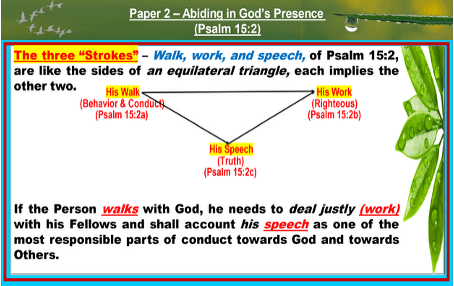
Ninth, the three “strokes” – Walk, work, and speech, of Psalm 15:2, are like the sides of an equilateral triangle, each implies the other two. If the Person walks with God, he needs to deal justly (work) with his Fellows and shall account his speech as one of the most responsible parts of conduct towards God and towards Others.
- Maturity – This is not an impossible picture of ideal maturity {not sinless perfection} – simply a description of whole-hearted obedience.
- Jesus’s Expectation no less, for the Person who “abides” in God’s House (Tabernacle) and “dwells” in God’s Presence (Mount Zion – Holy Hills – Ark of the Covenant’s Presence) of Psalm 15:1.
- Disciple – It is strange if less is expected in “a Disciple indeed” than in “an Israelite indeed” (John 1:47; 8:31).
 Morning Dew . Life