The Fear of The LORD has certain features and descriptive characteristics:
The Fear of the LORD is a hatred of evil – Proverbs 8:13 “The Fear of the LORD is to hate evil.”
The Fear of the LORD is Wisdom – Psalm 111:10 “The Fear of the LORD is the beginning of Wisdom.”
The Fear of the LORD is a Treasure – Proverbs 15:16 “Better is little with the Fear of the LORD than great treasure and trouble therewith.” – The Fear of the LORD is the Believer’s treasure. (Isaiah 33:6).
The Fear of the LORD is the Fountain of Life – Proverbs 14:27 “The Fear of the LORD is the Fountain of Life.”
The Fear of the LORD is Clean – Psalm 19:9 “The Fear of the LORD is clean.” It has the Sanctifying Power.
The Fear of the LORD endures forever – Psalm 19:9 “The Fear of the LORD is clean, enduring forever.”
The Fear of the LORD is Godly – Hebrews 12:28 “Let us have grace, whereby we may serve God acceptably with reverence and Godly Fear.” There is a difference between Reverence and Fear.
Motivation
What motives cause us to Fear the LORD, and walk in the Fear of the LORD:
God’s Holiness causes us to Fear Him – Revelation 15:4 “Who shall not Fear Thee, O Lord, and Glorify Your Name? for You are Holy.”
God’s Greatness causes us to Fear Him – Deuteronomy 10:12-17 “And now Israel, what does the Lord your God require of thee, but to Fear the LORD your God….”
God’s Goodness causes us to Fear Him – 1Samuel 12:24 “Only Fear the LORD and serve Him in truth with all your heart: for consider how great things He has done.”
God’s Forgiveness causes us to Fear Him – Psalm 130:4 “But there is forgiveness with Thee, that You may be Feared.” Praise the LORD for this, too.”
God’s Wondrous Works causes us to Fear Him – Joshua 4:23-24 “Joshua reviews these works.”
God’s Coming Judgement causes us to Fear Him – Revelation 14:7 “Saying with a loud voice, Fear God, and give Glory to Him; for the hour of His Judgement is come.”
Necessity
The Fear of the LORD is necessary for Growth and God’s Presence and Favour:
The Fear of the LORD is necessary for Worship – Psalm 5:7 “In Your Fear will I worship.” (Psalm 89:7).
The Fear of the LORD is necessary for Service – Psalm 2:11 “Serve the LORD with Fear and rejoice with trembling.”
The Fear of the LORD is necessary to keep us from Sin – Exodus 20:20 “Fear not: For God is come to prove you, and that His Fear may be before you face, that you sin not.”
The Fear of the LORD is necessary for Good Government – 2Samuel 23:3 “He that rules over men must be just, ruling in the Fear of God.” This is lacking in Governments today.
The Fear of the LORD is necessary for Administration of Justice – 2Chronicles 19:6-9 “And said to the Judges, ‘Take heed to what you are doing, for you do not judge for man but for the LORD, who is with you in the judgement.’ Now, therefore, let the Fear of the LORD be upon you; take care and do it, for there is no iniquity with the LORD our God, no partiality, nor taking of bribes. Moreover, in Jerusalem, for the judgement of the LORD and for controversies, Jehoshaphat appointed some of the Levites and Priests and some of the Chief fathers of Israel, when they returned to Jerusalem. And he commanded them, saying, ‘Thus you shall act in the Fear of the LORD, faithfully and with a loyal heart.”
The Fear of the LORD is necessary for the Perfecting of Holiness in our Christian lives – 2Corinthians 7:1 “Therefore, having these promises, beloved, let us cleanse ourselves from all filthiness of the flesh and spirit, perfecting holiness in the Fear of God.”
God’s Promises
The Fear of the LORD (God) comes with His Promises – no single aspect of the Christian life carries with it greater of God’s Promise of Blessings than to the Individual Believer and the Church who walks in the Fear of the LORD (God):
The Fear of the LORD brings Pleasure to the LORD – Psalm 147:11 “The LORD takes pleasure in them that Fear Him, in those that hope in His Mercy.”
The Fear of the LORD causes the LORD’S Pity to increase upon the child of God – Psalm 103:13 “Like as a father pities his children, so the LORD pities them that Fear Him.”
The Fear of the LORD brings acceptance with God – Acts 10:35 “But in every Nation he that Fears Him, and works righteousness, is accepted with Him.” Peter to Cornelius and friends.
The Fear of the LORD brings God’s Mercy – Psalm 103:17 “But the Mercy of the LORD is from everlasting to everlasting upon them that Fear Him.”
The Fear of the LORD brings blessings – Psalm 112:1 “Blessed is the man that Fears the LORD.”
The Fear of the LORD brings confidence – Proverbs 14:26 “By the Fear of the LORD is strong confidence.”
The Fear of the LORD brings separation from evil – Proverbs 16:6 “By the Fear of the LORD men depart from evil.” Today there is little Fear of the LORD and an abundance of evil. God’s Judgement on Ananias and Sapphira, resulted in great Fear of the LORD came among the people (Acts 5:1-11 {vs11}).
The Fear of the LORD brings Christian Fellowship – Malachi 3:16 “Then they that Feared the LORD speaks often one to another: and the LORD hearkened and heard it.”
The Fear of the LORD supersedes the Fear of man – Isaiah 8:12, 13 “…. Neither fear you their fear, nor be afraid. Sanctify the Lord of Hosts Himself; and let Him be your Fear.”
The Fear of the LORD brings Answer to Prayer – Psalm 145:19 “He will fulfil the desire of them that Fear Him: He also will hear their cry and will save them.”
The Fear of the LORD brings long life – Proverbs 10:27 “The Fear of the LORD prolongs days.”
Let us pray that God will teach us to Fear Him – Psalm 86:11 “Teach me Your way, O LORD; I will walk in Your truth: unite my heart to Fear Your Name.” (Proverbs 15:16; Proverbs 19:23).
The Reverential Fear of the LORD (God) comes with His Promises – no single aspect of the Christian life carries with it greater of God’s Promise of Blessings than to the Individual Believer and the Church who walks in the Reverential Fear of the LORD (God), will experience Sevenfold Blessings:
First, God’s Wisdom
There is a difference between Intellect (acquisition of Knowledge) and God’s Wisdom (Divine Insight & Application) – an Individual can be brainy but if he denies the Existence of God, he is a fool – Psalm 14:1 “The fool that said in his heart, there is no God.” God’s Wisdom comes to an Individual Believer or the Church, who has Reverential Fear of Him (God):
Job 28:28 “Behold, the fear of the LORD, that is wisdom.”
Psalm 111:10 “The fear of the LORD is the beginning of Wisdom: a good understanding has all they that do His Commandments.’
An Individual Believer or Church who walks in Reverential Fear of the LORD (God) is Wise because God directs his steps – Psalm 37:23 “the steps of a good man are ordered by the LORD, and He delights in his way.” It is difficult to be obedient to God’s Word, if the Individual Believer does not have the Reverential Fear of the LORD (God) – Hebrews 3:6 “Christ (is) as a Son over His own house; whose house are we, if we hold fast the confidence and the rejoicing of the hope firm unto the end.” – Hebrews 3:6 is God’s conditional Promise – its fulfilment is based on the Individual Believer’s respond – if the Individual Believer holds fast to God’s Word that comes to him, if he has ear to hear what God’s Spirit is saying to him, then God’s Promise will be fulfilled
Second, God’s Cleanses
Reverential Fear of the LORD (God) is like a disinfectant – Psalm 19:9 “The fear of the LORD is clean, enduring for ever:…..” – keeping the Individual Believer morally and spiritually clean; an Individual Believer who does not have Reverential Fear of the LORD (God) tends to become defiled more easily. The Reverential Fear of the LORD (God) does not only disinfect (clean); but it endures forever (Psalm 19:9b) – it keeps the Individual Believer not only from defilement but also keeps him from making stupid mistakes; that he tends to make, if he is not walking in the Reverential Fear of the LORD (God).
Third, God’s Guidance & Prosperity
The Individual Believer who walks in Reverential Fear of the LORD (God) will be guided by God and he will prosper in God – Psalm 25:12-14 “Who is the man that fears the LORD? Him shall He teaches in the way He chooses. He himself shall dwell in prosperity, and his Descendants shall inherit the earth. The secret of the LORD is with those who fear Him, and He will show them his Covenant.”
God Provides Guidance – “He teaches in the way He chooses.”
God Offers true Prosperity – “He (Individual) himself shall dwell in prosperity.” – The prosperity is more than financial but the total well-being.
God’s Provides for his Descendants – “His Descendants shall inherit the earth.”
God Reveals His Secret to him – “The Secret of the LORD is with him.” (Deuteronomy 29;29).
God Reveals His (God’s) Covenant to him – “He will show them His {God’s} Covenant.”
Our Lord Jesus assured the Individual Believer and the Church that “No one who has left home or brothers or sisters or mother or father or children or fields for Him and the Gospel will fail to receive a hundred times as much in this present age and in the age to come, eternal life” (Mark 10:29-30). But God’s Blessings are always in association with the Reverential Fear of the LORD (God); and not out of self-interest.
Fourth, Long Life
God’s Assurance that the Individual Believer who walks in the Reverential Fear of the LORD (God) will have long, satisfying, and fruitful life – Proverbs 10:27 “The fear of the LORD prolongs days; but the years of the Wicked will be shortened.” Rebellion with disobedience can shorten the Individual Believer’s life on the Earth – Proverbs 10:27b “But the years of theWwicked will be shortened.” Individual Believer who does not walk in the Reverential Fear of the LORD (God) tend to be careless in “Discerning the Lord’s Body” to his disadvantage – 1Corinthians 11:29-30 “For he who eats and drinks in an unworthy manner, eats and drinks judgement go himself, not discerning the Lord’s body. For this reason, many are weak and sick among you and many died prematurely.” Every time Believers gathered to partake of the Lord’s Table, it is vitally important that we truly Discern the Lord’s Body. But what does it mean to Discern the Lord’s Body? A study of the Corinthians Epistle reveals that there is a twofold aspect of the Lord’s Body, that is: (1) Christ’s Physical Body; (2) Christ’s Spiritual Body, the Church.
1. Discerning Christ’s Physical Body
When Jesus took bread and said to His Disciples, “Take, eat, this is My body broken for you……” (Matthew 26:26b):
Jesus is referring to His Physical Body that was to be crucified.
Christ in His Physical Body bore our sins – 1Peter 2:24a “Who Himself bore our sins in His own body on the tree (Cross)…….”
Christ, in His Physical Body bare our sicknesses, our diseases and death and it is by His strips we are healed (1Peter 2:24b; Isaiah 53:5).
In Discerning Christ’s Physical Body, we discern that Jesus took our sins, our sicknesses and our diseases and our spiritual death – there is forgiveness, healings, health and wholeness and life in the Body of Jesus, broken for us.
2.Discerning Christ’s Spiritual Body
The second aspect of Discerning Christ’s Body has to do with the Church – the Body of Christ:
Apostle Paul reminds us that the Church is a “Many-Members-Body” (1Corinthians 10:17).
The relationship is the main emphasis – In the Corinthians Church there was criticism, backbiting, strife, personality clashes, divisions, party-spirit (taking-sides in disputes), etc.
How can the Corinthians Church truly discern Christ’s Body in Christ’s Members with such rife carnality?
How many Believers failed to discern these two aspects of Christ’s Body (His Physical Body & Spiritual Body – the Church). How many of us see the Lord’s Table (Communion) as a memorial service? Individually, we need to examine ourselves, making sure that there are no unresolved conflicts with any members of the Body of Christ. There must be love, forgiveness and acceptance of one another as we gather to partake of the Communion. The theme: “one-another” is mentioned 75 times in God’s Word (Scripture). Individually, we can receive healing, strength, and Divine life, from Christ’s Body and shed Blood – this is what it means “to Discern the Lord’s Body!”
Fifth, God’s Confidence
The Reverential Fear of the LORD (God) delivers the Individual Believer from all kinds of fears that torment him – Proverbs 14:26-27 “In the fear of the LORD is strong confidence, and His children will have a place of refuge. The fear of the LORD is a fountain of life, to turn away from the snares of death.” The Reverential Fear of the LORD (God):
Is our Strong Confidence, in God, in adverse situations.
Is a Place of Refuge, for our Descendants.
Is a Fountain of Life.
Prevents untimely accident & death – “Turn away from the snares of death.”
Sixth, Life & Satisfaction
The Reverential Fear of the LORD (God) gives “life & satisfaction” – Proverbs 19:23 “the fear of the LORD leads to life and he who has it will abide in satisfaction; he will not be visited with evil.” This does not mean that the Individual Believer has trouble-free-life. It is in the face of “trouble,” that the Individual Believer find life and satisfaction. Because God gives him the ability and stamina to go through the problems without the devastation on his life. God will enable the Individual Believer to walk through trouble and not fear it. One of the Society’s problems is depression, arising out of fear; God will gives the Individual Believer, His (God’s) Perfect Peace, if he stays his mind in God – Isaiah 26:3 “You will keep him in perfect peace, whose mind is stayed on You, because he trusts in You.” God’s Assurance that the Individual Believer who walks in the Reverential Fear of the LORD (God) will not be touched by evil – Proverbs 19:23 “the fear of the LORD leads to life and he who has it will abide in satisfaction; he will not be visited with evil.”
Seventh, Future Secured
The Reverential Fear of the LORD (God) gives the Individual Believer and the Church a Secured Future:
Proverbs 22:4 “By humility and the fear of the LORD are riches, and honour, and life.”
Proverbs 23:17-18 “Let not thine heart envy Sinners: but be thou in the fear of the LORD all the day long. For surely there is an end; and thine expectation shall not be cut off.”
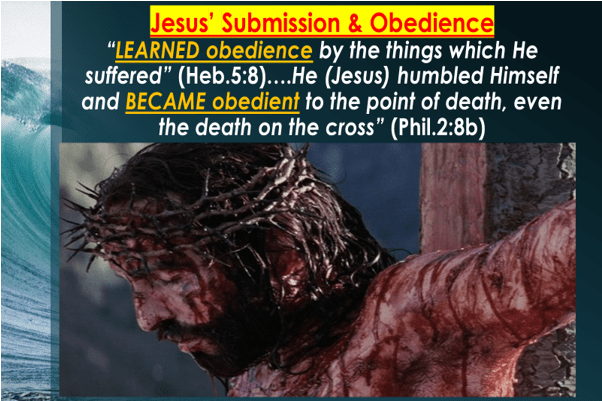
The Reverential Fear of the LORD (God), is always associated with the spirit of humility, resulting in riches, honour, and life – Proverbs 22:4 “By humility and the fear of the LORD are riches, and honour, and life.” And also, the Individual Believer’s expectation would be fulfilled – Proverbs 23:18b “And thine expectation shall not be cut off.” Jesus’ submission & obedience, is God’s Assurance to us.
Summary
We should remember God’s Seven-fold Promises ({1} God’s Wisdom; {2} God’s Cleanses; {3} God’s Guidance & Prosperity; {4} Long Life; {5} God’s Confidence; {6} Life & Satisfaction; {7} Futured Secured) are the result of the Reverential Fear of the LORD (God). The Reverential Fear of the LORD (God) should be taught, and should be the essential Character of the Church of Jesus Christ:
Teaches – The Reverential Fear of the LORD (God) can be taught – Psalm 34:11 “Come….I will teach you the fear of the LORD.” The Leaders of the Church need to study and explain both the concept and the application of the Reverential Fear of the LORD (God) to their people (Psalm 78:1-7). The Principles in Psalm 78:1-7 applies to the home, the Church, and is Intergenerational.
Warns – The Individual Believer or the Church who refuses the Reverential Fear of the LORD (God) will be at a disadvantage, as God’s warns: “I (God) also will laugh at your calamity; I will mock when your fear cometh; when your fear cometh as desolation, and your destruction cometh as a whirlwind; when distress and anguish cometh upon you. Then shall they call upon Me, but I will not answer; they shall seek Me early, but they shall not find Me; for that they hated knowledge and did not choose the fear of the LORD; they would none of My counsel; they despised all My reproof. Therefore, shall they eat of the fruit of their own way, and be filled with their own devices. For the turning away of the simple shall slay them. But whoso hearkened unto Me shall dwell safely and shall be quiet from fear of evil.” (Proverbs 1:26-33, KJV)
We, the End-Times-Generation is living in “the Perilous Times” (2Timothy 3:1), characterised by People who are: “Lovers of Themselves; Lovers of Money; and Lovers of Pleasure” (2Timothy 3:2, 4), with little respect for Authority (“Disobedient to Parents, unthankful and unholy” – 2Timothy 3:2b), and with no reverential Fear of the LORD (God).
God’s Word teaches that we are to: “Obey those who rule over us, and be submissive, for they (Leaders) watch out for our souls, as those who must give account (to God). Let them (the Leaders) do so with joy and not with grief, for that would be unprofitable to us” (Hebrews 13:17).
It is important to teach the Members of the Church and our Children to honour and be submissive to Authority (Home, Office, State {Country}, Church, etc); in so doing, we create an environment that our Children learned to have Reverential Fear of the LORD (God), for their benefits:
Job 28:28b “Behold, the Fear of the LORD, that is wisdom, and to depart from evil is understanding.”
Psalm 111:10 “The Fear of the LORD is the beginning of wisdom; a good understanding has all those who do His commandments. His praise endures forever.”
The Reverential Fear of the LORD (God) always begins with the Individual Believer respect for Authority (Home, Office, State {Country}, Church, etc). Thus, the Individual Believer respect for Authority (Home, Office, State {Country}, Church, etc) is never divorced from the Reverential Fear of the LORD (God).
The Success of the “Home, Office, State {Country}, Church, etc” is closely associated with the teaching of our Children on the respect of Authority and the Reverential Fear of the LORD (God). No single aspect of the Christian walk carries with it greater of God’s Promise of blessings than the Individual Believer who walks in Reverential Fear of the LORD (God):
Job 28:28b “Behold, the Fear of the LORD, that is Wisdom, and to depart from evil is understanding.”
Psalm 111:10 “The Fear of the LORD is the beginning of Wisdom; a good understanding has all those who do His commandments. His praise endures forever.”
1.1 Definition
The Reverential Fear of the LORD (God) is defined as: “An awesome reverence and respect towards God, knowing that God is Merciful, and Gracious, Long-suffering, and full of Compassion, abounding in Goodness and Truth.” (Exodus 33:19 & Exodus 34:6; etc).
1.2 Early Church
Reverential Fear of the LORD (God) was part of the Life of the Early Church – Acts 2:40-43 “And with many other words he (Peter) testified and exhorted them, saying, ‘Be saved from this preserve generation. Then those who gladly received his word were baptised; and that day about three thousand souls were added to them. And they continued steadfastly in the apostles’ doctrine (teaching) and fellowship, in the breaking of bread and in prayers. And fear came upon every soul, and many wonders and signs were done through the Apostles.’”
Acts 5:11 “So great fear came upon all the Church and upon all who heard these things.” God’s Judgement on Ananias and Sapphira caused the People to have a healthy Reverential Fear for God.
Acts 9:31“Then had the Churches rest throughout all Judea and Galilee and Samaria and were edified; and walking in the fear of the LORD, and in the comfort of the Holy Spirit, were multiplied.”
The Early Church has Five basic features: The Church was at Rest and the Church was edified and multiplied because the Early Church walked in the Reverential Fear of the LORD (God) and in the Comfort of God’s Spirit.George Barna Research Group released survey results, involving 12 largest Denominations in USA: Only 41% could be classified as “born-again.” Of all the adults surveyed, 41% believed that the Bible was completely accurate. Only 40% believed that Jesus Christ lived a sinless life, while incredibly, only 27% believed Satan was a real being. The survey indicates an alarming situation because these statistics were gathered among Professing Christians and not among the unchurched people. Thus, the End-Times-Generation is drifting from the Anchor of Biblical Truth and the Reverential Fear of the LORD (God).
1.3 Lawlessness
God’s Word warns that in the Last Day, “And because lawlessness will abound, the love (agape-love) of many will grow cold.” (Matthew 24:12). Lawlessness is found in Lucifer (later called: “Satan”) – Ezekiel 28:15, “You were perfect in your ways from the day you were created, till iniquity (lawlessness) was found in you…..You defiled your sanctuaries by the multitude of your iniquities (lawlessness), by your iniquities (lawlessness) of your trading (rakil – tale-bearing);…..” Thus, the “Mystery of Lawlessness” has its origin in Lucifer (Satan); and would come to its full-manifestation in the Lawless One (Antichrist) – 2Thessalonians 2:7-9 “For the mystery of lawlessness is already at work;……And then the Lawless One will be revealed,……The coming of the Lawless One is according to the working of Satan, with all power, signs and lying wonders.” Where there is lawlessness there is no respect and submission to authority (in home, Church, and State, etc), and correspondingly no Reverential Fear of the LORD (God). This outworking of Satan is to ensnare and to destroy the Individual Believer and the Church. The Individual Believer or the Church who does not have Reverential Fear of the LORD (God), he (and the Church) would not be fruitful Christian
1.4 What is not Reverential Fear?
Reverential Fear of God, in the mind of most people is wrongly concluded, for several reasons:
1.4.1 Natural Fear
We always associate natural fear with Reverential Fear of the LORD (God), which is not correct; even though natural fear is good as it keeps us from doing foolish things. Natural fear, in dangerous situation, is designed for our preservation. There are various types of natural fear, for example:
Claustrophobia fear of heights.
Fear of darkness.
Fear of crowds. Etc.
1.4.2 Demonic Fear
Demonic fear is not Reverential Fear of the LORD (God), because “God has not given us the spirit of fear” (2Timothy 1:7); demonic fear “has torment” (1John 4:18).
1.4.3 Religious Fear
Religious fear is not Reverential Fear of the LORD (God) – because “We have not received the spirit of bondage again to fear.” (Romans 8:15). Religious fear is defined in Isaiah 29:13 “Forasmuch as this people draw near Me with their mouth, and with their lips do honour Me, but have removed their heart far from Me, and their fear toward Me is taught by the precept of men.” The Individual Believer with religious fear is shown in 2Timothy 3:5a “Having a form of godliness but denying its power.” Legalism underpinned religious fear.
1.4.4 Fear of Man
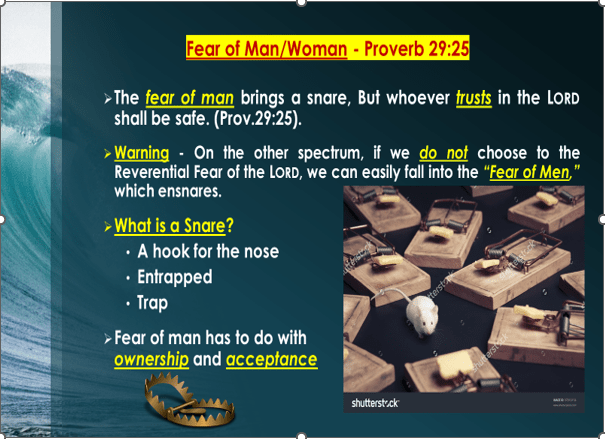
Fear of man is not Reverential Fear of the LORD (God), because “the fear of man brings a snare” (Proverbs 29:25). Many people fear men more than the Reverential Fear the LORD (God) – they allowed the faces of men to cause them to be withdrawn and thus, causing them to lose their confidence in God.
1.4.5 Not to Fear other gods
Although God’s Word teaches that we should not fear idols or other gods, nevertheless, we should not be disrespectful of others’ religions – 2Kings 17:38 “And the Covenant that I have made with you shall not forget; neither shall you fear other gods.”
1.4.6 Not to Fear Calamities
We are not to fear earthly calamities for they signify the near Return of Jesus – Luke 21:25-28 “….men’s hearts failing them for fear….then look up…..”
1.4.7 Not to Fear “Fear”
We are not to fear “Fear,” – Job 15:24 “Trouble and anguish shall make him (the unsaved) afraid,” but the Believer casts all his earthly fears on the Lord Jesus Christ (1Peter 5:7).
The Basic Principle – Whatever an Individual fear the most, he will worship. And if he fears nothing, the tendency is that it would end up in self-worship, because of pride – Pride focuses on self and is a form of “self-worship”Colossians 2:23b (NIV) “Self-imposed worship with false humility.” Thus, David Prayed: “Unite my heart to fear Your Name” (Psalm 86:11).
1.5 Commanded
The Fear of the LORD is commanded – Deuteronomy 13:4 “You shall walk after the LORD your God, and Fear Him, and Keep His Commandments, and Obey His Voice, and you shall Serve Him, and Cleave unto Him.”
1Peter 2:17 “Honour all men. Love the brotherhood. Fear God. Honour King.”
Psalm 22:23 “You that Fear the LORD, praise Him….Glorify Him; and Fear Him.”
Christ’s early Disciples set up a noble example in this matter – Acts 9:31”….and walking in the Fear of the LORD….were multiplied.” Cornelius was the man who Feared God (Acts 10:2). The Fear of the LORD teaches us to live circumspect lives, “Let us cleanse ourselves from all filthiness of the flesh and spirit, perfecting holiness in the Fear of God.” This Godly Fear becomes a powerful motivating force in our lives.
1.6 Reverential Fear of God
Scripture has significant passages on the Reverential Fear of the LORD (God) with His Promises (Job 28:28; Psalm 111:10; Psalm 19:9; Psalm 25:12-14; Proverbs 10:27; Psalm 34:11-15; Proverbs 19:23; Proverbs 22:4; Proverbs 23:17-18; etc). Reverential Fear of the LORD (God) is not religious, legalistic attitude towards God. Of the Sevenfold Nature of the Spirit of the LORD (Isaiah 11:1-3), that rested on Christ, the last aspect is “The Spirit of the Fear of the LORD,” is emphasized, twice, and is the chief characteristic of Christ – He (Christ) has Reverential Fear of God, His Father.
The Fear of the LORD (Isaiah 11:3a) – “The Spirit of the Fear of the LORD,” is, the deep tap-root of the Jesus’ Character: Fear (Reverence) of God, becoming humble and obedience unto death of the Cross – Philippians 2:6-8 (NIV) “Who (Jesus), being in very nature God, did not consider equality with God something to be grasped, but made Himself nothing, taking the very nature of a Servant, being made in human likeness. And being found in appearance as a man, He humbled Himself and became obedient to death – even death on a cross!” In fact, “the Spirit of the Fear of the LORD” is of such far-reaching importance that an explanatory clause is appended to indicate its fundamental importance, – “And His delight (“quick understanding”- KJV) shall be in the Fear of the LORD” (Isaiah 11:3a, NIV).
The term “delight” (NIV) carries the implication that “the Fear of the LORD” is fragrant to Jesus, that is, all of Jesus’ desires and actions are in total submission to the Father’s Will:
Hebrews 10:6-7b (KJV) “In burnt offerings and sacrifices for sin Thou hast had no pleasure…….Lo, I come (in the volume of the book it is written of Me) to do Thy will, O God.”
Hebrews 10:8b-9b (KJV) “Sacrifice, and offering and burnt offerings, and offering for sin Thou wouldest not, neither hadst pleasure in them, which are offered by the law,…….Lo, I come to do Thy will, O God.”
Such yielding of His (Jesus’) Own Will to the Father’s Will is not burdensome and unpleasant to Jesus, but rather a sheer “delight.” The verb used implies that this attribute constitutes the very purpose that Jesus came.
In studying the life of our Lord Jesus Christ, He consistently claimed that “The Son can do nothing of Himself, but what He seeth the Father does; for what things so ever he doeth these also doeth the Son likewise” (John 5:19, KJV). Jesus is totally submitted and dependent on His Father:
Luke 22:42 “Not My will, but Thine, be done.”
John 4:34 “My meat is to do the will of Him (Father) that sent Me, and to finish His work.”
Hebrews 10:6-7b (KJV) “In burnt offerings and sacrifices for sin Thou hast had no pleasure…….Lo, I come (in the volume of the book it is written of Me) to do Thy will, O God.”
Hebrews 10:8b-9b (KJV) “Sacrifice, and offering and burnt offerings, and offering for sin Thou wouldest not, neither hadst pleasure in them, which are offered by the law,…….Lo, I come to do Thy will, O God.”
Scripture warns us against man-pleasing – Proverbs 29:25 “The fear of man brings a snare but whoever trusts in the LORD shall be safe.” And yet the Scripture also teaches that we are to submit to human-authority as unto God Himself. Thus, understanding the two (warning & teaching) with proper balance between the two is importance:
1.1 No Fear of Man/Woman
Proverbs 29:25 “The fear of man brings a snare but whoever trusts in the LORD shall be safe.” There are many injunctions from God’s Word that advise and warn us against, the fear of man, in general (Proverbs 29:25):
Proverbs 29:25 “The fear of man brings a snare but whoever trusts in the LORD shall be safe.”
Isaiah 2:22 “Cease ye from man, whose breath is in his nostrils: for wherein is he to be accounted for?”
Jeremiah 17:5 “Cursed be the man (person) who trusts in man and makes flesh his arm.”
Psalm 118:6, 8, 9 “The LORD is on my side; I will not fear: what can man do unto me? It is better to trust in the LORD than to put confidence in man. It is better to trust the LORD than to put confidence in Princes.”
Job 32:21-22 “Let me not, I pray you, accept any man’s person, neither let me give flattering titles unto man. For I know not to give flattering titles; in so doing my Maker would soon take me away.”
Job 21:4 “As for me, in my complaint to man?”
Galatians 1:10 “Do I seek to please men? For if I yet pleased men, I should not be the Servant of Christ.”
1Corinthians 4:3 “But with me it is a very small thing that I should be judged of you, or of man’s judgement.”
Ephesians 6:6 “Not with eye-service, as men pleasers.”
1Thessalonians 2:4 “So we speak; not as pleasing men, but God, which tries our hearts.”
Although we should show due respect/honour man/woman in authority, the above Scriptures express explicitly that we should not indulge in inordinate desire to please, exalting the Individual more than he/she deserves
1.2 Honour Man/Woman in Authority
God’s Word teaches how we may/must please Persons with authority as unto God Himself. We must honour, obey, and please our Parents, Rulers, and Superiors in all things {except when it comes into conflict with God’s Word – Acts 4:18-20), that the Persons required us to do, in the Lord Jesus:
Exodus 20:12 “Honour thy father and mother.”
Colossians 3:20 “Children, obey your Parents in the Lord: for this is right.”
Ephesians 6:1 “Children obey your Parents in the Lord: for this is right.”
Romans 13:1-2 “Let every soul be subject unto the higher powers…..Whoever therefore resists the power, resisted the ordinance of God.”
Matthew 22:21 “Render therefore unto Caesar the things which are Caesar’s; and unto God the things that are God’s.”
Titus 3:1 “Put them in mind to be subject to Principalities and Powers, to obey Magistrates.”
1Peter 2:13 “Submit yourselves to every ordinance of man for the Lord’s sake: whether it be to the King, as Supreme.”
Colossians 3:22 “Servants, obey in all things your Masters according to the flesh.”
Hebrews 13:7 “Remember those who rule over you, who have spoken the Word of God to you, whose faith follow, considering the outcome of their conduct.”
Hebrews 13:17 “Obey those who rule over you, and be submissive, for they watch out for your souls, as those who must give account. Let them do so with joy and not with grief, for that would be unprofitable for you.”
Hebrews 13:24 “Greet all those who rule over you,…..”
God has given certain men/women authority over us, and we are obligated to render the respect due to them. We must understand that these men/women whom God Almighty has placed in the several Places of Authority. The Power/Authority given to them over us are from God, and not against God. They are to be honoured, obeyed, and pleased not in opposition to the Higher Authority of God, but as unto God Himself. There are therefore limits/ways as to how far we are to give our due respect to men/women in authority.
However, if we obey men/women more than God, and in doing so, we go against God; if we value the favour and approval of men/women in authority more than God’s or go against God’s approval in order to gain men/women in authority, favour; and if we fear men/women in authority, censure/displeasure more than God’s, we are putting men/women in authority up on a higher pedestal, in the place of God, idolising them, then, we need to reevaluate (Acts 4:18-20).
As this is a violation against God’s Commandment to worship Him {God} and Him {God} only – Exodus 34:14 “Thou shalt worship no other god: for the LORD, whose Name is Jealous is a Jealous God.” As the Scripture forbids that man be thought above that which is written – 1Corinthians 4:6 “Now these things, brethren, I have figuratively transferred to myself and Apollos for your sakes, that you may learn in us not to think beyond what is written, that none of you may be puffed up on behalf of one against the other.”
2.0 Balance
Thus, there is a need for balance between submission to man/woman under God’s ordained authority; against the general submission to man/woman out of inordinate fear of man/woman which could be a snare – Proverbs 29:25 “The fear of man brings a snare but whoever trusts in the LORD shall be safe.” Let us be ever watchful that we do not fall into the snare of pleasing man/woman, not taking God into account and therefore makes it our business to satisfy man/woman, out of fear; our fear should be the Reverential Fear of God. – Ecclesiastes 12:13 “Fear God and keep His Commandments: for this is the whole duty of man.”
Apostle Peter was given the “Keys of the Kingdom of Heavens” by the Lord Jesus Christ, when he (Peter) acknowledged that Jesus is the Christ, the Son of God, through the Revelation given to him (Peter) by God the Father (Matthew 16:15-19). Peter, with the “Key” opened the Gospel of the Kingdom of Heaven to the Jews in Jerusalem (Acts 2); then in God’s time, Peter was used by God to “open” the Gospel of the Kingdom of God to the Gentiles (Acts 10).
The “Opening” of the Kingdom of Heaven to the Gentile, involves the Supernatural Vision (Acts 10), – involving Peter, the Jew with Cornelius, the Gentile, the Roman Centurion, a devout man and one who feared (Reverence) God, who has a visitation from God. Cornelius was asked to seek out Peter, who was residing in Joppa (Acts 10:1-8).
How can God bring them together, when they were separated by such a religious, national, and cultural divide – especially, Peter, the Jew, ministering to Cornelius who is not only a Gentile but also a Centurion of the Roman; the Roman was hated by the Jews, in the time of Christ. God chose to minister the supernatural vision to Peter, the Jew, to unlock the national prejudice of the Jews against the Gentile, let alone, the Roman Centurion.
Peter was given a vision of a sheet lowered from Heaven, holding a variety full of edible animals, birds, and creeping things of which the Jew considered, unclean; he (Peter) was asked to kill and eat (Acts 10:9-13). Peter, first reaction, as a Jew, was his refusal, due to his (Peter’s) Jewish dietary laws (Acts 10:14). God spoke to Peter the second time, rebuking him (Peter) that what God has cleansed, must not be considered as common and unclean (Acts 10:15). It happened three times, and then, the objects were taken up into Heaven (Acts 10:16), leaving Peter totally bewildered about the Vision (Acts 10:17a).
What did the Vision mean? Peter has no interpretation for the Vision, but while he (Peter) was thinking about the Vision, God’s Spirit revealed the Purpose of the Prophetic Vision – Acts 10:19-20 “While Peter thought about the Vision, the Spirit said to him (Peter), ‘Behold, three men are seeking you. Arise therefore, go down and go with them, doubting nothing for I have sent them.” Peter went with the men to Cornelius’ house, preached the Gospel, and watched as the Holy Spirit fell on those people in Cornelius’ house, and he (Peter) saw the Gentiles added to the Church of Jesus Christ (Acts 10:21-48) – of Jews (Acts 2) and Gentiles (Acts 10). From this episode, Nine General Principles could be learned:
1. Change
Change is unpleasant but necessary because change is part of God’s Plan for the Individual, and the Church. The role of the Church Leader is to be an Agent of change and to manage it. Change is inherent in the Leadership of the Church. God modelled some Powerful Principles when he gave the “Keys of the Kingdom” (Matthew 16:19a) to Peter for the inclusion of Gentiles in His (God’s) Church (Acts 1:8), as recorded in Acts chapter 10. God led Peter from being an Opponent of Change, because to his Jewish heritage, to be a Champion of Change.
2. Value and Conviction
God addressed Peter’s Values and Convictions, as Peter was a Jew – Acts 10:9-16 (NIV) “About noon the following day as they were on their journey and approaching the city. Peter went up on the roof to pray. He became hungry and wanted something to eat, and while the meal was being prepared, he fell into a trance. He saw heaven opened and something like a large sheet being let down to earth by its four corners. It contained all kinds of four-footed animals, as well as reptiles of the earth and birds of the air. Then a voice told him, get up, Peter kills and eat. Surely not, Lord, Peter replied. I have never eaten anything impure or unclean. The voice spoke to him a second time. Do not call anything impure that God has made clean. This happened three times, and immediately the sheet was taken back to heaven.” A Wise Church Leader takes time to understand his People who must adapt to the Change. The Church Leader demonstrates that he is not out to violate their Values and Convictions, but rather to Convince and Convict his People that Change is necessary.
3. Plan Challenged
God allowed Peter to challenge His Plan – Acts 10:14-15 (NIV) “Surely not, Lord, Peter replied. I have never eaten anything impure or unclean. The voice spoke to him a second time. Do not call anything impure that God has made clean.” If People’s Objections are not addressed in a forthright and honest manner, the People will not “buy-in.” The Church Leader may wrongly perceive the People’s concerns as antagonism.
4. Worked Through Resistance
God allowed Peter to work through his (Peter’s) resistance – Acts 16-17 (NIV) “This happened three times, and immediately the sheet was taken back to heaven. While Peter was wondering about the meaning of the vision, the men sent by Cornelius found out where Simon’s house was and stopped at the gate.” Adaption to change takes time. The Wise Church Leader allows the People the time needed to work through their Reservations.
5. Controlled Situation
God allowed Peter to manage change in a controlled situation before thrusting him into major change. He allowed Peter to “try on” the change under controlled circumstances – Acts 10:18-23 (NIV) “They called out, asking if Simon who was known as Peter was staying there. While Peter was still thinking about the vision, the Spirit said to him, Simon, three men are looking for you. So get up and go downstairs. Do not hesitate to go with them, for I have sent them. Peter went down and said to the men, I am the one you are looking for. Why have you come? The men replied, we have come from Cornelius the centurion. He is a righteous and God-fearing man, who is respected by all the Jewish people. A holy angel told him to have you come to his house so that he could hear what you have to say. Then Peter invited the men into the house to be his guests.” A Wise Church Leader allows his People to experience the process of change in order that the People may begin to experience progressively the change’s effect.
6. Preparation
God prepares the People who are involved in change: (1) Cornelius, a Gentile and a Roman Centurion (Acts 10:1-8); (2) Peter, a Jew (Acts 10:19-23, 30-33): Cornelius – God Commended Cornelius’ Attitudes and Actions by the Angelic Visitation. Cornelius was commanded to look for Simon Peter and to bring him to his house (Acts 10:1-8). Peter – God moved Peter’s heart through the Heavenly Vision (Acts 10:34) and the Visitation of Cornelius’ Servants. God anticipated Peter’s Jewish background and objections. God addressed Peter’s fear and concern. When introducing change, a Wise Church Leader must be prepared to address the concern of the People and the questions that might arise.
7. Invitation
God did not ask Peter to change. He invited Peter to participate and become Agent of change – Acts 34 (NIV) “Then Peter began to speak: I now realise how true it is that God does not show favouritism but accepts men from every nation who fear Him and do what is right.” God showed forth the undeniable proof by the out pouring of the Holy Spirit – Acts 10:44-46a (NIV) “While Peter was still speaking these words, the Holy Spirit came on all who heard the message. The circumcised believers (Jews) who had come with Peter were astonished that the gift of the Holy Spirit had been poured out even on the Gentiles. For they heard them speaking in tongues and praising God.” Abandoning the comfort of the status quo (Peter, a Jew) can feel the threat. A Wise Church Leader helps his People to assimilate and adjust to the change.
8. Key Leader
God usually convicts the Key Leader (in this instant, Peter) and allowed that Leader himself to champion the change. The Key Leader needs to explain the Vision and Strategies (or Actions) – Acts 11:1-18 (NIV) “The apostles and the brothers throughout Judea heard that the Gentiles also had received the word of God. So when Peter went up to Jerusalem, the circumcised Believers (Jews) criticised him and said, you went into the house of uncircumcised men and ate with them. Peter began and explained everything to them precisely as it had happened……..When they heard this, they had no further objections and praised God, saying, so then, God has granted even the Gentiles repentance unto life.” Individuals are easier to work with than a Group. Change needs the support of other Leaders for it to be wide-spread and successful. Peter had the Apostles and brothers in Jerusalem for his support (Acts 11:18). These Leaders will then help to galvanise (“fire up”) Others to reconcile themselves to the New Change. Peter was given the “Keys of the Kingdom of Heaven” (Matthew 16:19) – Peter was the Key Leader in the Opening up of the Gospel to the Jews in Jerusalem, on the Day of Pentecost (Acts 2:14-41) and the Gospel to the Gentiles (Acts 10:1-48).
9. Core Values
Change is important, but it must not undermine the core values of the Church. Peter experienced that tension, and God helped him facilitate change while not abandoning his Jewish Core Values. Core Values should form as the Rock-Solid Foundation, while Practices and Procedure can be changed to enable the Church to face the future. Peter’s Core Values are: Peter was an Apostle (Matthew 10:1-2a) with the “Keys of the Kingdom of Heaven” (Matthew 16:19) – Matthew 10:1-2a, Matthew 16:19 (NIV) “He (Jesus) called His twelve disciples to Him…….These are the names of the twelve apostles……I will give you the keys of the kingdom of heaven.” And his (Peter’s) Jewish Heritage (Acts 10:9-17).
The three Divine requirements of human relationship is shown in Micah 6:8 “What doth the LORD requires of thee, but to do justly, and to love mercy, and to walk humbly with thy God.” In the 8th Century, before Christ, in the heart of idolatry in Israel, Prophet Micah, under the inspiration of God’s Spirit put forth a conception of threefold Divine requirements in human-relationship. Prophet Micah is conspicuous as the Prophet of Mercy. The strong rebuke at the beginning of his (Micah’s) Prophetic Book, of God’s judgement against sin, ends with depth of Mercy at the end of his Prophetic Book. This trinity of truth (“Do Justly,…..Love Mercy,…..Walk Humbly with our God”) sums up the requirements of God in our human-relationship; feeling God’s heart-beat for His people. What God has commanded us in Micah 6:8, He will enable us to do: “Faithful is He who calleth you, who also will enable us to do.” (1Thessalonians 5:24). God requires us to: “Do Justly,” and to “Love Mercy,” “Walk Humbly” before our God (Micah 6:8); these three things God asks us to do, in human relationship; He empowers us to be able to do them, involving:
Outer Profession (“Do Justly”).
Inner Disposition (“Love-Mercy”).
Upper Communion (“Walk humbly with our God”).
Point 1 – Do Justly
Micah 6:8 “What doth the LORD requires of thee, but to do justly, and to love mercy, and to walk humbly with thy God.” Prophet Amos, whose Disciple is Micah, sternly declared that religion can never be substituted for: “Justice, Mercy and Humility” (Micah 6:8); no matter what areas of influence we may have; God demands of us, first of all, an integrity of heart in our relationship with Others:
Action – that is, we are to “do justly.”
Attitude – In our thoughts, feelings, and actions, as Christians we must be fair and just in our relationship/dealing with people., as the Foundation of God’s Throne is Justice, and God is Just in all His dealings; and God expects us, His children to reflect His Character (Micah 6:8).
We look for others to be honourable, fair, and just as they relate to us, and we must be prepared to treat them according to the same standard, this is God’s requirement (Micah 6:8). Because we are Divinely Justified, we have Peace with God (Romans 5:1); we must exercise justice; that we carry God’s Presence in our actions, thus, impacting the people around us.
Point 2 – Love Mercy
Micah 6:8 “What doth the LORD requires of thee, but to do justly, and to love mercy, and to walk humbly with thy God.” Justice applied without Mercy could be correct, but cold. God does not want us to be merely Just, but He wants us to show Mercy and Tenderness in our dealings with others, without compulsion, but from generosity of heart. We are to “Love-Mercy.” In God’s Sight (Micah 6:8), Justice cannot be divorced from Mercy – “Doing Justice and Loving Mercy.” If Justice says, “Pay that thou owest,” Mercy listens to the Suppliant’s cry, “Have patience with me,” and forgives him “all that debt.” God delights in Mercy (Micah 6:8), we, His children must reflect His Character. So, although Justice is mentioned first, in Micah 6:8, God’s Word exhorts us to be Merciful in heart and action.
A mere show of Mercy is hypocrisy; if such a virtue is to be effective, it must be governed by God’s Love – “Love (agape) Mercy” (Micah 6:8). Tenderness is an inward disposition which makes possible Mercy in action. Justice without Mercy would crush the person we deal with and also hardened our character. In God, both Justice and Mercy act in unison, and He requires us to preserve the same harmony between them. We must not be hard, harsh, unfeeling, and unbending as we strive “to Do Justly.” Tender Mercy must be combined with integrity – Proverbs 11:17 “The merciful man does good for his own soul, but he who is cruel troubles his own flesh.” God is Just and Justifier of all who believe, but at the same time, He is “very pitiful and full of tender Mercy.” We, totally dependent upon God’s Mercy, we, in turn, are to show-forth Mercy and Grace – “Be ye therefore merciful as your Father also is Merciful” (Luke 6:36) was the exhortation of our God through whose Mercy we are saved.
Point 3 – Walk Humbly with Our God
Micah 6:8 “What doth the LORD requires of thee, but to do justly, and to love mercy, and to walk humbly with thy God.” Walking Humbly with our God is a true sign of God’s Servanthood in our life. “To Do Justly….to Love Mercy…..to Walk Humbly with our God” (Micah 6:8) could only be possible if we walk in deep fellowship and submission to the Lordship of God’s Spirit – “Can two walk together except they be agreed?” (Amos 3:3). Walking Humbly with our God leads to the transformation of our attitude and character (2Corinthians 5:18). The secret of “Doing Justly” and “Loving-Mercy,” is our Humble walk with our God, which always results in our walking as He walks. Enoch and Noah walked with God (Genesis 5:24; Genesis 6:8). Humility before God is called: “the Crown of all Virtues” (Saint Augustine); Pride is one of the deadliest of Sins. “Pride always goes before a Fall” (Proverbs 16:18). Pride brought about the Fall of Lucifer (Satan – Isaiah 14:12-15; Ezekiel 28:12-19). Pride is at the root of every Sin. Christ, our Lord, is associated with Humility and Obedient (Philippians 2:5-8; Hebrews 5:8). The Sevenfold Benefits of walking humbly with our God:
God’s Grace – 1Peter 5:5b “Be clothed with humility, for ‘God resists the Proud, but gives grace to the Humble.’” James 4:6 “But He {God} gives more grace. Therefore, He says: ‘God resists the Proud but gives grace to the Humble.” Proverbs 3:34 “Surely He {God} scorns the scornful but gives grace to the Humble.”
God’s Exaltation – 1Peter 5:6 “Therefore, humble yourselves under the mighty hand of God, that He may exalt you in due time.” And Psalm 75:6-7 “For exaltation comes neither from the east nor from the west nor from the south. But God is the Judge: He puts down one and exalts another.”
God’s Attention – Isaiah 66:2b “But on this man will I {God} look: on him who is poor (humble) and of a contrite (broken) spirit, and who tremble at My Word.”
God’s Presence – Isaiah 57:15 “For thus says the High and Lofty One Who inhabits eternity, whose name is Holy: ‘I dwell in the high and holy place, with him who has a contrite (broken) and humble spirit, to revive the spirit of the humble, and to revive the heart of the contrite ones.’”
God’s Nearness – Psalm 34:18 “The LORD is near those who have a broken (contrite) heart and saves such as have a contrite spirit.”
God’s Acceptance – Psalm 51:17 “The sacrifices of God are a broken (contrite) spirit, a broken and contrite heart – these, O God, You will not despise.’”
The Key of “Doing Justly” and “Loving-Mercy,” is our humble walk with our God (Micah 6:8). – Humility before God is called: “the Crown of all Virtues” (Saint Augustine).
Summary
Micah 6:8 “What doth the LORD requires of thee, but to do justly, and to love mercy, and to walk humbly with thy God.” The threefold Divine Requirements of: “Do Justly,….Love Mercy,…..and Walk Humbly with our God” (Micah 6:8) is not beyond us – and not too idealistic – because we have the Indwelling Holy Spirit, enables us with His Synergistic Works:
Philippians 2:12b-13 (NKJV) “Work out your own salvation with fear and trembling; for it is God who works in you both to will and to do for His good pleasure.”
Philippians 4:13 (NKJV) “I can do all things through Christ who strengthens me.”
Colossians 1:29 (NKJV) “To this end I also labour, striving according to His working which works in me mightily.”
Hebrews 13:21 “Make you complete in every good works to do His will, working in you what is well pleasing in His sight, through Jesus Christ,….”
Psalm 127:1“Unless the LORD builds the house, they labour in vain who build it; unless the LORD guards the city, the Watchman stays awake in vain.” God is involved in the building and watching; yet it is obvious the Psalmist envisions the Builders labouring to build God’s House and the Watchmen standing guard over the city. Both the Builders and the Watchmen carried out their responsibility in total dependence on God that is why the Psalmist speaks of God building and God watching.









 Morning Dew . Life