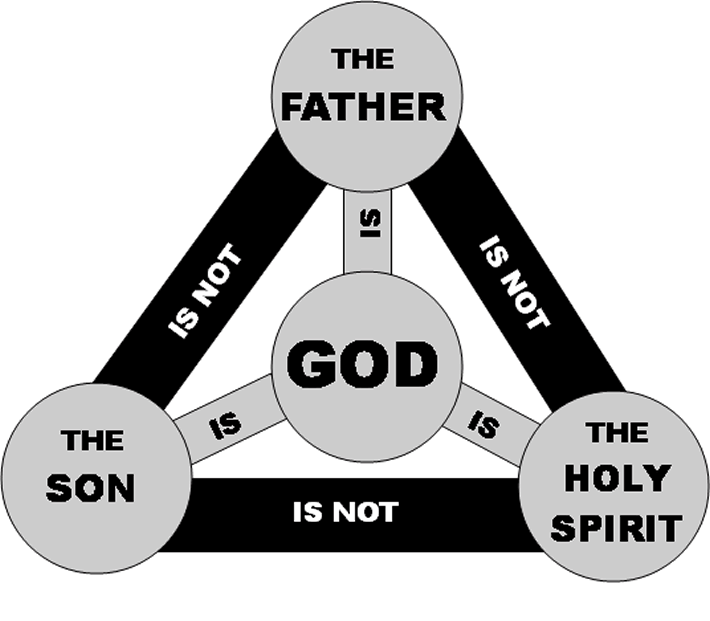
Matthew 28:19b “Baptizing them in the Name of the Father and of the Son and of the Holy Spirit.” Our God, the Three in One, with the term Trinity – while the term “Trinity,” as related to the three Persons (Father, Son & Holy Spirit – Matthew 28:19b) forming the Godhead – Romans 1:20b “Even His Eternal Power and Godhead,…..” is not found in the Scripture, yet the fact of it is clearly evident from the beginning (Book of Genesis) to the end (Book of Revelation). The number “three” has always been associated with the Godhead and Perfect Witness:
Matthew 28:19b “Baptizing them in the Name of the Father and of the Son and of the Holy Spirit.”
2Corinthians 13:1b “By the mouth of two or three witnesses every word shall be established.”
Three times the Seraphim cried: “Holy, Holy, Holy” (Revelation 4:8; Isaiah 6:3) – Holy to God the Father, Holy to God the Son (Christ), Holy to God the Holy Spirit. To the “World,” the concept of the “Three-in-One” cannot be comprehended by natural reasoning, nevertheless, to the born-again Believer, accepts by faith and revelation.
Point 1: Divine Benediction
Also, three times the Divine Benediction is given by Moses in Numbers 6:24-27: “The LORD (the Father) bless you and keep you; The LORD (the Son) make His face shine upon you, and be gracious to you; The LORD (the Holy Spirit) lift up His countenance upon you, and give you peace. So, they shall put My Name on the children of Israel, and I will bless them.” This Divine Benediction is affirmed in the N.T – 2Corinthians 13:14 “The grace of the Lord Jesus Christ, and the love of God (the Father), and the communion of the Holy Spirit be with you all. Amen.”
Each of the Divine Benediction in the O.T (Numbers 6:24-26) is twofold: (1) God the Father “bless and keep us;” (2) God the Son “makes His face shine upon us, and be gracious to us;” and God the Holy Spirit “lifts up His countenance upon us, and give us peace;” so that there are two Members of the Godhead in each, while the Name Jehovah (The LORD) is mentioned three times. This marks the “blessing” as being Divine in its Source. No human merit draws forth the Divine Benediction; God’s Grace was the Divine Benediction’s Origin, and God’s Peace was the Divine Benediction’s Result.
Point 2: Epistle of the Ephesians
A unique feature of the Epistle to the Ephesians is the way in which each chapter emphasises the Truth of the Trinity – the Three Persons of the Godhead are wrapped together in the verse:
Ephesians 1:17 “God….the Father of Glory……our Lord Jesus Christ, the Spirit of Wisdom and Revelation (imparted by God’s Spirit).”
Ephesians 2:19-22 “God (the Father),…..Jesus Christ……of God in the Spirit.”
Ephesians 3:14, 16 “…The Father…..Lord Jesus Christ,……His Spirit….”
Ephesians 4:30, 32 “…Holy Spirit of God…….God (the Father) in Christ…..”
Ephesians 5:18, 20”…..the Spirit…..God the Father…..Lord Jesus Christ.”
Ephesians 6:6, 17 “….Christ,……God (the Father)……the Spirit….”
Point 3 – Book of Revelation
The Three-in-One Mystery of the Godhead united in the Glorious Work of Redemption – God the Father “Warning” (Revelation 22:18-19); God the Son “Witnessing” (Revelation 22:16); God the Holy Spirit “Wooing” (Revelation 22:17).
Point 4 – Israel’s Flag
The Official Emblem of Israel’s flag is a “Six-Pointed-Star” known as “the Star of David,” or more correctly “the Shield of David.” The Emblem consists of two Triangles, one pointing upwards and the other Triangle pointing downwards. Many Hebrew Christians interpret this Emblem to Represent the Holy Trinity of the Father, Son and Holy Spirit (Matthew 28:19b), and the Human Trinity of man’s spirit, soul and body (1Thessalonians 5:23). In God’s Sight, “three” is the Perfect Number, expressive of Beginning, Middle and End, and therefore a symbol of Deity.
Point 5 – Operation of the Godhead
The Ministry of the Godhead Operates in three Beneficial Ways:
God the Father in the Past Eternity Conceived the Plan of Salvation for the World of Sinners, lost and ruined by Adam’s Fall (Genesis 2:17; Genesis 3:6; Romans 5:12; 1Corinthians 15:22a), yet the Fallen Humanity is loved by Him (the Father – John 3:16).
God the Son at Calvary Executed God the Father’s Divine Plan, and by doing so Manifested or Expressed that Love of God the Father’s Heart (1John 4:8 – “God is Love”).
God the Holy Spirit, sent by God the Father and God the Son, Reveals the Sacrificial Love of the Father and the Son to the hearts of men (1Corinthians 2:10-12), and He (Spirit) Operates the Divine Plan of Redemption in the lives of those who Repented of their sins and Received Jesus Christ as Lord and Saviour.
How comforting to know that we are loved by the Three Persons (Father, Son & Holy Spirit) of the Godhead, and we are received as God’s children with Inheritance! (Romans 8:14-17).
To study the Doctrines (Teaching) of the Bible, we ought to begin with God, as we are constantly challenged by Atheists, Sceptics, to prove that there is God; as it is difficult for natural man to believe in God, whom he cannot see, touch or feel – 1Corinthians 2:14 “But the natural man does not receive the things of the Spirit of God, for they are foolishness to him; nor can he know them, because they are spiritually discerned.”
1- God Declaration
God does not prove His Existence; but He declared His Existence – Genesis 1:1 “In the beginning God created the Heavens and the Earth.” Also, the Writers of the Bible do not attempt to prove this fact. The Bible states that it is the Fool who denies God’s Existence – Psalm 14:1 “The Fool has said in his heart, there is no God.” Any Person, with intelligence would acknowledge the evident fact of the Living God, in Creation, and in the Conscience in every Person.
2 – Proof from Scripture
The evidence is shown in the Beauty and Glory of Heaven – Psalm 19:1 “The Heavens declare the Glory of God, and the firmament shows His handy work.” Furthermore, Romans 1:20 goes further and reveals that Creation even teaches about the Eternal Power of the Godhead: “For the invisible things of Him from the Creation of the World are clearly seen, being understood by the things that are made, even His Eternal Power and Godhead; so that they are without excuse.”
3 – Proof from Conscience
Every Person on the face of the earth is born with a conscience:
Romans 2:15 “Which shows the work of the Law written in their hearts, their conscience also bearing witness, and their thoughts the mean while accusing or else excusing one another.”
Acts 17:23 “For as I passed by, and beheld your devotions, I found an altar with this inscription, ‘To the Unknown God.’”
4 – An Atherist’s Outlook
However, some, not all, Atheists claimed that their conscience does not tell them about God; it is doubtful, that there is a genuine Atheist, as every Individual has a conscience; but the Atheist chooses to deny Him (God). The honest Individual still finds that the inner still small voice says that God Exists and is Alive, today.
An Individual denies God’s Existence not because he cannot find Him {God} but because he is afraid to face the responsibility of being accountable to Him (God). Atheism is one of the tools to put that Individual “to spiritual sleep,” without accepting and receiving God’s Provision of Salvation through the Lord Jesus Christ. Thus, an Atheist may have this concept that because there is no God, he is not responsible to anyone, and he can live/die as he pleases.
5 – Cosmological Proof
The Heavenly Bodies (Sun, Moon, Stars, Planets, etc) must be created by Someone, for these Heavenly Bodies (Sun, Moon, Stars, Planets, etc) cannot just exist, by themselves:
Psalm 19:1 “The Heavens declare the Glory of God, and the firmament shows His handy work.”
Romans 1:20“For the invisible things of Him from the Creation of the World are clearly seen, being understood by the things that are made, even His Eternal Power and Godhead; so that they are without excuse.”
6 – Teleological Proof
The presentation from Design, provides proof of the Creator; for example, a Watch, could not exist but it has a Designer. It was planned for a specific purpose – to tell time. An examination of the world and the things in the world, large or small, shows that each is designed by an intelligent Person for a specific purpose in life. The colours of the bird and means of defence of the animals are not accident; they are the result of the Plan of God the Creator.
7 – Anthropological Proof
Every Individual has an intellectual and moral nature showing forth that God, the Creator cannot be an inanimate force but the Living, Intelligent Being:
Genesis 1:26 “Let us make man in our Image, after our Likeness.”
Genesis 1:27, God created man in the Image and Likeness of God, that is, patterned after Him.
Psalm 94:9 “He that planted the ear, shall He not hear? He that formed the eye, shall He not see?” God has given to every Individual ear, eyes, knowledge, intelligence, and will, and power, for these are the things that He {God} possesses.”
8 – Life Proof
Life comes from life and the original life must have come from the God that possesses Eternal Life, that is, life that existed before physical life was created. Where do our lives come from? It can only be found in God, who possesses Eternal Life – Psalm 36:9 “For with Thee is the Fountain (Source) of Life.” Jesus said in John 11:25, “I am….life,” also, in John 14:6, “I am ….life,” and in John 10:28, “And I give unto them Eternal Life.” All life proceeds from God. The theory of spontaneous generation has been proven false and completely unacceptable to authoritative Science. Life must have a beginning. The only logical answer is that beginning was with God.
9 – Congruity Proof
Atheism does not provide solution but creates multiples unsolved problems. The acceptance of the existence of God as Creator of the World and Man & Woman (Adam & Eve), as revealed in Scripture (Genesis chapters 1 & 2), affirmed Revelation, Knowledge and Science; and that He (God, the Father) has sent His Son, Jesus Christ, to lay down His (Christ’s) Life, as God’s Lamb (John 1:29, 36), in His Sacrificial Atoning Death, Burial and Resurrection (1Corinthians 15:1-4), for the Human Race. This irrefutable Doctrine (Teaching) enables the Christians to hold onto, even in the face of death.
1.1 Conclusion
Atheism, may lead to hopelessness and despair in the end; whereas, Faith in God and His (God’s) Existence (Genesis 1:1), leads the sincere Seeker into the path of fuller Revelation of God Himself and the Revelation of Jesus Christ’s Sacrificial-Atoning Death on the Cross (the Gospel – Matthew, Mark, Luke and John), His (Christ’s) Burial and Resurrection (1Corinthians 15:1-4), and the path to Eternal Life – Hebrews 11:6, “He that comes to God must believe that He is (exists).” Thus, let us come, as children, in simple faith, based on the Revelation of God, and the Sacrificial-Atoning Death of Jesus Christ on the Cross, His Burial and His Resurrection (1Corinthians 15:1-4); receiving Him (Jesus) as our Lord and Saviour, for the forgiveness of our sins and the Redemption with Eternal Life:
Ephesians 1:7 “In Him (Jesus) we have redemption through His Blood, the forgiveness of sins, according to the riches of His {God’s} Grace.”
Colossians 1:14 “In whom we have redemption through His {Jesus’} Blood, the forgiveness of sins.”
The Fear of The LORD has certain features and descriptive characteristics:
The Fear of the LORD is a hatred of evil – Proverbs 8:13 “The Fear of the LORD is to hate evil.”
The Fear of the LORD is Wisdom – Psalm 111:10 “The Fear of the LORD is the beginning of Wisdom.”
The Fear of the LORD is a Treasure – Proverbs 15:16 “Better is little with the Fear of the LORD than great treasure and trouble therewith.” – The Fear of the LORD is the Believer’s treasure. (Isaiah 33:6).
The Fear of the LORD is the Fountain of Life – Proverbs 14:27 “The Fear of the LORD is the Fountain of Life.”
The Fear of the LORD is Clean – Psalm 19:9 “The Fear of the LORD is clean.” It has the Sanctifying Power.
The Fear of the LORD endures forever – Psalm 19:9 “The Fear of the LORD is clean, enduring forever.”
The Fear of the LORD is Godly – Hebrews 12:28 “Let us have grace, whereby we may serve God acceptably with reverence and Godly Fear.” There is a difference between Reverence and Fear.
Motivation
What motives cause us to Fear the LORD, and walk in the Fear of the LORD:
God’s Holiness causes us to Fear Him – Revelation 15:4 “Who shall not Fear Thee, O Lord, and Glorify Your Name? for You are Holy.”
God’s Greatness causes us to Fear Him – Deuteronomy 10:12-17 “And now Israel, what does the Lord your God require of thee, but to Fear the LORD your God….”
God’s Goodness causes us to Fear Him – 1Samuel 12:24 “Only Fear the LORD and serve Him in truth with all your heart: for consider how great things He has done.”
God’s Forgiveness causes us to Fear Him – Psalm 130:4 “But there is forgiveness with Thee, that You may be Feared.” Praise the LORD for this, too.”
God’s Wondrous Works causes us to Fear Him – Joshua 4:23-24 “Joshua reviews these works.”
God’s Coming Judgement causes us to Fear Him – Revelation 14:7 “Saying with a loud voice, Fear God, and give Glory to Him; for the hour of His Judgement is come.”
Necessity
The Fear of the LORD is necessary for Growth and God’s Presence and Favour:
The Fear of the LORD is necessary for Worship – Psalm 5:7 “In Your Fear will I worship.” (Psalm 89:7).
The Fear of the LORD is necessary for Service – Psalm 2:11 “Serve the LORD with Fear and rejoice with trembling.”
The Fear of the LORD is necessary to keep us from Sin – Exodus 20:20 “Fear not: For God is come to prove you, and that His Fear may be before you face, that you sin not.”
The Fear of the LORD is necessary for Good Government – 2Samuel 23:3 “He that rules over men must be just, ruling in the Fear of God.” This is lacking in Governments today.
The Fear of the LORD is necessary for Administration of Justice – 2Chronicles 19:6-9 “And said to the Judges, ‘Take heed to what you are doing, for you do not judge for man but for the LORD, who is with you in the judgement.’ Now, therefore, let the Fear of the LORD be upon you; take care and do it, for there is no iniquity with the LORD our God, no partiality, nor taking of bribes. Moreover, in Jerusalem, for the judgement of the LORD and for controversies, Jehoshaphat appointed some of the Levites and Priests and some of the Chief fathers of Israel, when they returned to Jerusalem. And he commanded them, saying, ‘Thus you shall act in the Fear of the LORD, faithfully and with a loyal heart.”
The Fear of the LORD is necessary for the Perfecting of Holiness in our Christian lives – 2Corinthians 7:1 “Therefore, having these promises, beloved, let us cleanse ourselves from all filthiness of the flesh and spirit, perfecting holiness in the Fear of God.”
God’s Promises
The Fear of the LORD (God) comes with His Promises – no single aspect of the Christian life carries with it greater of God’s Promise of Blessings than to the Individual Believer and the Church who walks in the Fear of the LORD (God):
The Fear of the LORD brings Pleasure to the LORD – Psalm 147:11 “The LORD takes pleasure in them that Fear Him, in those that hope in His Mercy.”
The Fear of the LORD causes the LORD’S Pity to increase upon the child of God – Psalm 103:13 “Like as a father pities his children, so the LORD pities them that Fear Him.”
The Fear of the LORD brings acceptance with God – Acts 10:35 “But in every Nation he that Fears Him, and works righteousness, is accepted with Him.” Peter to Cornelius and friends.
The Fear of the LORD brings God’s Mercy – Psalm 103:17 “But the Mercy of the LORD is from everlasting to everlasting upon them that Fear Him.”
The Fear of the LORD brings blessings – Psalm 112:1 “Blessed is the man that Fears the LORD.”
The Fear of the LORD brings confidence – Proverbs 14:26 “By the Fear of the LORD is strong confidence.”
The Fear of the LORD brings separation from evil – Proverbs 16:6 “By the Fear of the LORD men depart from evil.” Today there is little Fear of the LORD and an abundance of evil. God’s Judgement on Ananias and Sapphira, resulted in great Fear of the LORD came among the people (Acts 5:1-11 {vs11}).
The Fear of the LORD brings Christian Fellowship – Malachi 3:16 “Then they that Feared the LORD speaks often one to another: and the LORD hearkened and heard it.”
The Fear of the LORD supersedes the Fear of man – Isaiah 8:12, 13 “…. Neither fear you their fear, nor be afraid. Sanctify the Lord of Hosts Himself; and let Him be your Fear.”
The Fear of the LORD brings Answer to Prayer – Psalm 145:19 “He will fulfil the desire of them that Fear Him: He also will hear their cry and will save them.”
The Fear of the LORD brings long life – Proverbs 10:27 “The Fear of the LORD prolongs days.”
Let us pray that God will teach us to Fear Him – Psalm 86:11 “Teach me Your way, O LORD; I will walk in Your truth: unite my heart to Fear Your Name.” (Proverbs 15:16; Proverbs 19:23).
The Reverential Fear of the LORD (God) comes with His Promises – no single aspect of the Christian life carries with it greater of God’s Promise of Blessings than to the Individual Believer and the Church who walks in the Reverential Fear of the LORD (God), will experience Sevenfold Blessings:
First, God’s Wisdom
There is a difference between Intellect (acquisition of Knowledge) and God’s Wisdom (Divine Insight & Application) – an Individual can be brainy but if he denies the Existence of God, he is a fool – Psalm 14:1 “The fool that said in his heart, there is no God.” God’s Wisdom comes to an Individual Believer or the Church, who has Reverential Fear of Him (God):
Job 28:28 “Behold, the fear of the LORD, that is wisdom.”
Psalm 111:10 “The fear of the LORD is the beginning of Wisdom: a good understanding has all they that do His Commandments.’
An Individual Believer or Church who walks in Reverential Fear of the LORD (God) is Wise because God directs his steps – Psalm 37:23 “the steps of a good man are ordered by the LORD, and He delights in his way.” It is difficult to be obedient to God’s Word, if the Individual Believer does not have the Reverential Fear of the LORD (God) – Hebrews 3:6 “Christ (is) as a Son over His own house; whose house are we, if we hold fast the confidence and the rejoicing of the hope firm unto the end.” – Hebrews 3:6 is God’s conditional Promise – its fulfilment is based on the Individual Believer’s respond – if the Individual Believer holds fast to God’s Word that comes to him, if he has ear to hear what God’s Spirit is saying to him, then God’s Promise will be fulfilled
Second, God’s Cleanses
Reverential Fear of the LORD (God) is like a disinfectant – Psalm 19:9 “The fear of the LORD is clean, enduring for ever:…..” – keeping the Individual Believer morally and spiritually clean; an Individual Believer who does not have Reverential Fear of the LORD (God) tends to become defiled more easily. The Reverential Fear of the LORD (God) does not only disinfect (clean); but it endures forever (Psalm 19:9b) – it keeps the Individual Believer not only from defilement but also keeps him from making stupid mistakes; that he tends to make, if he is not walking in the Reverential Fear of the LORD (God).
Third, God’s Guidance & Prosperity
The Individual Believer who walks in Reverential Fear of the LORD (God) will be guided by God and he will prosper in God – Psalm 25:12-14 “Who is the man that fears the LORD? Him shall He teaches in the way He chooses. He himself shall dwell in prosperity, and his Descendants shall inherit the earth. The secret of the LORD is with those who fear Him, and He will show them his Covenant.”
God Provides Guidance – “He teaches in the way He chooses.”
God Offers true Prosperity – “He (Individual) himself shall dwell in prosperity.” – The prosperity is more than financial but the total well-being.
God’s Provides for his Descendants – “His Descendants shall inherit the earth.”
God Reveals His Secret to him – “The Secret of the LORD is with him.” (Deuteronomy 29;29).
God Reveals His (God’s) Covenant to him – “He will show them His {God’s} Covenant.”
Our Lord Jesus assured the Individual Believer and the Church that “No one who has left home or brothers or sisters or mother or father or children or fields for Him and the Gospel will fail to receive a hundred times as much in this present age and in the age to come, eternal life” (Mark 10:29-30). But God’s Blessings are always in association with the Reverential Fear of the LORD (God); and not out of self-interest.
Fourth, Long Life
God’s Assurance that the Individual Believer who walks in the Reverential Fear of the LORD (God) will have long, satisfying, and fruitful life – Proverbs 10:27 “The fear of the LORD prolongs days; but the years of the Wicked will be shortened.” Rebellion with disobedience can shorten the Individual Believer’s life on the Earth – Proverbs 10:27b “But the years of theWwicked will be shortened.” Individual Believer who does not walk in the Reverential Fear of the LORD (God) tend to be careless in “Discerning the Lord’s Body” to his disadvantage – 1Corinthians 11:29-30 “For he who eats and drinks in an unworthy manner, eats and drinks judgement go himself, not discerning the Lord’s body. For this reason, many are weak and sick among you and many died prematurely.” Every time Believers gathered to partake of the Lord’s Table, it is vitally important that we truly Discern the Lord’s Body. But what does it mean to Discern the Lord’s Body? A study of the Corinthians Epistle reveals that there is a twofold aspect of the Lord’s Body, that is: (1) Christ’s Physical Body; (2) Christ’s Spiritual Body, the Church.
1. Discerning Christ’s Physical Body
When Jesus took bread and said to His Disciples, “Take, eat, this is My body broken for you……” (Matthew 26:26b):
Jesus is referring to His Physical Body that was to be crucified.
Christ in His Physical Body bore our sins – 1Peter 2:24a “Who Himself bore our sins in His own body on the tree (Cross)…….”
Christ, in His Physical Body bare our sicknesses, our diseases and death and it is by His strips we are healed (1Peter 2:24b; Isaiah 53:5).
In Discerning Christ’s Physical Body, we discern that Jesus took our sins, our sicknesses and our diseases and our spiritual death – there is forgiveness, healings, health and wholeness and life in the Body of Jesus, broken for us.
2.Discerning Christ’s Spiritual Body
The second aspect of Discerning Christ’s Body has to do with the Church – the Body of Christ:
Apostle Paul reminds us that the Church is a “Many-Members-Body” (1Corinthians 10:17).
The relationship is the main emphasis – In the Corinthians Church there was criticism, backbiting, strife, personality clashes, divisions, party-spirit (taking-sides in disputes), etc.
How can the Corinthians Church truly discern Christ’s Body in Christ’s Members with such rife carnality?
How many Believers failed to discern these two aspects of Christ’s Body (His Physical Body & Spiritual Body – the Church). How many of us see the Lord’s Table (Communion) as a memorial service? Individually, we need to examine ourselves, making sure that there are no unresolved conflicts with any members of the Body of Christ. There must be love, forgiveness and acceptance of one another as we gather to partake of the Communion. The theme: “one-another” is mentioned 75 times in God’s Word (Scripture). Individually, we can receive healing, strength, and Divine life, from Christ’s Body and shed Blood – this is what it means “to Discern the Lord’s Body!”
Fifth, God’s Confidence
The Reverential Fear of the LORD (God) delivers the Individual Believer from all kinds of fears that torment him – Proverbs 14:26-27 “In the fear of the LORD is strong confidence, and His children will have a place of refuge. The fear of the LORD is a fountain of life, to turn away from the snares of death.” The Reverential Fear of the LORD (God):
Is our Strong Confidence, in God, in adverse situations.
Is a Place of Refuge, for our Descendants.
Is a Fountain of Life.
Prevents untimely accident & death – “Turn away from the snares of death.”
Sixth, Life & Satisfaction
The Reverential Fear of the LORD (God) gives “life & satisfaction” – Proverbs 19:23 “the fear of the LORD leads to life and he who has it will abide in satisfaction; he will not be visited with evil.” This does not mean that the Individual Believer has trouble-free-life. It is in the face of “trouble,” that the Individual Believer find life and satisfaction. Because God gives him the ability and stamina to go through the problems without the devastation on his life. God will enable the Individual Believer to walk through trouble and not fear it. One of the Society’s problems is depression, arising out of fear; God will gives the Individual Believer, His (God’s) Perfect Peace, if he stays his mind in God – Isaiah 26:3 “You will keep him in perfect peace, whose mind is stayed on You, because he trusts in You.” God’s Assurance that the Individual Believer who walks in the Reverential Fear of the LORD (God) will not be touched by evil – Proverbs 19:23 “the fear of the LORD leads to life and he who has it will abide in satisfaction; he will not be visited with evil.”
Seventh, Future Secured
The Reverential Fear of the LORD (God) gives the Individual Believer and the Church a Secured Future:
Proverbs 22:4 “By humility and the fear of the LORD are riches, and honour, and life.”
Proverbs 23:17-18 “Let not thine heart envy Sinners: but be thou in the fear of the LORD all the day long. For surely there is an end; and thine expectation shall not be cut off.”
The Reverential Fear of the LORD (God), is always associated with the spirit of humility, resulting in riches, honour, and life – Proverbs 22:4 “By humility and the fear of the LORD are riches, and honour, and life.” And also, the Individual Believer’s expectation would be fulfilled – Proverbs 23:18b “And thine expectation shall not be cut off.” Jesus’ submission & obedience, is God’s Assurance to us.
Summary
We should remember God’s Seven-fold Promises ({1} God’s Wisdom; {2} God’s Cleanses; {3} God’s Guidance & Prosperity; {4} Long Life; {5} God’s Confidence; {6} Life & Satisfaction; {7} Futured Secured) are the result of the Reverential Fear of the LORD (God). The Reverential Fear of the LORD (God) should be taught, and should be the essential Character of the Church of Jesus Christ:
Teaches – The Reverential Fear of the LORD (God) can be taught – Psalm 34:11 “Come….I will teach you the fear of the LORD.” The Leaders of the Church need to study and explain both the concept and the application of the Reverential Fear of the LORD (God) to their people (Psalm 78:1-7). The Principles in Psalm 78:1-7 applies to the home, the Church, and is Intergenerational.
Warns – The Individual Believer or the Church who refuses the Reverential Fear of the LORD (God) will be at a disadvantage, as God’s warns: “I (God) also will laugh at your calamity; I will mock when your fear cometh; when your fear cometh as desolation, and your destruction cometh as a whirlwind; when distress and anguish cometh upon you. Then shall they call upon Me, but I will not answer; they shall seek Me early, but they shall not find Me; for that they hated knowledge and did not choose the fear of the LORD; they would none of My counsel; they despised all My reproof. Therefore, shall they eat of the fruit of their own way, and be filled with their own devices. For the turning away of the simple shall slay them. But whoso hearkened unto Me shall dwell safely and shall be quiet from fear of evil.” (Proverbs 1:26-33, KJV)
We, the End-Times-Generation is living in “the Perilous Times” (2Timothy 3:1), characterised by People who are: “Lovers of Themselves; Lovers of Money; and Lovers of Pleasure” (2Timothy 3:2, 4), with little respect for Authority (“Disobedient to Parents, unthankful and unholy” – 2Timothy 3:2b), and with no reverential Fear of the LORD (God).
God’s Word teaches that we are to: “Obey those who rule over us, and be submissive, for they (Leaders) watch out for our souls, as those who must give account (to God). Let them (the Leaders) do so with joy and not with grief, for that would be unprofitable to us” (Hebrews 13:17).
It is important to teach the Members of the Church and our Children to honour and be submissive to Authority (Home, Office, State {Country}, Church, etc); in so doing, we create an environment that our Children learned to have Reverential Fear of the LORD (God), for their benefits:
Job 28:28b “Behold, the Fear of the LORD, that is wisdom, and to depart from evil is understanding.”
Psalm 111:10 “The Fear of the LORD is the beginning of wisdom; a good understanding has all those who do His commandments. His praise endures forever.”
The Reverential Fear of the LORD (God) always begins with the Individual Believer respect for Authority (Home, Office, State {Country}, Church, etc). Thus, the Individual Believer respect for Authority (Home, Office, State {Country}, Church, etc) is never divorced from the Reverential Fear of the LORD (God).
The Success of the “Home, Office, State {Country}, Church, etc” is closely associated with the teaching of our Children on the respect of Authority and the Reverential Fear of the LORD (God). No single aspect of the Christian walk carries with it greater of God’s Promise of blessings than the Individual Believer who walks in Reverential Fear of the LORD (God):
Job 28:28b “Behold, the Fear of the LORD, that is Wisdom, and to depart from evil is understanding.”
Psalm 111:10 “The Fear of the LORD is the beginning of Wisdom; a good understanding has all those who do His commandments. His praise endures forever.”
1.1 Definition
The Reverential Fear of the LORD (God) is defined as: “An awesome reverence and respect towards God, knowing that God is Merciful, and Gracious, Long-suffering, and full of Compassion, abounding in Goodness and Truth.” (Exodus 33:19 & Exodus 34:6; etc).
1.2 Early Church
Reverential Fear of the LORD (God) was part of the Life of the Early Church – Acts 2:40-43 “And with many other words he (Peter) testified and exhorted them, saying, ‘Be saved from this preserve generation. Then those who gladly received his word were baptised; and that day about three thousand souls were added to them. And they continued steadfastly in the apostles’ doctrine (teaching) and fellowship, in the breaking of bread and in prayers. And fear came upon every soul, and many wonders and signs were done through the Apostles.’”
Acts 5:11 “So great fear came upon all the Church and upon all who heard these things.” God’s Judgement on Ananias and Sapphira caused the People to have a healthy Reverential Fear for God.
Acts 9:31“Then had the Churches rest throughout all Judea and Galilee and Samaria and were edified; and walking in the fear of the LORD, and in the comfort of the Holy Spirit, were multiplied.”
The Early Church has Five basic features: The Church was at Rest and the Church was edified and multiplied because the Early Church walked in the Reverential Fear of the LORD (God) and in the Comfort of God’s Spirit.George Barna Research Group released survey results, involving 12 largest Denominations in USA: Only 41% could be classified as “born-again.” Of all the adults surveyed, 41% believed that the Bible was completely accurate. Only 40% believed that Jesus Christ lived a sinless life, while incredibly, only 27% believed Satan was a real being. The survey indicates an alarming situation because these statistics were gathered among Professing Christians and not among the unchurched people. Thus, the End-Times-Generation is drifting from the Anchor of Biblical Truth and the Reverential Fear of the LORD (God).
1.3 Lawlessness
God’s Word warns that in the Last Day, “And because lawlessness will abound, the love (agape-love) of many will grow cold.” (Matthew 24:12). Lawlessness is found in Lucifer (later called: “Satan”) – Ezekiel 28:15, “You were perfect in your ways from the day you were created, till iniquity (lawlessness) was found in you…..You defiled your sanctuaries by the multitude of your iniquities (lawlessness), by your iniquities (lawlessness) of your trading (rakil – tale-bearing);…..” Thus, the “Mystery of Lawlessness” has its origin in Lucifer (Satan); and would come to its full-manifestation in the Lawless One (Antichrist) – 2Thessalonians 2:7-9 “For the mystery of lawlessness is already at work;……And then the Lawless One will be revealed,……The coming of the Lawless One is according to the working of Satan, with all power, signs and lying wonders.” Where there is lawlessness there is no respect and submission to authority (in home, Church, and State, etc), and correspondingly no Reverential Fear of the LORD (God). This outworking of Satan is to ensnare and to destroy the Individual Believer and the Church. The Individual Believer or the Church who does not have Reverential Fear of the LORD (God), he (and the Church) would not be fruitful Christian
1.4 What is not Reverential Fear?
Reverential Fear of God, in the mind of most people is wrongly concluded, for several reasons:
1.4.1 Natural Fear
We always associate natural fear with Reverential Fear of the LORD (God), which is not correct; even though natural fear is good as it keeps us from doing foolish things. Natural fear, in dangerous situation, is designed for our preservation. There are various types of natural fear, for example:
Claustrophobia fear of heights.
Fear of darkness.
Fear of crowds. Etc.
1.4.2 Demonic Fear
Demonic fear is not Reverential Fear of the LORD (God), because “God has not given us the spirit of fear” (2Timothy 1:7); demonic fear “has torment” (1John 4:18).
1.4.3 Religious Fear
Religious fear is not Reverential Fear of the LORD (God) – because “We have not received the spirit of bondage again to fear.” (Romans 8:15). Religious fear is defined in Isaiah 29:13 “Forasmuch as this people draw near Me with their mouth, and with their lips do honour Me, but have removed their heart far from Me, and their fear toward Me is taught by the precept of men.” The Individual Believer with religious fear is shown in 2Timothy 3:5a “Having a form of godliness but denying its power.” Legalism underpinned religious fear.
1.4.4 Fear of Man
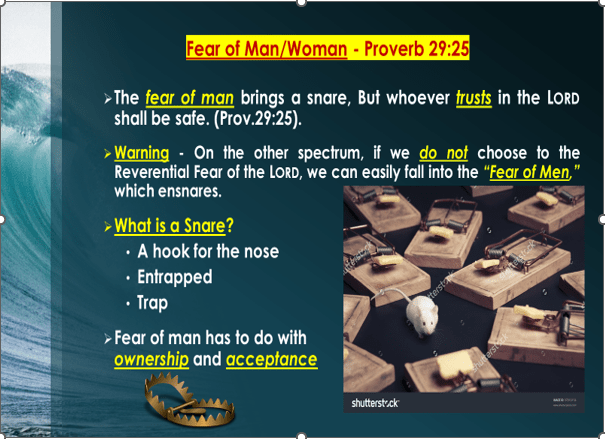
Fear of man is not Reverential Fear of the LORD (God), because “the fear of man brings a snare” (Proverbs 29:25). Many people fear men more than the Reverential Fear the LORD (God) – they allowed the faces of men to cause them to be withdrawn and thus, causing them to lose their confidence in God.
1.4.5 Not to Fear other gods
Although God’s Word teaches that we should not fear idols or other gods, nevertheless, we should not be disrespectful of others’ religions – 2Kings 17:38 “And the Covenant that I have made with you shall not forget; neither shall you fear other gods.”
1.4.6 Not to Fear Calamities
We are not to fear earthly calamities for they signify the near Return of Jesus – Luke 21:25-28 “….men’s hearts failing them for fear….then look up…..”
1.4.7 Not to Fear “Fear”
We are not to fear “Fear,” – Job 15:24 “Trouble and anguish shall make him (the unsaved) afraid,” but the Believer casts all his earthly fears on the Lord Jesus Christ (1Peter 5:7).
The Basic Principle – Whatever an Individual fear the most, he will worship. And if he fears nothing, the tendency is that it would end up in self-worship, because of pride – Pride focuses on self and is a form of “self-worship”Colossians 2:23b (NIV) “Self-imposed worship with false humility.” Thus, David Prayed: “Unite my heart to fear Your Name” (Psalm 86:11).
1.5 Commanded
The Fear of the LORD is commanded – Deuteronomy 13:4 “You shall walk after the LORD your God, and Fear Him, and Keep His Commandments, and Obey His Voice, and you shall Serve Him, and Cleave unto Him.”
1Peter 2:17 “Honour all men. Love the brotherhood. Fear God. Honour King.”
Psalm 22:23 “You that Fear the LORD, praise Him….Glorify Him; and Fear Him.”
Christ’s early Disciples set up a noble example in this matter – Acts 9:31”….and walking in the Fear of the LORD….were multiplied.” Cornelius was the man who Feared God (Acts 10:2). The Fear of the LORD teaches us to live circumspect lives, “Let us cleanse ourselves from all filthiness of the flesh and spirit, perfecting holiness in the Fear of God.” This Godly Fear becomes a powerful motivating force in our lives.
1.6 Reverential Fear of God
Scripture has significant passages on the Reverential Fear of the LORD (God) with His Promises (Job 28:28; Psalm 111:10; Psalm 19:9; Psalm 25:12-14; Proverbs 10:27; Psalm 34:11-15; Proverbs 19:23; Proverbs 22:4; Proverbs 23:17-18; etc). Reverential Fear of the LORD (God) is not religious, legalistic attitude towards God. Of the Sevenfold Nature of the Spirit of the LORD (Isaiah 11:1-3), that rested on Christ, the last aspect is “The Spirit of the Fear of the LORD,” is emphasized, twice, and is the chief characteristic of Christ – He (Christ) has Reverential Fear of God, His Father.
The Fear of the LORD (Isaiah 11:3a) – “The Spirit of the Fear of the LORD,” is, the deep tap-root of the Jesus’ Character: Fear (Reverence) of God, becoming humble and obedience unto death of the Cross – Philippians 2:6-8 (NIV) “Who (Jesus), being in very nature God, did not consider equality with God something to be grasped, but made Himself nothing, taking the very nature of a Servant, being made in human likeness. And being found in appearance as a man, He humbled Himself and became obedient to death – even death on a cross!” In fact, “the Spirit of the Fear of the LORD” is of such far-reaching importance that an explanatory clause is appended to indicate its fundamental importance, – “And His delight (“quick understanding”- KJV) shall be in the Fear of the LORD” (Isaiah 11:3a, NIV).
The term “delight” (NIV) carries the implication that “the Fear of the LORD” is fragrant to Jesus, that is, all of Jesus’ desires and actions are in total submission to the Father’s Will:
Hebrews 10:6-7b (KJV) “In burnt offerings and sacrifices for sin Thou hast had no pleasure…….Lo, I come (in the volume of the book it is written of Me) to do Thy will, O God.”
Hebrews 10:8b-9b (KJV) “Sacrifice, and offering and burnt offerings, and offering for sin Thou wouldest not, neither hadst pleasure in them, which are offered by the law,…….Lo, I come to do Thy will, O God.”
Such yielding of His (Jesus’) Own Will to the Father’s Will is not burdensome and unpleasant to Jesus, but rather a sheer “delight.” The verb used implies that this attribute constitutes the very purpose that Jesus came.
In studying the life of our Lord Jesus Christ, He consistently claimed that “The Son can do nothing of Himself, but what He seeth the Father does; for what things so ever he doeth these also doeth the Son likewise” (John 5:19, KJV). Jesus is totally submitted and dependent on His Father:
Luke 22:42 “Not My will, but Thine, be done.”
John 4:34 “My meat is to do the will of Him (Father) that sent Me, and to finish His work.”
Hebrews 10:6-7b (KJV) “In burnt offerings and sacrifices for sin Thou hast had no pleasure…….Lo, I come (in the volume of the book it is written of Me) to do Thy will, O God.”
Hebrews 10:8b-9b (KJV) “Sacrifice, and offering and burnt offerings, and offering for sin Thou wouldest not, neither hadst pleasure in them, which are offered by the law,…….Lo, I come to do Thy will, O God.”
Scripture warns us against man-pleasing – Proverbs 29:25 “The fear of man brings a snare but whoever trusts in the LORD shall be safe.” And yet the Scripture also teaches that we are to submit to human-authority as unto God Himself. Thus, understanding the two (warning & teaching) with proper balance between the two is importance:
1.1 No Fear of Man/Woman
Proverbs 29:25 “The fear of man brings a snare but whoever trusts in the LORD shall be safe.” There are many injunctions from God’s Word that advise and warn us against, the fear of man, in general (Proverbs 29:25):
Proverbs 29:25 “The fear of man brings a snare but whoever trusts in the LORD shall be safe.”
Isaiah 2:22 “Cease ye from man, whose breath is in his nostrils: for wherein is he to be accounted for?”
Jeremiah 17:5 “Cursed be the man (person) who trusts in man and makes flesh his arm.”
Psalm 118:6, 8, 9 “The LORD is on my side; I will not fear: what can man do unto me? It is better to trust in the LORD than to put confidence in man. It is better to trust the LORD than to put confidence in Princes.”
Job 32:21-22 “Let me not, I pray you, accept any man’s person, neither let me give flattering titles unto man. For I know not to give flattering titles; in so doing my Maker would soon take me away.”
Job 21:4 “As for me, in my complaint to man?”
Galatians 1:10 “Do I seek to please men? For if I yet pleased men, I should not be the Servant of Christ.”
1Corinthians 4:3 “But with me it is a very small thing that I should be judged of you, or of man’s judgement.”
Ephesians 6:6 “Not with eye-service, as men pleasers.”
1Thessalonians 2:4 “So we speak; not as pleasing men, but God, which tries our hearts.”
Although we should show due respect/honour man/woman in authority, the above Scriptures express explicitly that we should not indulge in inordinate desire to please, exalting the Individual more than he/she deserves
1.2 Honour Man/Woman in Authority
God’s Word teaches how we may/must please Persons with authority as unto God Himself. We must honour, obey, and please our Parents, Rulers, and Superiors in all things {except when it comes into conflict with God’s Word – Acts 4:18-20), that the Persons required us to do, in the Lord Jesus:
Exodus 20:12 “Honour thy father and mother.”
Colossians 3:20 “Children, obey your Parents in the Lord: for this is right.”
Ephesians 6:1 “Children obey your Parents in the Lord: for this is right.”
Romans 13:1-2 “Let every soul be subject unto the higher powers…..Whoever therefore resists the power, resisted the ordinance of God.”
Matthew 22:21 “Render therefore unto Caesar the things which are Caesar’s; and unto God the things that are God’s.”
Titus 3:1 “Put them in mind to be subject to Principalities and Powers, to obey Magistrates.”
1Peter 2:13 “Submit yourselves to every ordinance of man for the Lord’s sake: whether it be to the King, as Supreme.”
Colossians 3:22 “Servants, obey in all things your Masters according to the flesh.”
Hebrews 13:7 “Remember those who rule over you, who have spoken the Word of God to you, whose faith follow, considering the outcome of their conduct.”
Hebrews 13:17 “Obey those who rule over you, and be submissive, for they watch out for your souls, as those who must give account. Let them do so with joy and not with grief, for that would be unprofitable for you.”
Hebrews 13:24 “Greet all those who rule over you,…..”
God has given certain men/women authority over us, and we are obligated to render the respect due to them. We must understand that these men/women whom God Almighty has placed in the several Places of Authority. The Power/Authority given to them over us are from God, and not against God. They are to be honoured, obeyed, and pleased not in opposition to the Higher Authority of God, but as unto God Himself. There are therefore limits/ways as to how far we are to give our due respect to men/women in authority.
However, if we obey men/women more than God, and in doing so, we go against God; if we value the favour and approval of men/women in authority more than God’s or go against God’s approval in order to gain men/women in authority, favour; and if we fear men/women in authority, censure/displeasure more than God’s, we are putting men/women in authority up on a higher pedestal, in the place of God, idolising them, then, we need to reevaluate (Acts 4:18-20).
As this is a violation against God’s Commandment to worship Him {God} and Him {God} only – Exodus 34:14 “Thou shalt worship no other god: for the LORD, whose Name is Jealous is a Jealous God.” As the Scripture forbids that man be thought above that which is written – 1Corinthians 4:6 “Now these things, brethren, I have figuratively transferred to myself and Apollos for your sakes, that you may learn in us not to think beyond what is written, that none of you may be puffed up on behalf of one against the other.”
2.0 Balance
Thus, there is a need for balance between submission to man/woman under God’s ordained authority; against the general submission to man/woman out of inordinate fear of man/woman which could be a snare – Proverbs 29:25 “The fear of man brings a snare but whoever trusts in the LORD shall be safe.” Let us be ever watchful that we do not fall into the snare of pleasing man/woman, not taking God into account and therefore makes it our business to satisfy man/woman, out of fear; our fear should be the Reverential Fear of God. – Ecclesiastes 12:13 “Fear God and keep His Commandments: for this is the whole duty of man.”
Jesus Seventh Statement from the Cross reveals to us about Death and how Jesus died – Luke 23:46 “And when Jesus had cried out with a loud voice, He said, ‘Father, into Your hands I commit My spirit.’ Having said this, He breathed His last.”Five Characteristics of Christ’s Death encouraged us of our Salvation in our Lord Jesus:
1.1 Christ’s Death was Determined
The Death of Jesus Christ was determined for Him beforehand – Acts 2:23 “Him, being delivered by the determined purpose and foreknowledge of God, you have taken by wicked hands, have crucified and put to death.” (Acts 4:28). Jesus, the Lamb of God (John 1:29, 36) was slain from the Foundation of the World – Revelation 13:8b “The Lamb slain from the foundation of the world.” Thus, before Adam was created – the Fall of Adam was anticipated. Before Sin entered the world, Salvation from it had been planned by God (Acts 2:23).
In the Eternal Counsel of the Godhead, it was fore-ordained that Jesus Christ, will be the God-Man, the Saviour, that will die for Sinners (Philippians 2:6-8; Hebrews 5:8). Thus, Christ’s Death is the “Undergirding of the Cross.”
1.2 No Bones were Broken
Luke 23:46b “Father, into Your hands I commit My spirit.’ Having said this, He breathed His last.” – Some people taught that Jesus’ Death was an illusion, but this was not the case; Jesus died, as John recorded that the Roman Officials checked very carefully to be sure that Jesus had died. When the Soldiers came to look at the bodies on the crosses, they discovered that Jesus was already dead (John 19:330; thus, the Soldiers did not break His legs in fulfilment of the Prophecy:
Psalm 34:20 “He guards all His bones; not one of them is broken.”
John 19:33, 36 “But when they (soldiers) came to Jesus and saw that He was already dead, they did not break His legs…..For these things were done that the Scripture should be fulfilled, ‘Not one of His bones shall be broken.’”
Exodus 12:46 “In one house it shall be eaten; you shall not carry any of the flesh outside the house, nor shall you break one of its bones.”
Numbers 9:12 “They shall leave none of it until morning, nor break one of its bones. According to all the ordinances of the Passover they shall keep it.”
Psalm 22:17a “I can count all My bones.”
When Joseph and Nicodemus wanted to get custody of Christ’s Body, to give Christ a decent burial, they must check with Pilate, and Pilate marvelled that Jesus was already dead (Mark 15:44). Thus, the official evidence of the Roman Empire was that Jesus had died. The evidence of the Gospel Writers is that Jesus had died; Jesus tasted death for every Person. Jesus tasted the full experience of death – Jesus confronted the last Enemy – Death – and courageously faced its sorrow, its trial, its pain and its finality – Jesus had victory over Death (2Timothy 1:10; Isaiah 25:8; Hosea 13:14; 1Corinthians 15:24-26; Hebrews 2:14; Revelation 20:14; Revelation 21:4; Luke 20:35-36; 2Corinthians 5:1-2; John 11:43-44; Romans 1:4; Revelation 1:18; John 5:28-29; 1Corinthians 15:25-26; Acts 2:27). Thus, our Eternity in Christ is Secured!
1.3 Christ Died Confidently
a. Jesus died confidently – Luke 23:46b “Father, into Your hands I commit My spirit.’ Having said this, He breathed His last.”
Father’s Presence – Jesus died confidently because He had the Father’s Presence – He addressed His Father, three times on the Cross:
Jesus’ First Word from the Cross: “Father, forgive them; for they know not what they do.” (Luke 23:34).
Jesus’ Fourth Word “My God, My God, why hast Thou forsaken Me?” (Matthew 27:46; Psalm 22:1).
Jesus’ Seventh Word: “Father, into Thy hands I commit My spirit.” (Luke 23:46). At the beginning, in the middle and at the end of His ordeal, our Lord Jesus addressed to His Father.
Jesus died confidently because He had the Father’s Presence – He addressed His Father, three times on the Cross:
b. Father’s Promise – Jesus had the Father’s Promise, as prophesied in Psalm 31:5 “Into Thine hand I commit My spirit: Thou hast redeemed Me, O Lord God of truth.” Psalm 31:5 is the O.T. Promise, Jesus applied it to Himself; but He (Jesus) changed it, and since He is the Author of the Word, He can do this. He added the address, “Father,” but He omitted the phrase about being redeemed: “Thou hast redeemed Me, O Lord God of truth.” – Jesus did not have to be redeemed because He never sinned, and it was not necessary for Him to be redeemed. When He died, He claimed God’s Word and entrusted Himself to His Father.
c. Father’s Fulfilment – Jesus fulfilled the Scripture – All of Jesus’ three Prayers from the Cross are tied to Prophecy of the Scripture:
When Jesus prayed: “Father, forgive them; for they know not what they do.” (Luke 23:34), was in fulfilment of Isaiah 53:12 “He….made intercession for the transgressors.”
When Jesus cried: “My God, My God, why hast Thou forsaken Me.” (Matthew 27:46). Jesus was quoting Psalm 22:1.
When Jesus cried out: “Father, into Thy hands I commit My spirit.” (Luke 23:46), Jesus was quoting part of Psalm 31:5.
Thus, Our Lord Jesus lived by God’s Word, and died by God’s Word. Jesus’ Assurance was His Father’s Promises in His Word.
d. Father’s Protection – Jesus has the Assurance and Protection of His Father – Luke 23:46b “Father, into Your hands I commit My spirit.’ Having said this, He breathed His last.” – For many hours our Lord Jesus had been in the hands of the Roman Soldiers, the Jewish Religious Leaders, and the People, experiencing their mocking (Luke 23:35-39; Matthew 27:49; Psalm 22:7-8). Jesus told His Disciples, “I am going to be delivered into the hands of the Sinners.” (Matthew 16:21; Luke 24:7; Matthew 26:45; Mark 14:41).
The Sinners took hold of Jesus and bound Him (Matthew 26:57; 27:2).
The Sinners stripped Him (Matthew 27:28).
The Sinners put a crown of thorns upon His head (Matthew 27:29).
The Sinners spit on Him and struck Him (Matthew 27:30; Isaiah 50:6).
The Sinners pulled out Jesus’ beard (Isaiah 50:6).
The Sinners nailed Him to the Cross, and crucified Him (Matthew 27:31, 35a).
The Sinners pierced His side (John 19:34).
But when He (Jesus) approached the End of His Ordeal of the Sacrificial Redemptive Work on the Cross, Jesus was no longer in the hands of the Sinner, but in His Father’s Hands – Luke 23:46b “Father, into Your hands I commit My spirit.’ Having said this, He breathed His last.” As prophesied in Psalm 31:8 “Thou hast not shut Me up into the hands of the enemy.” And Psalm 31:15 “My times are in Thy hand: deliver Me from the hands of Mine enemies, and from them that persecute me.” Thus, our security is in both, Jesus’ Hands, and the Father’s Hands – the double security – John 10:28-29 “And I give them Eternal Life, and they shall never perish; neither shall anyone snatched them out of My hand. My Father, who has given them to Me, is greater than all; and no one is able to snatch them out of My Father’s hand.”
1.4 Christ Died Willingly
Christ died Confidently, and Christ died Willingly – In one sense, Jesus was killed – Peter said: “Him…you have taken, by wicked hands have crucified and slain” (Acts 2:23); but in another sense, Christ was not killed, for He died willingly, laid down His Own Life:
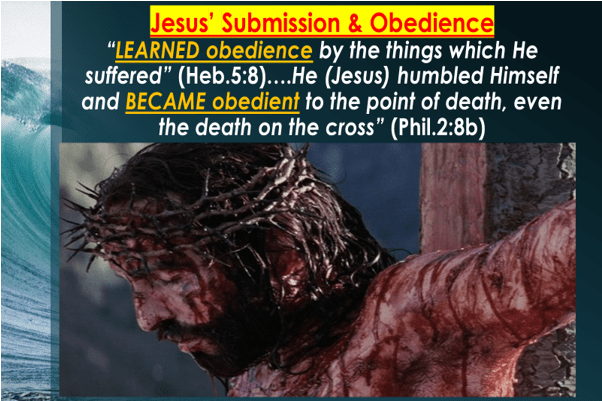
Hebrews 5:8 “Though He (Jesus) was the Son, yet He learned obedience by the things which He suffered.”
Philippians 2:6-8 “Who (Jesus), being in the form of God, did not consider it robbery to be equal with God, but made Himself of no reputation, taking the form of a bondservant, and coming in the likeness of Man. And being found in appearance as a Man, He humbled Himself and became obedient to the point of death, even the death of the cross.”
John 10:17-18 “Therefore does My Father love Me, because I lay down My life, that I might take it again. No man takes it from Me, but I lay it down of Myself. I have power to take it again.”
Thus, our Lord Jesus died willingly in obedient to the Father’s Will. This is an amazing event! No O.T. sacrifices ever died willingly. No lamb, goat, or sheep, birds, etc., ever willingly gave its life. But Jesus willing laid down His Life as God’s Lamb (John 1:29, 36). Jesus willingly laid down His Life on our behalf (John 3:16).
1.5 Christ Died Victoriously
Luke 23:46b “Father, into Your hands I commit My spirit.’ Having said this, He breathed His last.” Jesus Confidently, Jesus died Willingly, and Jesus died Victoriously, for He cried out: “Father, into Your hands I commit My spirit.’ Having said this, He breathed His last.” (Luke 23:46b). Our Lord Jesus Christ accomplished the Work that God the Father gave Him to do, and when He gave up His Spirit, several miracles took place:
The Veil of the Temple was torn in two, from top to bottom – Matthew 27:51a. “Then, behold, the veil of the temple was torn in two from the top to bottom.” – Thus, God opened the way for us into His Presence (Hebrews 10:19-20).
Some Graves were opened, and some of the Dead Saints were Resurrected (Matthew 27:52).
Satan and the Satanic Hosts were defeated – Colossians 2:15 “Having disarmed Principalities and Powers, He (Jesus) made a public spectacle of them, triumphing over them in it.”
The Mosaic Ordinances, Statutes, Feasts, Offerings, the Aaronic Priesthood and Sacrifices were abolished – Colossians 2:14 “Having wiped out the handwriting of requirements that was against us, which was contrary to us. And He (Jesus) has taken it out of the way, having nailed it to the Cross.”
There was even an Earthquake in that Area (Matthew 27:51b) – the Earthquake reminds us of the Earthquake at Mount Sinai when God came down and gave the Law (Ten Commandments – Exodus 19:18). However, this Earthquake, did not announce the terror of the Law; it announced the Fulfilment of the Law by our Lord Jesus Christ – Romans 10:4 “For Christ is the end of the Law for righteousness to everyone who believes.”
Thus, our Lord Jesus Christ’s Sacrificial Redeeming Victorious Death – “It is Finished” (John 19:30) – And Luke 23:46b “Father, into Your hands I commit My spirit.’ Having said this, He breathed His last.” – Overcame Satan, Sin, Death, and Hell:
Satan is Defeated – Colossians 2:15 “Having disarmed principalities and powers, He (Jesus) made a public spectacle of them, triumphing over them in it.”
Sin is Defeated – Romans 6:23 “For the wages of sin is death, but the gift of God is Eternal Life in Christ Jesus our Lord.”
Death & Hell are Defeated – 1Corinthians 15:54b-55 “Death is swallowed up in victory, O Death, where is your sting? O Hades (Hell), where is your victory?”
Death & Hell will be Removed after the 1,000 Millennial Rule of Christ – Revelation 20:14 “The Death and Hades (Hell) were cast into the Lake of Fire. This is the Second Death.”
Our Lord Jesus died for the Sinners: He died Confidently, He died Willingly, and He died Victoriously! – Thus, we, who have received the Lord Jesus Christ as our Lord and Personal Saviour, our Salvation is Secured in Him (Christ) and in God the Father – John 10:28-29 “And I give them Eternal Life, and they shall never perish; neither shall anyone snatched them out of My hand. My Father, who has given them to Me, is greater than all; and no one is able to snatch them out of My Father’s hand.”
Jesus’ Sixth Statement on the Cross: “It is Finished” (John 19:30) – John 19:30 “When Jesus therefore had received the vinegar, He said. It is finished: and He bowed His head and gave up the spirit.” – Most Christians have lost the understanding of the price that our Lord Jesus Christ paid for our sin, on the Cross. In the days of Christ, crucifixion meant shame, torture, and slow and agonizing death. Our Lord Jesus was “obedient unto death, even the death of the Cross.” (Philippians 2:8). The Sixth Statement of Jesus made on the Cross was: “It is Finished” (John 19:30). When we compared the Gospel Records, we discovered that Jesus shouted this Statement. With a loud voice He cried, “It is Finished Then He bowed His head, and He gave up His spirit.” (John 19:30).
Our Lord Jesus was able, at the end of His Ministry, to shout in Great Victory: “It is Finished.” (John 19:30); because of His (Christ’s) Sacrificial Redemptive Work on the Cross, we have the assurance of Eternal Salvation.
A. The Servant
“It is Finished” (John 19:30), “Telelestai,” is a familiar Greek Word used in the time of Christ. In that culture, when the Servant or Slave finished his work, he would come back and say to the Master: “Telelestai – I have finished the work that you gave me to do.” Jesus Christ, who is God’s Servant, has accomplished the Work of Salvation on the Cross and cried out: “It is Finished” (Gk: “telelestai” – John 19:30).
Philippians 2:6-8 “Who, being in the form of God, did not consider it robbery to be equal with God, but made Himself of no reputation, taking the form of a bond Servant, and coming in the likeness of men. And being found in appearance as a Man, He humbled Himself and became obedient to the point of death, even the death of the cross.”
Hebrews 5:8 “Though He was the Son, yet He learned obedience by the things which He suffered.
The Lord Jesus Christ came with a Special Mission on behalf of His Father – John 17:4 “I have finished the work which Thou gavest Me to do.” – “It is Finished” (John 19:30).
B. The Priest
“It is Finished” (John 19:30). The Priest also used this Statement: “It is Finished.” (John 19:30). The Jewish people had to bring their sacrifices to the Priest to be examined because it was against the Law to offer imperfect sacrifice at God’s Altar. After the Priest had examined the sacrifice, he would declare: “It is Perfect.” The use of the Hebrew or the Aramaic word would be equivalent to “telelstai
Our Lord Jesus Christ, dying on the Cross, was God’s Perfect, faultless Sacrifice – “The Lamb of God who takes away the sin of the world.” (John 1:29, 36), as attested by His Father – “This is My Beloved Son, in whom I and well-pleased” (Matthew 3:17). God the Father put His Seal of Approval upon the Lord Jesus Christ, God’s Son (Matthew 3:17). The Holy Spirit came down as a Dove and rested on Jesus (Matthew 3:16-17). Thus, the Priest used the word “telelestai” to declare that the “sacrifice was perfect.” Jesus Christ dying on the Cross was God’s Perfect, Faultless Sacrifice – The Lamb of God,” as declared; (John 1:29, 36).
C. Artist
“It is Finished” (John 19:30) – (1) The Servant when the task is completed would declared to his Master: “Telelestai” (“It is Finished”); (2) The Priest, after examine the sacrifice, would declared: “Telelestai” (It is Finished); (3) The Artist, when he has completed his work, would declare: “Telelestai” – “It is Finished” of his (Artist’s) Master-Piece.
D. Merchant
It is Finished” (John 19:30). The term “It is Finished” (GK: “telelestai”) was also a common term used by the Merchant. To the Merchant, it means that “the debt has been paid in full,” (GK: “telelestai”).
E. Christ
“It is Finished” (John 19:30) – Christ, God’s Faithful Servant, came to do the Father’s Will – John 4:34 “Jesus said, ‘My meat is to do the will of Him that sent Me, and to finish His work.” (Also, Philippians 2:6-8; Hebrews 5:8) – Christ Priestly Prayer – John 17:4 “I have glorified Thee on the earth: I Have finished the work which Thou gavest Me to do.” – Christ completed His Father’s Work and declared on the Cross, with the declaration: “It is Finished (Telelestai).” (John 19:30).
1.1 Prophecies Fulfilled
When Jesus cried out “It is Finished” (John 19:30), He (Christ) brought about the completion and fulfilment of ALL the O.T. Prophecies, symbols, and foreshadowing about Himself. From Genesis to Malachi, there are about 300 detailed Prophecies His (Christ’s) First Coming and the Atoning Work of Redemption:
The Seed of the Woman – Genesis 3:15 “And I will put enmity between you and the woman, and between your seed and her Seed (Christ); and He (Christ) shall bruise your head, and you shall bruise His heed (the crucifixion).” Also, Isaiah7:14 “Therefore the Lord Himself will give you a sign: behold, the virgin shall conceive and bear a Son, and shall call His Name Immanuel.”
Tabernacle & Offerings – All the Structures in the Tabernacle, the Priesthood, the Five-Offerings, the Furnishing – all foreshadowed Christ and His Works on Earth – Colossians 2:14 “Blotting out the handwriting of ordinances that was against us, which was contrary to us, and took it out of the way, nailing it to the cross.”
The Veil (Christ’s Body)– When Christ completed the Sacrificial Redemptive Work on the Cross and declared: “It is Finished” (John 19:30, the Veil (Christ’s Body), in the Temple was torn in two – Matthew 27:51a “Then, behold, the veil of the temple was torn in two from top to bottom.” – Opening the direct access of God to us (Hebrews 10:19-20).
The Law – The Righteousness of the Law was fulfilled through the Finished Work of the Lord Jesus Christ – Romans 10:4 “Christ is the end of the Law for righteousness to everyone who believes.”
God’s Wrath Appeased – God the Father uphold His own Holiness and yet fulfilled His own demands when Jesus died on the Cross, on our behalf – “It is Finished” (John 19:30). Thus, there is now no condemnation to them that are in Christ Jesus (Romans 8:1).
The Types and Prophecies in the Law were fulfilled in the Lord Jesus Christ’s Sacrificial Redemptive Work on the Cross – “It is Finished” (John 19:30), as in Hebrews 9:26-28; 10:4, 12 “Once in the end of the world (age) hath He appeared to put away sin by the sacrifice of Himself! And as it is appointed unto men once to die, but after this the judgement: So Christ was once offered to bear the sins of many….It is not possible that the blood of bulls and of goats should take away sin….But this Man (Jesus), after He had offered one Sacrifice for sin forever, sat down on the right hand of God.”
The Work of Salvation is completed – “It is Finished,” (John 19:30); Our Lord Jesus was buried, and He arose from the dead. He ascended to Heaven and sat down on God the Father’s Right-hand (Acts 2:22-36). Thus, Salvation established in Christ’s Death, Burial and Resurrection (1Corinthians 15:1-4), is completed; therefore, nothing should be added or taken away or substituted for the Salvation. Salvation is the Finished Work of the Lord Jesus Christ (John 19:30). – Jesus cried: “It is Finished” (Gk: “telelestai” – John 19:30)!
Jesus’ Fifth Statement on the Cross: “I Thirst.” (John 19:28). “After this, Jesus knowing that all things were now accomplished, that the Scripture might be fulfilled, saith, I thirst. Now there was set a vessel full of vinegar: and they filled a sponge with vinegar, and put it upon hyssop, and put it to His mouth, when Jesus therefore had received the vinegar, he said, It is Finished: and He bowed His head, and gave up the spirit.” (John 19:28-30). The first Three Statements of Jesus, on the Cross were centred on Others:
FirstStatement to His (Christ’s) Enemies – “Father forgive them, for they do not know what they do.” (Luke 23:33-34).
Second Statement to the Repentant Thief – “Today, you shall be with Me in Paradise” (Luke 23:42-43).
Third Statement to Mary, the mother of Jesus and to John, His (Christ’s) Disciple – “When Jesus therefore saw His mother, and the Disciples standing by, whom He loved, He saith unto His mother, “Woman, behold thy Son! Then saith He to the Disciple, Behold your mother! And from that hour that Disciples took her unto his own home.” (John 19:26-27).
1. Jesus’ Fourth Statement, “My God, My God, why has You forsaken Me?”(Matthew 27:46; Psalm 22:1), was made when the transaction between His Father and Himself (Jesus) took place, in the 3 hours of “deep-darkness that covered the whole earth,” from 12pm (Noon) to 3pm (Matthew 27:45; Amos 8:9) – God the Father laid “the Sin of the Whole Human-Race,” upon His Son (Jesus), and He (the Father) has to turn His Face from our Lord Jesus, and there was a temporarily broken relationship between the Father and the Son, because the Sin of the Whole Human Race was laid upon Jesus –2Corinthians 5:21 “For He (Father) made Him (Jesus) who knew no sin to be sin for us, that we might become the righteousness of God in Him (Jesus).”
2. Last Three Statements – But Jesus’ last three Statements focused on Himself – First, His body – “I thirst” (John 19:28); Second, His Soul: “It is Finished” (John 19:30; Isaiah 53:10); Third, His Spirit – “Father into Thy hands I commend My spirit.” (Luke 23:46). Christ’s Body, Soul and Spirit – all were offered by our Lord Jesus Christ in Perfect Obedience to His Father (Hebrews 5:8; Philippians 2:6-8).
1.1 Fifth Statement
Jesus’ Fifth Statement on the Cross, is the shortest “I thirst” (John 19:28b, 29) – This was in fulfilment of the Prophecy in Psalm 69:21b:
Psalm 69:21b “In my thirst they gave me vinegar to drink.
John 19:28b-29 “I thirst! Now a vessel full of sour wine was sitting there; and they filled a sponge with sour wine, put it on hyssop, and put it to His (Jesus’s) mouth.”
In the Greek N.T. it is one word of four letters. It is the only Statement in which Jesus referred to His physical need – “I thirst,” – which is part of His physical suffering. Crucifixion is an agonising form of death; as Jesus hung on the Cross, all His physical fluid was drained right out of Him, through His wounds.
Psalm 69 speaks about this when it describes His (Christ’s) Suffering: “Reproach hath broken My heart; I am full of heaviness: and I looked for some to take pity, but there was none; and for comforters, but I found none” (Psalm 69:20). “My throat is dried: mine eyes fail while I wait for My God” (Psalm 69:3). Psalm 69 sketches the portrait of our Suffering Saviour, the Lord Jesus Christ. This simple Statement “I thirst” (John 19:28), reveals to us the heart of the Lord Jesus, and see His love in deeper way, due to His mental, physical, and spiritual sufferings showing forth the three Portraits of Christ:
The Obedience Son of God. Jesus submitted Himself, completely to His Father’s Will – Hebrew 5:8 “Though He was a Son, yet He learned obedience by the things which He suffered.” (Philippians 2:6-8).
The Suffering Son of Man – His physical torture, under the Romans; His rejection by the Nation of Israel; His torments under the Roman Soldiers, the Jewish Religious Leaders, and the People (Luke 23:35-39; Psalm 22:7-8); abandonment by His Father (Matthew 27:46; Psalm 22:1). When Jesus was on the Cross, He was offered the same narcotic (anaesthesia) that the two thieves were offered. Jesus refused to drink the wine that was mingled with myrrh because He did not want His senses to be stupefied; thus, He experienced the full-level-of-pains – Matthew 27:34 “They gave Him sour wine mingled with gall to drink. But when He has tasted it, He would not drink.” (Mark 15:23).
The Loving Saviour of Sinners (Luke 23:42-43; 2Corinthians 5:21). When Jesus completed that Great Transaction for our Salvation, in the three hours of “Deep-Darkness,” when He cried out: “My God, My God, why has You forsaken Me?” (Matthew 27:46; Psalm 22:1). There were several Cups of Calvary:
Cup of Charity – they offered Him wine mingled with myrrh, an opiate to deaden His (Christ’s) pain, but He rejected it (Matthew 27:34; Mark 15:23).
The Cup of Mockery – the Soldiers offered Him sour wine, in mockery – Luke 23:36-37 “The soldiers also mocked Him, coming and offering Him sour wine, and saying, ‘If You are the King of the Jews, save Yourself.”
Cup of Sympathy – somebody put some vinegar on a sponge and lifted it to His (Christ’s) dry lips (John 19:29).
Cup of Iniquity (Sin), on our behalf – Jesus said in the Garden, “The Cup which My Father hath given Me, shall I not drink of it?” (John 18:11b).
Jesus is the “Living-Water,” of God, when we received Him as our Lord and Saviour, our spiritual thirst is fully quenched – John 7:37b-39 “If anyone thirsts, let him come to Me (Jesus) and drink. He who believes in Me, as the Scripture has said, out of his heart will flow Rivers of Living Water. But this He spoke concerning the Spirit, whom those believing in Him would receive; for the Holy Spirit was not yet given, because Jesus was not yet glorified.”
Jesus’ Fourth Statement of Jesus on the Cross: “My God, My God, why have You Forsaken Me?” (Matthew 27:46; Psalm 22:1) – The first three Statements that Jesus spoke while hanging on the Cross were:
First,“Father, forgive them; for they know not what they do” (Luke 23:34). Jesus Pleaded for forgiveness to those who went against Him. Jesus came to bring God’s forgiveness; so, it is consistent with His (Christ’s) Nature and Teaching.
Second, He Assured the Repentant Thief: “Today, shalt thou be with Me in Paradise” (Luke 23:43). Jesus provides the Way of Salvation, and Reconciliation back to God the Father.
Third, Jesus Committed Mary, His mother to John, His Disciples: ““Woman, behold thy Son! Then saith He to the Disciple, Behold your mother! And from that hour that Disciples took her unto his own home.” John 19:26-27). The Fifth Commandment of The Law stated that we should honour our father and mother; and Jesus, fulfilled the Law, commended His mother, Mary to His Disciple, John.
But the Fourth Statement of Jesus on the Cross is the Cry of Jesus: “My God, My God, why have You Forsaken Me?” (Matthew 27:46; Psalm 22:1), was prophesied in Psalm 22:1, given about 1,030 years, earlier, by King David, under the Anointing of God’s Spirit. Some of the People that stood there, when they heard that Jesus, called out “Eli, Eli lama sabachthani?” (Matthew 27:46), thought that Jesus cried out for Elijah; and straightway one of them ran, and took a sponge, and filled it with vinegar, and put it on a reed, and gave Jesus to drink. The remaining of the People said, “Let be, let us see whether Elisha will come and save Him” (Matthew 27:45-49); failing to understand the cry of Jesus was in fulfilment of the Prophecy of Psalm 22:1.
1.1 The Mystery
The Three Great Mystery of God is wrapped up in Jesus’ Cry on the Cross – Matthew 27:45-49 “Now from the sixth hour (Noon – 12pm) there was darkness over all the land unto the ninth hour (3pm). And about the ninth hour (3pm), Jesus cried with a loud voice, saying ‘Eli, Eli, lama sabachthani?’ That is to say, ‘My God, My God, why hast Thou forsaken Me?’ Some of them that stood there, when they heard that, said, This Man called for Elias. And straightway one of them ran, and took a sponge, and filled it with vinegar, and put it on a reed, and gave Him (Jesus) to drink. The rest said, let be, let us see whether Elias will come to save Him.”
1.1.1 The Mystery of Fulfilment
“The Three Hours of Darkness Across the Earth, from 12pm {Noon} to 3pm”(Matthew 27:45; Mark 15:33) – This was a Supernatural Darkness – this was not an eclipse. This Darkness was not something that people imagined. It was a Supernatural Darkness sent by God the Father.
Prophesied – The “Three Hours of Darkness Across the Earth,” was prophesied in Amos 8:9 (NKJV) “And it shall come to pass in that day, says the Lord God, ‘That I will make the sun go down at noon (12pm), and I will darken the earth in broad daylight.
Mourning – The Day of Israel’s Mourning of Crucifixion of God’s Only Son, the Lord Jesus Christ – Amos 8:10 (NKJV) “I will turn your Feasts into mourning, and all your songs into lamentation; I will bring sackcloth on every waist, and baldness on every head; I will make it like mourning for an Only Son, and its end like a bitter day.”
Solemnity – The “Three-Hours of Darkness Across the Earth,” was associated with the Sacrificial Death of God’s Begotten Son, the Lord Jesus Christ – Amos 8:10 (NKJV) “I will turn your Feasts into mourning, and all your songs into lamentation; I will bring sackcloth on every waist, and baldness on every head; I will make it like mourningfor an Only Son, and its end like a bitter day.”
Secrecy – The “Three-Hours of Darkness Across the Earth,” was the “Darkness-of-Secrecy,” – in those “Three Hours of Darkness,” Jesus Christ was accomplishing a Great Work that He alone could accomplish. Jesus was carrying on an Eternal Transaction with His Father – When God the Father placed “the Sins of the Whole Human-Race,” upon Jesus, the Father has to turned His Face away from Jesus, and there was a temporary broken relationship between Him (Jesus) and the Father, that is why He (Christ) cried out: “My God, My God, Why Hast Thou Forsaken Me?” (Matthew 27:46; Psalm 22:1).
1.1.2 The Mystery of Loneliness
The “Mystery of Loneliness” on the Cross, because His (Christ’s) Father, turned His Face from Him (Christ), when He (God the Father) placed the “Sin of the Whole Huma-Race,” upon His Son; there was a temporary broken relationship between Christ and His Father; and He, Jesus, felt forsaken by His Father – “My God, My God, Why Hast Thou Forsaken Me?” (Matthew 27:46; Psalm 22:1).
1.1.3 The Mystery of Blindness
The “Mystery of People’s Blindness,” – There were many People – the Soldiers and others – before the Cross. They heard Jesus’ Cry, “My God, My God, why hast Thou forsaken Me?” (Matthew 27:46: Psalm 22:1).
People’s Blindness – The People were blinded, not knowing that the Scripture of Psalm 22:1, was being fulfilled; they said, “He is calling for Elijah” (Matthew 27:47).
People’s Sneer – Someone said, “Let’s wait to see if Elijah comes” (Matthew 27:49). Jesus was not calling for Elijah, but was speaking forth the Prophecy of Psalm 22:1-2 “My God, My God, why hast Thou forsaken Me?….I cry in the daytime, but Thou hearest not; and in the night season, and am not silent.”
People’s Attitude – The People have experienced, “the three hours of Darkness Across the Earth,” in fulfilment of the Prophecy of Amos 8:9, but yet their attitudes were described in the Prophecy given by King David 1,030 years ago in Psalm 22:7-8 “All they that see Me laugh me to scorn: they shoot out the lip, they shake the head, saying, He trusted on the LORD that He would deliver Him: let Him deliver Him, seeing He delighted in Him.” This was fulfilled in Matthew 27:39-43, 49).
People’s Action – Psalm 22:18 says: “They part my garments among them, and cast lots upon my vesture,” was fulfilled when Jesus was crucified – Luke 23:34b “And they divided His garments and cast lots.”
1.2 Summary
The people were blinded to the Fulfilment of the Scripture, blind to the Saving Work of Jesus on the Cross; they said: “Let’s see whether Elijah will come and save Him” (Matthew 27:49). At that hour, the Lord Jesus Christ was made sin for us (2Corinthians 5:21), and when He was made sin, he was forsaken by God the Father (Matthew 27:46; Psalm 22:1). Thus, we have the threefold Mystery of the Cross:
The Mystery of the “Three Hours of Darkness Across the Earth” (Amos 8:9; Matthew 27:45); the mourning of God’s Only Begotten Son (Amos 8:10; John 1:29, 36).
The “Mystery of Loneliness,” when “the Sin of the Whole-Human-Race,” was placed upon the Lord Jesus Christ (Matthew 27:46; Psalm 22:1; 2Corinthians 5:21).
The “Mystery of Ignorance of the People,” (Psalm 22:7-8; Matthew 27:39-43, 49); the Soldiers cast lots for Jesus’ garment (Psalm 22:18; Luke 23:34b).
I trust that you are not blinded today, but that, by faith, received the Lord Jesus Christ, the Lamb of God (John 1:29, 36), as your Personal Lord and Saviour and be “Born-Again,” by His Word and Spirit (John 3:3-8; 1Peter 1:23; Titus 3:5); be assured that the assurance that Jesus gave to the Repentant Thief on the Cross: “Today, you shall be with Me in Paradise!” (Luke 23:43), is also our assurance from Him (Christ)!









 Morning Dew . Life