Tag: god

Second Psalm – The Messianic (Part 1)

1.0 Statement

Psalm 2 is called the Messianic Psalm because it speaks of the Person and Work of our Lord Jesus Christ. The question may be asked: “How can we recognise a Messianic Psalm?”  The answer would be where there is a reference to the Messiah in a Psalm, and it is applied to Christ and expounded in the New Testament.

  • Sometimes a whole Psalm applies to Christ for example, Psalm 22.
  • Sometimes a paragraph for example, Psalm 40:6-10.
  • Sometimes several verses for example, Psalm 69:4, 9,21.
  • Sometimes a single verse for example, Psalm 41:9.

It is obvious that some of the Psalms are occupied entirely with the Person, the thoughts, and feelings of our Lord Jesus, while others clearly refer to the experience of the Psalmist, and then there is included an isolated reference to the Messiah. Psalm 69 is an example. David exclaims: “O God, You knows my foolishness, and my sins are not hid from Thee,” he (David) obviously is referring to himself in Psalm 69:5. But when he (David) says: “They gave Me…..gall for My meat; and in My thirst they gave Me vinegar to drink” (Psalm 69:21), these words are applied to Christ in Matthew 27:34-48, they are clearly Messianic.

So, we must be careful to distinguish between the spiritual experience of the Writer of the Psalm and the Prophetic Reference to Christ Himself. While keeping in mind this rule, that a quotation in the New Testament from a Psalm, which applies it to the Lord Jesus, confirmed it as Messianic, there are three Psalms which are exceptions. They are obviously Messianic but are not quoted in the New Testament:

  • Psalm 24 Speaks of the King of Glory.
  • Psalm 72 Outlines the Millennial Reign of Christ.
  • Psalm 89 Expounds the Davidic Covenant fulfilled by David’s greater Son, the Messiah, the Lord Jesus Christ.

It is noted that the reference to the Messiah in the Psalms (16 numbers) do not follow the sequence or in chronological order. Psalm 2 is an introduction to the whole collection, giving the Prophetic Outline of the Glories of the Messiah. Psalm 40 refers to His (Christ’s) Incarnation; Psalm 22 to His Crucifixion; Psalm 16 to His (Christ’s) Resurrection. The Writer (R/S) rearranged the Sixteen Messianic Psalms in Chronological Order, for impact:

  1. Psalm 2 – The Glory of the Eternal Son, the Lord Jesus Christ.
  2. Psalm 40 – The Incarnation of the Lord Jesus Christ.
  3. Psalm 91 – The Temptation of the Lord Jesus Christ.
  4. Psalm 41 – The Betrayal, by Judas Iscariot, on the Lord Jesus Christ.
  5. Psalm 22 – The Crucifixion of the Lord Jesus Christ.
  6. Psalm 69 – The Trespass Offering of the Lord Jesus Christ.
  7. Psalm 16 – The Resurrection of the Lord Jesus Christ.
  8. Psalm 68 – The Ascension of the Lord Jesus Christ.
  9. Psalm 45 – The King-Bridegroom.
  10. Psalm 24 – The King of Glory, the Lord Jesus Christ.
  11. Psalm 110 – The Priest-King-Judge, the Lord Jesus Christ.
  12. Psalm 8 – The Last Adam, the Lord Jesus Christ (1Corinthians 15:45).
  13. Psalm 72 – The Millennial Reign of the Lord Jesus Christ (Revelation chapter 20).
  14. Psalm 89 – The Davidic Covenant, Jesus, David’s Greater Son (Revelation 22:16b).
  15. Psalm 102 – The Unchangeable One, the Lord Jesus Christ.
  16. Psalm 118 – The Headstone of the Corner, the Lord Jesus Christ.

Psalm 2 has no Superscription or Title. Psalm 1 and Psalm 2 are linked together in the Hebrew Bible. They are an Introduction and a Preface to the Psalms as a whole. It alerts us to the fact that here we are not only dealing with our Devotional Life and Personal Destiny (Psalm 1), but also with the whole Purpose of God in History and the Destiny of the Nation of Israel and the World (Psalm 2). 

NoPsalm 1Psalm 2
1Psalm 1 begins with “the blessed,” the beatitudes (Psalm 1:1)Psalm 2 ends with “the blessed,” the beatitude (Psalm 2:12)
2Psalm 1 gives us God’s Word as the Conceptual Framework for our Mediation.Psalm 2 gives us the movement of that Word in History and its Interpretive Key: “Yet I have set My King upon My Holy Mountains.
3Psalm 1 deals with the Word.Psalm 2 deals with the World.
4Psalm 1 contrasts the Righteous with the Ungodly.Psalm 2 contrasts the Nations with their Divine Ruler.
5Psalm 1 deals with the Personal Life.Psalm 2 deals with the Historical Life.
6Psalm 1 deals with the Individual.Psalm 2 deal with the Universal.

Together (Psalm 1 and Psalm 2) form an admirable introduction to the whole 150 Psalms.  There is a certain correspondence between the Psalm 1 and Psalm 2 – in both the main idea and shows the conflict between the Righteous and the Wicked:

  1. Psalm 1 sets forth this conflict by a contrast between two types of Individuals. Psalm 2 shows the two Kingdoms of Light and Darkness, engaged in their internecine (mutually, destructive, and deadly) conflict.
  2. Psalm 1 deals with the two Ways for an Individual’s Life and Psalm 2 sets forth the two Ways for Nations and Peoples.
  3. Psalm 1 speaks of the two Ways of Man, measured by relationship to God’s Word {Law} and Psalm 2 speaks of the two Ways, measured by relationship to God’s Son, the Lord Jesus Christ:
    • Psalm 1 – “The Counsel of the Ungodly” (Psalm 1:1).
    • Psalm 2 – “The Council Chambers of the Ungodly” (Psalm 2:1-2).
    • Psalm 1 – “The Counsel of God – The Law (God’s Word – Psalm 1:2).
    • Psalm 2 – “The Throne of God (Psalm 2:6).
  4. The Typologies as shown in Psalm 1 and Psalm 2, in comparison and in contrast:
    • In Psalm 1 we see Christ’s Moral Glory and in Psalm 2 we see Christ’s Divine Glory.
    • In Psalm 1 we see Christ’s Humanity, the Happy Man, occupied with the Law {Word} of God, a Tree, and Rivers and in Psalm 2 we see Christ’s Deity, The King, ruling the Nations with a rod of iron.
  5. Psalm 2 is considered as the Messianic Psalm – The word “Anointed” in Psalm 2:2 means “Messiah” in the Hebrew and “Christ” in the Greek. When Paul preached to the Jews of Antioch in Pisida, he cited Psalm 2:7 in (Acts 13:33). This is the only numbered reference to any Old Testament passage, in the New Testament. The New Testament Writers (Peter and Paul) interpreted Psalm 2 “The LORD’s Anointed” to Jesus Christ (Acts 4:25-27; Acts 13:33).
  6. Psalm 2 is quoted Seven Times in the New Testament:
    • Twice in the Book of Acts (Acts 4:24-28; Acts 13:33).
    • Twice in the Book of Hebrews (Hebrews 1:5; Hebrews 5:5).
    • Three times in the Book of Revelation (Revelation 2:7; Revelation 12:5; Revelation 19:15).
    • All these references are applied to the Messiah, the Lord Jesus Christ, giving us our authority for calling Psalm 2, “The Messianic Psalm.”
  7. There are Four Official Messianic Titles used in Psalm 2
    • The Anointed (Psalm 2;2; Acts 4:26,27).
    • My King (Psalm 2:6).
    • My Son (Psalm 2:7; Acts 13:33; Hebrews 1:5; Hebrews 5:5).
    • The LORD (Psalm 2:11).
  8. King David is the Author of Psalm 2 – Psalm 2:1 “Why do the heathen rage, and the peoples imagine a vain thing?” –  Acts 4:25 “Who, by the mouth of thy Servant, David, hast said, why did the heathen rage, and the peoples imagine vain things?”  Paul also confirmed it as Psalm 2 – Psalm 2:7 “I will declare the decree: The LORD hath said unto me, Thou art My Son; this day have I begotten Thee.” – Acts 13:33 “God hath fulfilled the same unto us their children, in that He hath raised up Jesus again; as it is also written in the Second Psalm, Thou art My Son, this day have I begotten Thee.”

Psalm 2 has 12 Verses, divided into four Sections of three Verses each. There are four Speakers, one in each Section:

  • The Rebels Speak – Man in Revolt (Psalm 2:1-3).
  • The Father Speaks – God in His Wrath (Psalm 2:4-6).
  • The Revelation of the Son (Psalm 2:7-9).
  • The Spirit’s Call to Submission (Psalm 2:10-12).

It is the Answer of the Triune God to the Anarchy of Human Race.

1.1 Man’s Rebellion

The Opening Psalm 2:1-3, describes the actions of ungodly men, in general and specific terms and with progressively more detail.

  • The Psalmist indicts the Nations and the People in Psalm 2:1.
  • The Psalmist indicts the Leaders of the People in Psalm 2:2.

Their deeds are described in Psalm 2:1 as generally mad and futile but are narrowed down in Psalm 2:2 to a specific plot to overthrow God and His Christ (Anointed).

Psalm 2:3 gives the details of this evil plot – Psalm 2:1-3 “Why do the heathen rage, and the people imagine a vain thing? The Kings of the earth set themselves, and the Rulers take counsel together against the LORD, and against His Anointed, saying: Let us break their bands asunder, and cast away their cords from us.”

1.         The Question – The Questions Psalm 2:1“Why do the Heathen rage, and the People imagine a vain thing?”  are rhetorical not analytical; for any revolt against God is regarded as baseless. The Collective Power of Nations and People can only plot in vain. The point of the questions is to demonstrate the absurdity of those who would rebel against the Rulership of the Almighty. Their Rebellion was against God and His Christ. 

2.         The Application – Psalm 2:1-3 “Why do the heathen rage, and the people imagine a vain thing? The Kings of the earth set themselves, and the Rulers take counsel together against the LORD, and against His Anointed, saying: Let us break their bands asunder, and cast away their cords from us.” – Apostle Peter applies the words in Psalm 2:1-3 to the Crucifixion of the Lord Jesus Christ, in Acts 4:27-28: “For of a truth against Thy Holy Child Jesus whom Thou hast Anointed, both Herod, and Pontius Pilate, with the Gentiles, and the People of Israel, were gathered together, for to do whatever Thy hand and Thy Counsel determined before to be done.”  This is the Primary Application of Psalm 2:1-3, but it has the Prophetic Application as well. Here we have a fourfold Coalition of Power united against Almighty God and His Christ:

  • The Nations – The whole world organised against the Lord Jesus in deliberate opposition to His Rule – “The Kings of the earth set themselves (draw themselves up in array), and the Rulers take counsel together against the LORD, and against His Anointed.”
  • Israel – The “People,” the Nation of Israel.
  • Government, Gentile Organised Government represented by Herod.
  • Judicial Power represented by Pontius Pilate.

The Confederacy (the Nations, Israel, Government, and Judicial Power) at the Cross of Jesus Christ, foreshadows another at the End of the Age. They imagined “a vain thing,” that they can overthrow God! The words “take counsel” and “set themselves” indicate the deliberate adoption of the policy, the passing of the resolution. It is the overthrow of Law and Order, the underwriting of the hardened outburst against God.

3.         Five Resistance – Five forms of Resistance to the Rulership of God’s Anointed (Christ) are indicated – Psalm 2:1-2 “Why do the Nations rage, and the People plot a vain thing? The Kings of the Earth set themselves and the Rulers take counsel together, against the LORD and against His Anointed, saying, let us break their bonds in pieces and cast away their cords from us.”

  • Raging – Tumultuous Agitation, as when waves of ocean are lashed to fury (Psalm 2:1a).
  • Imagining (Psalm 2:1b)– Meditating (same word as in Psalm 1:2). Turning over and over in the mind some Plan of Opposition. The same Hebrew word lies behind the “meditate” of Psalm 1:2 as the word “imagine” in Psalm 2:1. Whereas the Godly Person uses his mental energy delighting in God’s Word, the Ungodly Leaders use theirs to plot against God’s rule. This description of the unfortunate and uninformed state of the unregenerate mind is not unique to 1000 B.C. when David lived. The same thought patterns prevail openly today.
  • Setting themselves – The Result of the Meditation in the Resolution, in opposition.
  • Taking Counsel Together – For Combined and Concerted Action, of the fourfold Coalition of Powers (Nations, Israel, Government {Gentiles}, Judicial).
  • Saying, etc – Agitation, meditation, resolution, concerted actions taking effect in a verbal utterance: Psalm 2:3 “Let break their bands asunder and cast away their cords from us.” The World is at Enmity with God, and Rulers and ruled alike seek to escape God’s Demands on our lives. The People of the Work seeks to outwit the Creator {God} and to undo the Mission of the Lord Jesus Christ.

4.         Breaking the Bands

Psalm 2:3 “Let us break their bands asunder and cast away their cords from us.” – The rebellious People wanted to be free from God’s Restraining Goodness because they wanted to do the things in their own manner, ridding of themselves of all restraints.

  • The rebellious Coalition of Four (Nations, Israel, Government, Judiciary), chafed at them, fret against them, and, in the last resort – so far as their will goes – wholly throw them of.
  • “Bands” and “cords” are the fetters that restrain. The Law of God restraints our evil ways of which the four Coalition Powers, desire to cast off and assert their absolute freedom – Psalm 2:3 “Let us break their bonds in pieces and cast away their cords from us.”
  • The Heathen Rage and constantly devises ways to thwart God’s Purposes, of the Law of God, the Bible, and all Principles concerning morals, marriage, and relationships, etc., are to be rejected.
  • Man is the Maker of his own destiny and “situation ethics” is to be the rule of life. All bands and cords of their relationship and responsibilities with God are to be thrown away; modern man is to be liberated from all restraint.?
  • Even today there are straws in the wind which indicate what will happen at the End of the Age, when all the restraints are down. – 2Thessalonians 2:9 “The coming of the Lawless One (Antichrist) is according to the working of Satan, with all power, sings and lying wonders.”  
  • It starts in the home where the child instead of the Parents rule. It continues in the school, where it is illegal to discipline with the rod, and where the evolution and Hegelian (hedonism – pleasure seeking) philosophy is taught by Apostate Teachers.
  • It increases in the social sphere, where the gay generation openly claims license for unnatural sex, abortion has been legalised in some countries. And unisex breaks down the distinction between man and woman.

If these things take place while the Holy Spirit Restraints (2Thessalonians 2:7), what will it be when He (Holy Spirit) is removed? Today the Mystery of Iniquity is already working, but it will be revealed in all its lurid (explicit) wickedness when the avalanche breaks forth.

  • Story – The French Revolution of 1798 was a little foretaste of it, when a harlot was enthroned in Notre Dame, and again in 1917 after the Bolshevik Revolution, when millions were liquidated, and godless atheism took over.
  • Psalm 2 points forward to that day when the Satanic Trinity (Satan, Antichrist, and false Prophet), the two wild Beasts of Revelation 13, backed by the Devil himself, will proclaim a decree prohibiting the Worship of God and His Christ, our Lord Jesus Christ (2Thessalonians 2:3-4; Revelation 13:4-8: Revelation 12:17). Those who refuse to obey, to carry his mark, and to worship the image of the “Man of Sin” will be executed. This will be the climax of the work of the organised World Powers and the final fulfilment of the first Section (Psalm 2:1-3) of Psalm 2.

To be Continued….. Stay Tuned…..

Godly Person & Ungodly Person (Psalm 1:1-6) (Part 2)

3.0 Attitude and Action

The Righteous Person’s Attitude and Action is shown in Psalm 1:2 “But his delight is in the Law of the LORD; and in His Law doth he meditates day and night.”

3.1 His Attitude – Delights

Psalm 1:2a “But his delight is in the Law of the LORD.”  The Righteous Person does not attempt to mobilise his human resources to find encouragement from Outsiders and thus depend upon external circumstances for peace and rest; he learns to draw upon God’s Strength through His {God’s} Word (Logos). This is the Secret of the Righteous Person’s Life.  

The Righteous Person has an “Attitude of delight in the Law {God’s Word} of the LORD,” which leads him to an action as “In His Law (God’s Word) he meditates day and night.”

The Attitude of the righteous Person determines his Action – his right attitude, delight, leads him to the right action, meditation.

  • Delight = Pleasure, desire, incline to (Psalm 119:16, 47, 77). God’s Written Word (Law) is precious to the Righteous Person. God’s Word is “the rejoicing of his heart” (Jeremiah 15:16; Colossians 3:16). He loves God’s Law (God’s Word) as a Practical Guide in his Life (John 8:12, 31, 32).
  • The Law – Throughout the Psalms, the phrase “the Law of the LORD is used to describe God’s Entire Word, not only “the Law” of the First Five Books of the Bible (Genesis, Exodus, Leviticus, Numbers and Deuteronomy). Thus, the Righteous Person delights in God’s Entire Word (the Bible).

The written Torah is an important text for Judaism and world history, which by definition, means the ”law” or ”teachings” of Judaism. It contains the books of Genesis, Exodus, Leviticus, Numbers, and Deuteronomy. The written Torah is the first part of the Tanakh, the Jewish Hebrew Bible or Christian Old Testament.

3.2 His Action – Meditates

Psalm 1:2b “And in His Law does he meditates day and night.” Meditate – Biblical meditation, unlike many recent popular techniques, is not content-less but content-full. It is not accomplished by eliminating thought but redirecting thought to God’s Word.  

Meditate – The Hebrew word for “meditate” (hágah) means “To utter sounds, to speak, low sound.” Meditate includes audible recitation, and it is to be done continually, “day and night.” God said to Joshua: “This Book of the Law shall not depart from your mouth, but you shall meditate in it day and night, that you may observe to do according to all that is written in it” (Joshua 1:8). The Scripture is read half aloud in the process of meditation (Joshua1:8; Psalm 63:6; Psalm 77:12; Psalm 143:5).

Meditate often appears in synonymous parallelism with zákar, “To remember, call to mind,” and Síah, “To consider, ponder.” – Psalm 143:5 reads: “I remember the days of old; I meditate on all your works; I muse on the work of Your hands.”  Meditate, then, is to recall all that God has said and done. Meditation includes audible recitation, and it is to be done continually, “day and night.”  

  • The Righteous Person meditates constantly on God’s Word (Logos), God’s Mercy, Forgiveness, Sacrifice, Intercession, Grace, Strength, etc.
  • The Righteous Person enthrones God’s Word (Logos) in the place of honour in his life. Maintaining a disciplined devotional life has been one of the major struggles of every Christian.
  • The Righteous Person’s life is centred on God’s Word {Law}, he rejects the world’s philosophy because he has learned to delight himself in God’s Word (Law) of the LORD.
  • The Righteous Person has learned that God’s Word gives him a completely different view of life than what he gets from the world.
  • The Righteous Person reflects on God’s Word {Law} day and night. That does not mean he goes around thinking about Scriptures and repeating them over and over all day long, that would be a mechanical understanding of Psalm 1:2.
  • The Righteous Person enjoys in God’s Word {Law} and he desires to meditate upon God’s Word {Law}.
  • The Righteous Person delights in God’s Word {Law} as did Bunyan’s Pilgrim who rushed away from the City of Destruction holding his Bible and crying, “Life, life, Eternal life!” 
  • The Righteous Person has learned the wonderful new life made possible by God and available for any situation. He keeps appropriating God’s Word (Logos) all day and all night, in the face of changing situations/circumstances!
  • Attitude determines action. The right attitude, delight, leads to the right action, meditation.

Bible Meditation unlike many recent popular techniques, is not content-less but content-full. It is not accomplished by eliminating thought but by redirecting thought to God’s Word. 

Our Mind is the first bastion (stronghold) to be defended. The “Law of the LORD stands opposed to “the Counsel of the Wicked,” to which it is ultimately the answer.

  • Psalm One is contented to develop this one theme, implying that whatever really shapes an Individual’s thinking, shapes his life – Proverbs 23:7a (NKJV) “For as he thinks in his heart, so is he.”
  • Thoughts lead to action – action leads to habit – habit leads to character – character leads to stronghold (good or bad?).

4.0 God’s Planted Person {Tree}

Psalm 1:3 “And he {Righteous} shall be like a Tree planted by the Rivers of Water, that brings forth his fruit in his season; his leaf also shall not wither; and whatsoever he does shall prosper.” The Results of the Righteous’ Attitude and Actions (Psalm 1:1-2):

  • Walks Not {in Decisions} in the Counsel of the Ungodly – Ungodly: “Melancholy {miserable), ingratitude (ungratefulness), complaining, envy, jealousy and anger,” are just a few, {Psalm 1:1}.
  • Stands Not {in Association} in the Path of the Sinners – Sinner, (in Hebrew), is the term that means “To make a loud noise” or “to cause an uproar;” it has the idea of: Provoking a riot, creating a disturbance, or making trouble” (Psalm 1:1) – Proverbs 2:12b “The Person who speaks malicious things.” {Psalm 1:1}.
  • Sits Not (in Settled Attitude} in the Seat of the Scornful – Scornful: “Contemptuous, disdainful, insulting disrespectful. exhibiting lack of respect; rude and discourteous.” Thus, the term “Scorn,” could be termed as “Badmouthing,” {Scoffer – Psalm 1:1}.
  • Delights – “His delight is in the Law (Word – Scripture) of the LORD.” (Psalm 1:2a).
  • Meditates – “And in His {God’s} Law (Word – Scripture) he meditates day and night.” (Psalm 1:2b).

Thus, the Righteous is “Liken to a Tree Planted by the Rivers of Water.” (Psalm 1:3a). These Rivers are irrigation canals; as the Righteous delight and meditates on God’s Word (Scripture), he is continually watered by God’s Word (Scripture) – Ephesians 5:26 “That He (Jesus) might sanctify and cleanse her with the washing of water by the Word (Rhema – Romans 10:17).” 

4.1 Planted

Psalm 1:3a “And he {Righteous} shall be like a Tree planted by the Rivers of Water….” The verb “planted” (Hebrew, “Shatal”) indicates that the Righteous does not accidentally, nor under his own initiative, takes root and bear fruit.

The “Planting & Tender Caring” is of the ministry of the Holy Spirit, acting through God’s Word {Scripture}. The Results of this Nourishment is threefold:

  • First, the Root of the Righteous is deep, that he bears forth “Fruit of the Spirit” of: “Love, Joy, Peace, Patience, Kindness, Goodness, Faithfulness, Gentleness and Self-control” (Galatians 5:22-23); in “Christ’s Image” (2Corinthians 3:18), in due Season (God’s Time).
  • Second, the Righteous’ Fruitfulness {Fruit, More Fruit, Much Fruit} is abiding in Jesus, the Vine (John 15:1-11}.
  • Third, the Righteous is Evergreen“His leaf also shall not wither” (Psalm 1:3b) – God’s Promised Protection of the “leaf” (physical life) from withering is not independence of the rhythm of the seasons (situations/circumstances), but freedom from the crippling damages of drought (adverse circumstances/situations – Jeremiah 17:8).

4.2 Rivers of Living Water

Psalm 1:3a “And he {Righteous} shall be like a Tree planted by the Rivers of Water.” The “Rivers of Living Water refers to God’s Spirit working in and flowing out of the Believer’s Life – John 7:38-39a “He who believes in Me {Jesus}, as the Scripture has said, out of his heart will flow Rivers of Living Water. But this He (Jesus) spoke concerning the Spirit, whom those believing in Him will receive…..”

  • “Rivers” (Psalm 1:3) – The “Rivers” in Psalm 1:3 are irrigation canals; the regulation of waters all the year round, in every situation, never lacking. Thus, God’s Word (Scripture – Ephesians 5:26) and the Holy Spirit (John 7:38-39), work together for the fruitfulness of the life of the Believer. 
  • “Flow” (Psalm 1:3) – The term “flow,” speaks of continuous movement, moving along or out steadily and continuously in a current or stream, thus, not static, resulting in freshness and not stagnation. God’s Word (Scripture) and the Holy Spirit continuous are involved in the life of the Righteous in situations to bring forth freshnessPsalm 1:3 “And he {Righteous} shall be like a Tree planted by the Rivers of Water, that brings forth his fruit in his season; his leaf also shall not wither; and whatsoever he does shall prosper.” Although the Righteous is not the source of flow, but he is the channel of flow of God’s Life in him to the people.
  • Ezekiel 47:3-5 – Speaks of 4 stages of spiritual experiences in the life of the Believer – “Ankles’ experience (vs.3b)…..Knees’ experience (vs.4a)…….Waist’s experience (vs.4b)…….Floating’s experience (vs.5).”  

The Righteous is spiritually healthy, vibrant, productive, and successful because he is planted in an abundant supply of God’s Word (Water – Ephesians 5:26) and God’s Spirit (John 7:38-39).

In such an Individual’s life, God’s Inspired Word (2Timothy 3:16, 17) becomes God’s Illustrated Word, bearing “the Fruit of the Spirit” (Galatians 5:22-23), of: “Love, joy, peace, patience, kindness, goodness, faithfulness, gentleness and self-control.”    

4.3 Freshness

The Righteous has freshness, God’s Joy, which is the Righteous’ strength (Nehemiah 8:10b), all the year round.

  • The Righteous is always the vital and exciting kind of Person.
  • The Righteous is never dull, dreary, or boring.
  • The Righteous is not freed from “drought” (adverse situations/circumstances) which affects the ungodly Person (Psalm 1:4; Isaiah 1:30), but that the Righteous is able to ride over “the drought” (adverse situations/circumstances) because of God’s Presence and Promise.

4.4 Prosper

God’s Promise – “And whatever he does shall prosper.” (Psalm 1:3b). The term Prosper mean “To push forward, break out, to succeed.” The root meaning is “To accomplish satisfactorily,” what is intended.

4.5 God’s Favour

The Righteous delights in God’s Written Word {Scripture}, meditates upon God’s Written Word {Scripture} and Prosper {“Push forward, break out, succeed, accomplish satisfactorily”}. Guided and Guarded by God’s Written Word {Scripture}, the Righteous lives in God’s Full- Blessings, as the firm, “Fruitful Tree,” rooted deeply against “the winds” of change of situations/circumstances (Matthew 7:24-25).

5.0 Prayer Points from Psalm 1:1-3:

  1. Lord Jesus makes me an example of a Righteous Person, make me to be a blessing for this Generation (Psalm 1:1).
  2. Lord Jesus teaches me to find solace in your Word (Scripture – Psalm 1:2).
  3. Lord Jesus let my life be fruitful and cause me to prosper in the things/situations, of life (Psalm 1:3).

6.0 The Ungodly Person

Psalm 1:4-5 “The Ungodly are Not so but are like the chaff which the wind drives away. Therefore, the Ungodly  shall not stand in the judgement, nor Sinners in the Congregation of the Righteous.”

6.1 The Hebrew Word

for “ungodly” describes “The Individual who does not belong to God and is controlled by his passions.” Because of such attitudes/actions, he is incapable of doing anything that has eternal value in God’s Sight.

  • Romans 3:12 “All have turned aside; together they (ungodly) has become worthless (“chaff” – Psalm 1:4a)…”
  • Romans 3:18 “There is no fear of God before his eyes.”

6.2 The Biblical Description

of the Ungodly is found in Jude 15-16 (NKJV) “To execute judgement on all, to convict all who are ungodly among them of all their ungodly deeds which they have committed in an ungodly way, and of all the harsh things which ungodly Sinners have spoken against Him (God). These (ungodly) are Grumblers, Complainers, walking according to their own lusts; and they mouth great swelling words, flattering people to gain advantage.”

  • The Ungodly committed ungodly deeds in ungodly way (Jude 15).
  • Grumblers (Murmurers {Amp.Bible}), Complainers {of their lot in life – Amp.Bible – Jude 16a}.
  • Walking after their own lusts {Going after their own desires, controlled by their passions – Amp.Bible – Jude 16b} – “The lust of they flesh, the lust of the eyes and the pride of life” (1John 2:15-17).
  • Boastful and Arrogant, “Mouth with great swelling words” {“talk is boastful and arrogant – Amp.Bible – Jude 16c}.
  • Insincere {dishonest} Flatter – “Flattering people to gain advantage” {“Claim to admire men’s persons and pay people flattering compliments to gain advantage” – Amp.Bible – Jude 16d}.

6.3 The Psychological Description

is characterised, as the term “ungodly” is descriptive of the attitude of: “Melancholy {miserable), ingratitude (ungratefulness), complaining, envy, jealousy and anger,” are just a few. The longer the bad attitude goes unchecked, the deeper rooted it will become. 

  • It takes two verses (Psalm 1:2-3) to describe the Righteous Person and only two words to describe the Ungodly: “Not so.”  
  • Everything that is said about the Ungodly is “Not so.” Everything said of the Righteous Person is stable as a Tree, continual life, and nourishment, fruitful, alive, and prosperous (Psalm 1:2-3) – but is “Not so” for the Ungodly.
  • An abrupt change now occurs with the words “Not so.”  The sharp contrast is intensified by the use of this frequent term, “Not so,” for the ungodly, which stands as the exact antithesis (opposite) of the term, “the Righteous.”

The contrast of the Righteous and the Ungodly is striking. Unlike the “firmly rooted Tree” of the Righteous, the character of the Ungodly is like “the Chaff.” – Chaff is universally regarded as totally worthless things. That is the evaluation of life that has no room for God or for Others. 

6.4 The Chaff

Psalm 1:4a “The ungodly are not so but are like the chaff.” Chaff = separated grain husks; chopped hay and stray worthless stuff. Chaff is used throughout Scriptures as an emblem of what is weak and worthless (Psalm 35:5; Isaiah 5:24; Isaiah 17:13).

In the Ancient Times chaff was considered of no values at all, and when corn was winnowed; it was thrown up in the air until the wind had blown all the chaff away (Job 21:18 – “History of Ancient Egypt). Chaff was also thrown into the fire to be consumed (Isaiah 5:24). The Ungodly is a Chaff-like Person. = Rootless (“vain”), and Weightless of Judges 9:4 “And they gave him threescore and ten pieces of silver out of the house of Baal berith, wherewith Abimelech hired vain and light persons, who followed him.”

6.5 Blow Away

Psalm 1:4b “Which the wind drives away.”  The tree planted by Rivers of Water (Psalm 1:3) is quite different from the chaff (Psalm 1:4b) because the Tree cannot be moved. To be severed from God’s Written Word {Scripture} is to have no root, no nourishment, no fruit, no life, or as in Jesus’ Parable, it is to be like the House built upon the Sand, demolished by the storms of life (Matthew 7:24-27).

Wind in Scripture speaks of “Doctrines.”   – Ephesians 4:14 “That we henceforth be no more children, tossed to and fro, and carried about with every Wind of Doctrines, by the sleight of men, and cunning craftiness, by which they lie in wait to deceive.” The ungodly Individual is like the chaff, driven and carried about with every wind of doctrine, with divers and strange doctrines, entertaining every light and airy notion; and easily drawn aside and carried away.

6.6 Times of Trial

Psalm 1:5a “Therefore the ungodly shall not stand {shall not rise} in the judgement.” – The therefore, of Psalm 1:5, the ungodly Individual is contrasted with Psalm 1:1, the righteous Individual.

  • Shall not Stand (Psalm 1:5a) is rendered “Shall not rise or shall not hold up his head (LXX/Vulg.)” – Self-convicted, and shrink away before God’s unerring scrutiny, like the Person without a wedding garment of Matthew 22:12. The situation descripted in Psalm 1:5a, is not the Judgement of Revelation 20:11-15.
  • Shall not Stand (Psalm 1:5a) means “Shall not endure in the judgement,” the time of trials, which will assuredly come, which will cause the ungodly Individual’s heart to fail, as God is not with him in his trials. The “judgement” of Psalm 1:5a, is not of “God’s Judgement” at the Great White Throne of Revelation 11-15, but rather, “trials in all places and at all times.” (Barnes’ Notes).

6.7 Feel out of Place

with the Congregation of the Righteous – Psalm 1:5b “Nor Sinners (Troublemakers) in the Congregation of the Righteous.”Sinner, (in Hebrew), is the term that means “To make a loud noise”or “to cause an uproar;” it has the idea of: Provoking a riot, creating a disturbance, or making trouble” (Psalm 1:1)Proverbs 2:12b “The Person who speaks malicious things.” The “Troublemaker” {Sinner} Individual feels out of place in the company of the Congregation of the Righteous. The Sinner (Troublemaker) senses that he does not belong in the congregation of the Righteous if he continues remaining as “the Troublemaker {Sinner}.”

7.0 God Separates

Psalm 1:6 “For the LORD knows the Way of the Righteous; but the Way of the Ungodly shall Perish.” Psalm 1 concludes with the word of explanation:

  • Why does all this happen in this way?
  • Why is it that, though outwardly the Person’s life may be very impressive, inwardly it may be nothing but a hollow shell, empty and worthless?

7.1 The Righteous Person

Psalm 1:6a concludes with a tremendous word of explanation: “For the LORD knows the Way of the Righteous.”

  • Knows – Here the Psalmist uses the verb form that indicates that the LORD keeps on knowing the way of the Righteous Person.
  • Knows – To “know” is more than to be informed (as in Psalm 139:1-6): it includes to care about, as in Psalm 31:7 (Hebrews 8), and to own or identify oneself with (Proverbs 3:6).
  • Knows – The Hebrew has it yet more fully, “The LORD is knowing the way of the Righteous Person.” God is constantly looking on Righteous Person’s way, and though it may be often in midst of difficulties, yet the LORD knows it.
  • Knows – God is said to “know” the Individual of whom He (God) approves, and on whom He (God) “Lifts up the Light of His Countenance.” He (God) knows and loves the Righteous Person and his way and the Righteous Person live and prosper.  Luther said: “The way I do not know, but well do I know my Guide.”

Second, God Watches – God’s Eyes are upon the Righteous Person. God’s Ears are open to the Righteous Person.  Thus, the ultimate significance difference of the Life of the Righteous Person and the Life of the Ungodly is found in God’s Attitude. 

Third, God Acts upon the Righteous Person, He {God} watches over the Righteous Person, guiding him, guarding him, and keeping him.  But the Ungodly shall Perish – that means it will dribble out into nothingness. “His lamp will be put out in utter darkness” (Proverbs 20:20b). Our Security is in the LORD who communes with him.

The Answer is: “The LORD knows the Way of the Righteous” The LORD knows that Path. He (God) watches over the Righteous Person, guiding him, guarding him, and keeping {preserving} him (Psalm 121 – God, the Helper, Protector, and Preserver).

7.2 The Ungodly Person

Psalm 1:6b “But the Way of the Ungodly shall Perish.” The root meaning of the Hebrew verb uses for the word “Perish” means “To wander off.”

  • Perish – Like an animal who has wandered far from the safety of the Flock, the Ungodly Person strays from the watchful eyes of God will surely suffer the ultimate disaster of “the horse” and “the mule” (Psalm 32:8-9).
  • Perish – God “does not know” the Ungodly, “Casting him out of the sight of His (God’s) eyes” – “Cast him behind His back;” refuses to acknowledge him {Ungodly}. The Ungodly Person and his way led to peril and punishment.
  • Perish – The word “perish” is used in many senses, here for instance of a road or course that comes to nothing or to ruin; elsewhere of hopes of plans frustrated (Psalm 112:10; Proverbs 11:7); of Creatures that got lost (Psalm 119:176), and of men and achievement that come to grief (Psalm 2:9; Psalm 9:6).
  • Perish – Compare the begin and end of Psalm 112:1 & 10 “Praise the LORD! Blessed is the man who fears the LORD, who delights greatly in His Commandments…..The Ungodly  will see it and be grieved; he will gnash his teeth and melt away; the desire of the Ungodly

Summary – Not only shall the Ungodly perish himself, but his way shall perish, too. The Righteous Person carves his Name upon the Rock, the Ungodly his remembrance in the sand!

8.0 The Six-fold Blessings

Psalm 1:1-6 presents two Persons: (1) Psalm 1:1-3 of the Righteous Person; (2) Psalm 1:4-5 of the Ungodly Person. The Summary of the two Persons of Psalm 1 is shown in Psalm 1:6.

  • The Righteous Person (Blessed) is likening “to an Evergreen and Productive Tree” (Psalm 1:3) because he {Righteous Person} is planted by the River of Waters (Jeremiah 17:8).
  • The Ungodly is pictured as Chaff (Psalm 1:4), the worthless refuse of the wheat-threshing operation.

God’s Sixfold Blessings to the Righteous Person is shown in Psalm 1:1-3, with the affirmation in Psalm 1:6a “For the LORD knows the way of the Righteous.” 

8.1 Blessedness –

Psalm 1:1a “Blessed is the man….” – The Hebrew word for “blessed” (esher), is the form of the Hebrew word “ashar,” which in its root means: “To be straight” or “to be right.”

  • Blessed – Thus, it can say that “the Righteous Person” (Psalm 1:6a) is “the Blessed Person” (Psalm 1:1a).
  • Blessed speaks of the Person who has “contentment in life,” whose life is “right” or “straight” with God and Man, in his relationship.
  • Blessed, in the Hebrew, the word “blessed,” is in the plural, which denotes “the multiplicity of blessings or an intensification of them.” (Boice).
  • The word “Blessed” is used twenty-five times in the Book of Psalms.
  • The 9 Blessedness in the Sermon on the Mount (Matthew 5:3-11) called “The Be-Attitudes.”
  • The 7 Blessedness in the Book of Revelation (Revelation 1:3; Revelation 14:13; Revelation 16:15; Revelation 19:9; Revelation 20:6; Revelation 22:7, 14; 1Kings.10:8).

8.2 Rooted Life

Psalms 1:3″And he shall be like a tree planted by the Rivers of Water.”  As the Righteous Person delights and meditates on God’s Written Word {Logos}, he will be continually watered by God’s Written Word

  • The Righteous Person is like “a Tree” planted by the River of Waters which sends the roots down deep into the ground and finds plenty of the water it needs.
  • River of Waters = Streams or Canals of Irrigation so common both in Egypt and in Babylon, by which fruit trees were planted, especially Date-Palms which need the vicinity of water.
  • That such planting of trees by the waterside was known to the Israelites is evident, both from this passage and from several others (Numbers 24:6; Ecclesiastes 2:5; Jeremiah 17:8; Ezekiel 17:5,8).
  • The River of Water also speaks of the Holy Spirit’s Presence (John 7:37-39). The Righteous Person is spoken of as “a Tree” (Job 8:16; Psalm 1:3; Psalm 92:12). The Planting is done by God (Numbers 24:6; Ecclesiastes 2:5; Jeremiah 17:8; Ezekiel 17:5, 8).

Planted, not self-sown, not dropped into its place by chance – Planted by God’s Own Hand (James 1:18).

  • By the Waters drawing life and freshness from an unfailing Source {John 7:38-39}.
  • Sand-Person – Some lives that make a fair show are the Trees whose roots run near the surface – the storm uproots them (Matthew 7:26-27).
  • Tree-Person – The Person “rooted” in Christ (Colossians 2:7) is the Pine, sending down so strong a taproot that the avalanche may break the trunk, but cannot uproot it.

8.3 Fruit-Bearing

Psalm 1:3a “That brings forth Fruit in its Season.” The phase, “Its Fruit in its Season” emphasises both the distinctiveness and the quiet grown of the Product. Jeremiah 17:8 “Neither shall cease from yielding fruit.”

  • Holy Spirit’s Fruit – The Righteous Person bears “Fruit” – of the Holy Spirit (Galatians 5:22,23) and “Fruits” of Souls (Proverbs 11:30; Daniel 12:3).
  • Fruitfulness is an essential quality of the Person in God’s Favour. The “Fruit” in Season is also the regular and abundant service which he renders to God and His {God’s} People – Proverbs 11:30 “The Fruit of the Righteous is a Tree of Life; and he that wins souls is Wise.”
  • An Evergreen, Fruit-bearing Tree is the bright Image of the Successful Person, in God, not necessarily financially.
  • Solomon’s – Among the costly works in which King Solomon exercised his Wisdom and displayed his Magnificence were Gardens rich in fruit trees and watered by channels and reservoirs. 

8.4 Freshness

Psalm 1:3b “Its leaf also shall not wither.”Evergreen – God’s Promise of Evergreen means that we will not wither, even in barren times.

  • Health – Since God’s Word stands forever (Isaiah 40:8), the primary reference is to health and well-being (3John 1:2; Proverbs 3:5-7).
  • Prosperity – There is the prosperity that fears no change, glory that fades not, labour that cannot be lost (3John 2; 1Peter 1:4; 5:4; 1Corinthians 15:58). 
  • Immunity – God’s Promise of Immunity of the Leaf from withering is not independence of the rhythm of the Season but freedom from the crippling damage of drought. Jeremiah 17:8b “Her leaf shall be green.”
  • Freshness – The Righteous Person has Freshness all the year round.  He is always vital, exciting Person. He is never dull, dreary, boring. He is an exciting, vital Person because he is in touch with God.
  • The Righteous Person is free from drought which affect the ungodly Person (Psalm 1:4; Isaiah 1:30).

8.5 Success

Psalm 1:3c “And whatsoever he doeth shall Prosper.” The Righteous Person is successful in all his undertakings. In the Old Testament, the Righteous Person got along well and became rich in this world, for example Abraham (Genesis 13:2) and Job (Job 1:3).

  • Success is certain because he puts his trust firmly in God.  Prosper = To (cause to) go on prosperously, to push forward, break out, to succeed, the rooting meaning is to accomplish satisfactorily what is intended.
  • God’s Resource – When the Righteous Person puts his hand to be accomplished because he is not doing it in his own strength but in the strength of the LORD, from whose Resources he is continuously drawing.

8.6 Known of God

Psalm1:6a “For the LORD knows the Way of the Righteous.” The Way of the Righteous Person is known by the LORD. 

  • Known = To care about (Psalm 31:7); to own or identify oneself with (Proverbs 3:6).
  • Mutual – The Righteous Person knows God’s Way through God’s Word (Law) and the LORD knows the way of the Righteous Person (Psalm 1:1, 6).

Godly Person & Ungodly Person (Psalm 1:1-6) (Part 1)

1.0 The Statement

The Book of Psalms is appropriate for the times we are living in because it relates the experiences of Believers from the past, reflecting the emotional happiness, upsets, problems, disturbances, and distress that Saints of old have gone through.

  • Psalms are wonderful for helping us to cope with our emotional pressures. There is no Book like Psalms to meet the heart when it is discouraged or feels a sense of defeat, or when it is elated and encouraged.
  • Psalms are absolutely without peer in expressing these feelings and are helpful in teaching us how to find our way through our manifold problems and joys.
  • Psalms simply recount what various men and women from the past have experienced and the reality of God in their situations and lives.

Psalm One has no Superscription and Title. The Writer of Psalm One is unknown, but most Expositors attribute Psalm One to David.  Psalm One, like our Lord’s Sermon on the Mount, begins with a Beatitude (“blessed”). Although not specifically written as an introduction to the whole collection of the Book of Psalms, the First Psalm provides the basis for all the Psalms to follow:

  1. Psalm One may be regarded as “The Preface (Forward) Psalm” and fills the Place of Prologue (Introduction) to the whole Book of Psalms.
  2. Psalm One deals with the theme close to the heart of the Psalmists. Psalm One compares the happiness of being found in the LORD with the sadness of those who do not know Him.
  3. Psalm One deals with the alternative Character of man (Righteous or Ungodly {Wicked}) – displayed in alternative modes of Conduct (Godliness or Ungodliness) and resulting in alternative Destinies (Tree or Chaff).
  4. Psalm One describes both the God-centred life (Psalm 1:1-3) and the Self-centred life (Psalm 1:4-5). With God’s Mandate summed up in Psalm 1:6.
  5. The Self-centred Life (Psalm 1:4-5) is termed as “the Ungodly {Wicked}” (Psalm 1:4-5). The term “Ungodly {Wicked}” means the Person who has little or no regards for God in his life. The Person who has ruled God out of his affairs and his thinking – Psalm 14:1 & Psalm 53:1, “The Fool declares that there is no God.”
  6. Psalm One is a sort of “Creed,” an assertion of the blessedness of the Righteous Person and the Faith that God will see him through, as Psalm 1:6 reveals.
  7. Psalm One is considered as “The Door-Keeper,” the Entrance into the 150 Psalms.
  8. Psalm One is “Yahwistic Psalter.” The Hebrew Divine Name “Yahweh (LORD) occurs 272 times in the First Book of Psalms (Psalm 1 to 41), while “Elohim (God)” occurs only 15 times. 
  9. The Second Book of Psalms (Psalm 42 to72) is “Elohistic Psalter.” The Name “Elohim (God)” occurs 164 times in the Second Book of Psalms, whereas “Yahweh (LORD)” occurs only 30 times.
  10. Psalm One has a Chiastic Structure (Chiastic means that the first and last themes or ideas reflect each other, and the middle ideas reflect each other – ABBA).
    • Two Men – The Godly (Righteous) Person and the Ungodly (Unrighteous) Person.
    • Two Ways – The Way of the Godly Person and the Way of the Ungodly Person.
    • Two Destinies – Blessing to the Godly and judgement to the Ungodly.
    • Two Agricultural terms used – Fruit-bearing man and Chaff-like man.
  11. Psalm One is called “The Psalm of Congratulations,” for the Psalmist regards the Righteous Person whom Psalm One describes as Person who has great reason for gladness, and who therefore may be fittingly congratulated.
  12. Psalm One opens with the Benediction “Blessed,” even as did the Sermon on the Mount (Matthew chapters 5 to 7). The original term “blessed” is plural, literally, “blessings are the man,” the multiplicity of the blessings which shall rest upon the Righteous Person whom God blesses.

1.1 The Text

Psalm 1:1 “Blessed is the man who walks not in the counsel of the ungodly, nor stands in the path of the Sinner, nor sits in the seat of the Scornful.

1.1.1 The Blessed

Psalm 1:1a “Blessed is the man….” – The Hebrew word for “blessed” (esher), is the form of the Hebrew word “ashar,” which in its root means: “To be straight” or “to be right.”

  • Blessed – Thus, it can say that “the Righteous Person” (Psalm 1:6a) is “the Blessed Person” (Psalm 1:1a).
  • Blessed speaks of the Person who has “contentment in life,” whose life is “right” or “straight” with God and Man, in his relationship.
  • Blessed, in the Hebrew, the word “blessed,” is in the plural, which denotes “the multiplicity of blessings or an intensification of them.” (Boice).

Blessedness brings “joyfulness {God’s Strength – Nehemiah 8:10},  and a fulfilled life.” The Righteous Person does three things:

1.1.2  Walks Not

Psalm 1:1a “Blessed is the man that walks not in the Counsel of the Ungodly. – The Righteous Person “Walks not in the Counsel of the Ungodly.”

Walk – The term “Walk” is the reference to the decisions/Agreements that must be makes all day-long. – Amos 3:3 “Can two walks together, unless they are agreed {an agreement reached through compromise}?”  Person takes steps throughout the day, making decisions in the face of all types of situations/matters. “Walking is taking a series of steps of decisions.” Walk = Pursue (Jeremiah 7:24), is a reference to the decisions that must be made all day long.

The Ungodly is characterised with the attitude of: “Melancholy {miserable), ingratitude (ungratefulness), complaining, envy, jealousy and anger,” are just a few. The longer the bad attitude goes unchecked, the deeper rooted it will become. 

We all know how it is. We take steps throughout each day, making decisions on all kinds of matters/issues:

  • For Counsel, a Christian is encouraged to seek the Counsel of the Elders (Proverbs 11:14; Proverbs 15:22; Proverbs 24:6), not that he cannot seek other avenues of Counselling.
  • The Warning of taking the wrong Counsel is given in (Isaiah 30:1-3).
  • Rehoboam accepted the Counsel of the young men and rejected the Counsel of the elderly men (1Kings 12:8,13), resulting in the split of the Kingdom of Israel into Judah (2 Tribes – Southern Kingdom) & Israel (Ten Tribes – Northern Kingdom)
  • Absalom received the Ungodly Counsel of Ahithopiel (2Samuel15:31; 2Samuel 17:14) and usurped his father, David’s Kingdom.
  • Israel – The backslidden Nation of Israel was a Nation void of Godly Counsel (Deuteronomy 32:28). The LORD is “The Counsellor” (Isaiah 9:6), but Israel seeks not.

The Man (the word “haish” is emphatic – that man) walks in the Commandments of the LORD. His footsteps are ordered by God’s Word {Scripture} and not by the ways of the Carnal Man. He is the Righteous Person (Man – Psalm 1:6a).

  • Righteous Person is known by the Company he keeps/avoids: “He that walks with wise men shall be wise, but a companion of fools shall be destroyed” (Proverbs 13:20). Note the Progress of Evil – the Ungodly (Vs.1), the Sinners (Vs.1) and the Scoffers {Ridiculers – Vs.1).
  • Ungodly Person – The margin gives for the Ungodly the term “Wicked,” and this is probably the best rendering of the word. Wicked expresses the real essence of all wickedness (Jeremiah 2:13).  

The Righteous Person “does not walk in the Counsel of the Ungodly (Wicked)” – He does not throw in his lot with the Ungodly {Wicked}, nor follows the advice (counsel) of the Ungodly (Wicked) Person, who leaves God out of his life.

1.1.3 Stands Not

Psalm 1:1b “Nor Stands (in associations) in the way of Sinners (People who make trouble).”  The term “Stand,” means “Association.” To “Stand” also means Commitment.

  • Stand – The term “Stand” speaks of “in Association/or making Decision,” of important issues/matters of life.
  • Sinner – The term “Sinner,” is an interesting term, for in the Hebrew, Sinner is the term that means “To make a loud noise” or “to cause an uproar;” it has the idea of provoking a riot, creating a disturbance, or making troubleProverbs 2:12b “The Person who speaks malicious things.”

Dissociation – Thus, the Righteous Person “does not stand,” in association/or in decision with the “trouble-making-Individual;” he does not participate in the Practices (Conducts) of the Sinners {Troublemaker}. He (Righteous) enjoys Psalm 16:11“You (God) will show me the path of life; in Your (God’s) Presence is fullness of joy; at Your right hand are pleasures forevermore.”

Identification – Thus, God Word (Scripture) teaches that we can recognise the Righteous Person in that “He does not make trouble; he does not provoke riots, he is not at work causing disturbances; he is obedient to the Laws of life and of the State/Nation. He “does not stand (identify with),” in the way of those who live to cause trouble. He rejects all that.

1.1.4   Sits Not

Psalm 1:1c “Nor sits in the seat of the Scornful {Mockers}.” The term “Sits,” means “the settled attitude” of the heart, the continuous disposition of the Righteous Person’s life.

Scornful, adjective. expressing extreme contempt. Synonyms: “Contemptuous, disdainful, insulting disrespectful. exhibiting lack of respect; rude and discourteous.” Thus, the term “scorn,” could be termed as “badmouthing.”  Thus, “the scornful” Person has the habit of badmouthing” others – Saying unkind or critical things about someone, behind his back.  What is the difference between “gossiping,” and “badmouthing?”

  • Gossiping is “the habitual revealing of personal or sensational facts or fictions {imaginative happenings} about others.”
  • Badmouthing is “the speaking of unkind or critical things about an Individual, whether it is true or not.”

The Scornful is the Scoffer (Ridiculer), the Cynic, who casts a baleful eye at life in general and blames Others for his problems. The Righteous Person has no fellowship with “the Gossipers,” and the Individuals who “badmouthed” Others.

Ambassador – The term “Scornful” represents “Ambassador or Representative of Babylon.” The term “Scornful” is used many times in the Book of Proverbs (Proverbs 1:22; Proverbs 3:34; Proverbs 13:1; etc) but only once in the Book of Psalms (Psalm 1:1). The Characters of the Scoffers {Mocker/Scornful):

  1. Scoffer mocks at Judgement (Proverbs 19:28).
  2. Scoffer is Proud and Haughty (Proverbs 21:24).
  3. Scoffer is Incorrigible (Proverbs 9:7).
  4. Scoffer is Resistant to all Reproof (Proverbs 9:8; Proverbs 15:12).
  5. Scoffer hates Rebuke (Proverbs 3:1).
  6. Scoffer has God’s Wisdom and God’s Knowledge elude him (Proverbs 14:6).
  7. Scoffer is an Abomination to all People (Proverbs 24:9).
  8. Scoffer is to be Punished (Proverbs 19:25; Proverbs 21:11).
  9. Scoffer is to be avoided (Psalm 1:1).
  10. Scoffer is Prideful in his heart (Proverbs 3:34; James 4:6; 1Peter 5:5; Proverbs 21:24).
  11. Scoffer creates strife, contention. God’s Reproach will cease when the Scoffer is removed (Proverbs 22:10).
  12. Scoffer faces God’s Judgement (Proverbs 19:29; Isaiah 29:20).
  13. Scoffer delights in his own Scoffing (Proverbs 1:22).

2.0     Summary

Psalm 1:1 “Blessed is the man who walks not in the counsel of the ungodly, nor stands in the path of the Sinner, nor sits in the seat of the Scornful.” – The Righteous Person finds “his secret,” in God, and his confidence can be recognised by the fact that he:

  1. Walks Not {in Decisions/Agreement – Amos 3:3} in the Counsel of the Ungodly – Ungodly: “Melancholy {miserable), ingratitude (ungratefulness), complaining, envy, jealousy and anger,” are just a few, {Psalm 1:1}.
  2. Stands Not {in Association} in the Path of the Sinners – Sinner, (in Hebrew), is the term that means “To make a loud noise” or “to cause an uproar;” it has the idea of: Provoking a riot, creating a disturbance, or making trouble” (Psalm 1:1) – Proverbs 2:12b “The Person who speaks malicious things.” {Psalm 1:1}.
  3. Sits Not (in the Settled Attitude} in the Seat of the Scornful – Scornful: “Contemptuous, disdainful, insulting disrespectful. exhibiting lack of respect; rude and discourteous.” Thus, the term “Scorn,” could be termed as “Badmouthing,” {Scoffer – Psalm 1:1}.

The three Attitudes of the Righteous Person of: “Walks not, Stands not, and Sits not,” demonstrate his Faithfulness in God (1Corinthians 4:1-2). Psalm One reveals that life is a journey offering “two Alternatives.” Regardless of how offensive Psalm One may be to an Individual – There is no reconciliation of Opposites. Thus, Psalm One is structured as: (1) Psalm 1:1-3, in respect of the Righteous Person; (2) Psalm 1:4-5, in respect of the Ungodly {Wicked}; (3) Psalm 1:6 is the Summary in respect of both {Righteous & Wicked}, together.

  • The Righteous is characterised by God’s Honouring Attitudes – He is Selfless in his Motivations, Obedient in his Actions, Obedient to the Law of the Land, and he does not adopt the role of the Critic but is cheerful and acceptance of whatever comes as coming from God’s Hand (Psalm 1:1-3).
  • The description of the Righteous Person is one who is completely fearless, continually cheerful (“The Joy of the LORD is his strength” – Nehemiah 8:10).

The three Negatives (Ungodly, Sinner, Scoffer) have cleared the way for what is positive (Walks not, Stands Not, and Sits not), which is the Righteous Person’s Attitudes and the value of his hard cutting edge.  The shift is then made from the refusal to the delight.

To be continued….. Stay Tuned

The Trinity (Matthew 28:19b) (Part 1)

The Statement

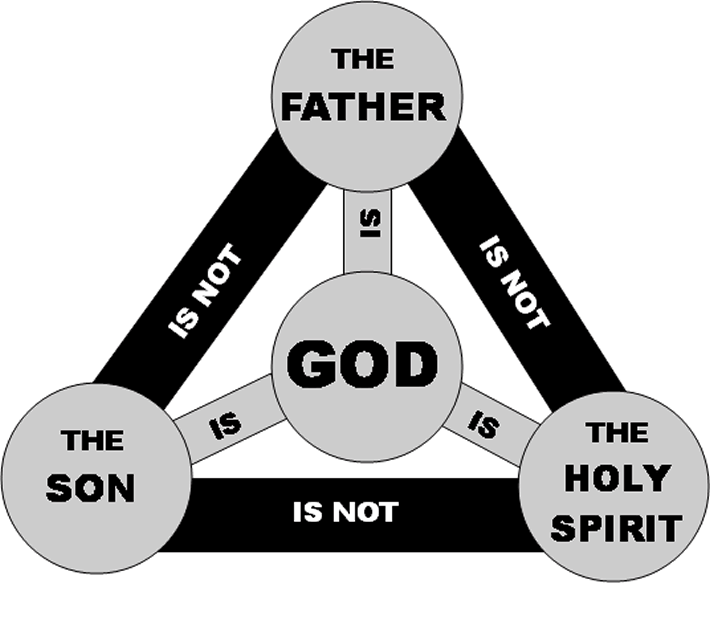
Matthew 28:19b “Baptizing them in the Name of the Father and of the Son and of the Holy Spirit.” Our God, the Three in One, with the term Trinity – while the term “Trinity,” as related to the three Persons (Father, Son & Holy Spirit – Matthew 28:19b) forming the Godhead – Romans 1:20b “Even His Eternal Power and Godhead,…..” is not found in the Scripture, yet the fact of it is clearly evident from the beginning (Book of Genesis) to the end (Book of Revelation). The number “three” has always been associated with the Godhead and Perfect Witness:

  • Matthew 28:19b “Baptizing them in the Name of the Father and of the Son and of the Holy Spirit.”
  • 2Corinthians 13:1b “By the mouth of two or three witnesses every word shall be established.”

Three times the Seraphim cried: “Holy, Holy, Holy” (Revelation 4:8; Isaiah 6:3) – Holy to God the Father, Holy to God the Son (Christ), Holy to God the Holy Spirit. To the “World,” the concept of the “Three-in-One” cannot be comprehended by natural reasoning, nevertheless, to the born-again Believer, accepts by faith and revelation.

Point 1: Divine Benediction

Also, three times the Divine Benediction is given by Moses in Numbers 6:24-27: “The LORD (the Father) bless you and keep you; The LORD (the Son) make His face shine upon you, and be gracious to you; The LORD (the Holy Spirit) lift up His countenance upon you, and give you peace. So, they shall put My Name on the children of Israel, and I will bless them.” This Divine Benediction is affirmed in the N.T – 2Corinthians 13:14 “The grace of the Lord Jesus Christ, and the love of God (the Father), and the communion of the Holy Spirit be with you all. Amen.”

Each of the Divine Benediction in the O.T (Numbers 6:24-26) is twofold: (1) God the Father “bless and keep us;” (2) God the Son “makes His face shine upon us, and be gracious to us;” and God the Holy Spirit “lifts up His countenance upon us, and give us peace;” so that there are two Members of the Godhead in each, while the Name Jehovah (The LORD) is mentioned three times. This marks the “blessing” as being Divine in its Source. No human merit draws forth the Divine Benediction; God’s Grace was the Divine Benediction’s Origin, and God’s Peace was the Divine Benediction’s Result.  

Point 2: Epistle of the Ephesians

A unique feature of the Epistle to the Ephesians is the way in which each chapter emphasises the Truth of the Trinity – the Three Persons of the Godhead are wrapped together in the verse:

  • Ephesians 1:17 “God….the Father of Glory……our Lord Jesus Christ, the Spirit of Wisdom and Revelation (imparted by God’s Spirit).”  
  • Ephesians 2:19-22 “God (the Father),…..Jesus Christ……of God in the Spirit.”
  • Ephesians 3:14, 16 “…The Father…..Lord Jesus Christ,……His Spirit….”
  • Ephesians 4:30, 32 “…Holy Spirit of God…….God (the Father) in Christ…..”
  • Ephesians 5:18, 20”…..the Spirit…..God the Father…..Lord Jesus Christ.”
  • Ephesians 6:6, 17 “….Christ,……God (the Father)……the Spirit….”

Point 3 – Book of Revelation

The Three-in-One Mystery of the Godhead united in the Glorious Work of Redemption – God the Father “Warning” (Revelation 22:18-19); God the Son “Witnessing” (Revelation 22:16); God the Holy Spirit “Wooing” (Revelation 22:17).  

Point 4 – Israel’s Flag

The Official Emblem of Israel’s flag is a “Six-Pointed-Star” known as “the Star of David,” or more correctly “the Shield of David.” The Emblem consists of two Triangles, one pointing upwards and the other Triangle pointing downwards. Many Hebrew Christians interpret this Emblem to Represent the Holy Trinity of the Father, Son and Holy Spirit (Matthew 28:19b), and the Human Trinity of man’s spirit, soul and body (1Thessalonians 5:23). In God’s Sight, “three” is the Perfect Number, expressive of Beginning, Middle and End, and therefore a symbol of Deity.

Point 5 – Operation of the Godhead

The Ministry of the Godhead Operates in three Beneficial Ways:

  • God the Father in the Past Eternity Conceived the Plan of Salvation for the World of Sinners, lost and ruined by Adam’s Fall (Genesis 2:17; Genesis 3:6; Romans 5:12; 1Corinthians 15:22a), yet the Fallen Humanity is loved by Him (the Father – John 3:16).
  • God the Son at Calvary Executed God the Father’s Divine Plan, and by doing so Manifested or Expressed that Love of God the Father’s Heart (1John 4:8 – “God is Love”).
  • God the Holy Spirit, sent by God the Father and God the Son, Reveals the Sacrificial Love of the Father and the Son to the hearts of men (1Corinthians 2:10-12), and He (Spirit) Operates the Divine Plan of Redemption in the lives of those who Repented of their sins and Received Jesus Christ as Lord and Saviour.  

How comforting to know that we are loved by the Three Persons (Father, Son & Holy Spirit) of the Godhead, and we are received as God’s children with Inheritance! (Romans 8:14-17).