Tag: Jesus

Psalms 10:12-18: God’s Intervention

This is a continuation of Psalm 10 1-11: The Portrait of the Wicked

1.3 Call for God’s Intervention

Psalm 10:12-13 is the call for God’s intervention to address the afflictions of the Helpless (Poor). The Psalmist prays for the LORD to act on behalf of the Helpless (Poor), who are the victim of the Wicked. The Psalmist expresses confidence that God will not forget the Helpless (Poor – Weak, defenceless). The Psalmist expresses confidence that God will forget the Helpless (Poor – Weak, Defenceless). Instead, that God will see their troubles.  

1.3.1 Arise O God

Psalm 10:12a “Arise, O LORD! O God, lift up Your hand!” –  Having fully described the words, deeds, and behaviour of the Wicked (Psalm 10:1-11), the Psalmist now abruptly calls upon God to intervene. The Psalmist uses two different Names for God:

  • The LORD (Jehovah), the God of the Covenant.
  • El and Elohim (God), the God of Power.

The Wicked boasts that God will not ask him to give an account of his (Wicked) deeds and attitudes or judge them (Psalm 10:11), but God says: “Be sure your sin will find you out” (Numbers 32:23). The LORD keeps His Covenant Promises to His People, and there will be the Day of Reckoning. 

David in Psalm 7:6 states: “Arise, O Jehovah!” This exclamation: “Arise, O LORD, O God” (Psalm 10:12a), is like that of Numbers 10:35b “Rise up, LORD” and the triumphant march of the Nation of Israel.  The Psalmist in faith calls out to God to Arise. If God does not act, human cruelty will triumph, and the Innocent Poor (Helpless) will suffer.

1.3.2 The Pleads

Psalm 10:12b “Do not forget the humble.” – The Call for God’s Intervention is immediately followed by the Plea to the LORD: Psalm 10:12b “Do not forget the humble.” The Psalmist pleads with God to remember the evil that has been perpetrated against the Humble (Poor/Helpless). The charge that “God has forgotten” will be answered when God Avenges those who have been abused. The word “humble” is the same word translated as “Poor” in Psalm 10:2; or “Helpless” in Psalm 10:10. 

1.3.3 Give Account


First, the question: Psalm 10:13a “Why do the Wicked renounce (reject) God?” The Wicked despises God, or treat God with disregard, by not paying respect to God’s Word, His (God’s) Presence and God’s Character. The Wicked violates God’s Laws, and spurns God’s counsels and entreaties, not fearing God’s judgement., The same thought has already appeared in statement in Psalm 10:3b “The Wicked renounces the LORD.”  


Second, “the Wicked has said in his heart.” (Psalm 10:13b) – This expression is repeated for the third time in Psalm 10 (see Psalm 10:6; Psalm 10:11). The idea is that the rebellious nature of the Wicked comes from within “his heart.” 


Third, “You (God) will not require an account.” (Psalm 10:13c) – The Hebrew is simply “You will not seek:” the idea is, that God would not make an investigation on the Wicked Person’s conduct/actions. The Wicked has the audacity (boldness) to revile (despise) God and think that He will not require himself to give an account of his evil acts against the humble (Poor/Helpless) – The verb “require” is used in Legal Contexts for interrogation or investigation. The Wicked Person thinks that God would not make an investigation/take action on his (Wicked) actions. The Wicked Person acts as if he is not responsible to God, and as if it is a settled point that he would never be called to give God an account.

God will not tolerate that puny man should despise Him. The Wicked has boasted in his presumption that the LORD will not require an account of what he (Wicked) has done. Though God appears to have forgotten, it is not so: “God requires that which is past” (Ecclesiastes.3:15). The LORD sees, knows, and remembers, and will eventually requite (take reprisals for). 

1.4 The Consequences

Psalm 10:14-15 “But You have seen, for You observe trouble and grief, to repay it by Your hand. The Helpless (Poor) commits himself to You; You are the Helper of the fatherless. Break the arm of the Wicked and the Evil Man; seek out his wickedness until You find none.” – In contrast to the Wicked, the Psalmist (David) trusts the Living God, even in times of His (God’s) Silence. While the Wicked claims God’s Ignorance and Absence, he (Wicked) knows otherwise.

God has seen the Pride (Psalm 10:2), the Boasting (Psalm 10:3), the greed (Psalm 10:5a), the murderous spirit (Psalm 10:8), and the oppression and grief of the Poor (helpless – Psalm 10:9-10). The word “spite” (grief) includes “vexation and anger.” The Helpless (Poor) is vexed by the injustice he received. He grieves at his oppression and loss:

1.4.1 God sees

Psalm 10:14a “You (God) have seen.” – The LORD is not standing afar off from the Oppression, for “You (God) have seen” (Psalm 10:14a)

  • This is the most emphatic contradiction that was possible to the Wicked Person’s “He (God) will not see it” (Psalm 10:11). God sees, notes, bears in mind, and never forgets every act of wrongdoing that the Wicked Person commits, and especially acts of oppression.
  • This offers the rebuttal to the Wicked Person who claims God does not see his deeds. That arrogance comes from the assumption God is not interested in his deeds (Psalm 10:11).
  • In the ancient era, orphaned children were arguably the weakest, most vulnerable members of society. Also, in a difficult position were widows. Speaking of God as one who actively helps “the fatherless” refers to His (God’s) immense love and care for even “the least” of mankind. Apostle James encourages his Readers to practice true religion by “visiting orphans and widows in their affliction.” (James 1:27).

However, the Psalmist (David) states that God sees (Psalm 33:13). He (God) grasps every detail of the trouble and grief the Wicked inflicts on the Helpless. The two Hebrew words translated “trouble and grief” combines to cover the physical and emotional suffering. God is not only aware of what evil Wicked Person does; He (God) also knows the anguish the Wicked Person causes.

1.4.2 God’s Justice

Psalm 10:14b “For You observe trouble and grief, to repay it by Your hand.” God is on the side of the Innocent (Poor = Helpless). The Psalmist (David) knows that God will bring justice – Psalm 10:14c “The Poor commits himself unto You (God).”

  • As the Righteous Judge, God is the Helper of the fatherless – Psalm 10:14d “You (God) are the Helper of the fatherless.” 
  • Spurgeon says: “God is the Parent to the Orphans.”
  • Hosea says: “In You the fatherless finds Mercy” (Hosea 14:3). 

Despite the Wicked Person’s arrogance, God has the situation under control (Job 42:2). The Helpless can trust in Him.

  • Peter, in his first epistle to the persecuted and exiled Jewish Christians, he (Peter) encourages his Readers to cast all their anxieties on God, because He (God) cares for them (1Peter 5:7).
  • In Romans 8, Paul assures Believers that nothing can separate us from God’s Love revealed in Christ Jesus. The Believers can depend on the truth that “for those who love God all things work together for good, for those who are called according to His purpose” (Romans 8:28).

God will eventually requite (revenge) – When, at last assize (tried by judge), the Books are open (Revelation 20:11-15), there will be the Divinely accurate account of all that the Wicked has done and God will judge accordingly – “For You (God) behold mischief (trouble) and spite (grief), to requite (consider) it with Your hand” (Psalm 10:14b). God will render justice to the Perpetrator (Wicked Person) of Evil.

1.4.3 Power Broken

Psalm 10:15a “Break the arm of the Wicked and the evil man.” – The Psalmist (David) now turns from the Promise of Mercy for the fatherless to judgment upon Oppressors (Wicked). The Psalmist (David) Prays: “Break the arm of the Wicked and evil man” (Psalm 10:15a). The Arm is a symbol of Strength and Power. The metaphor of “breaking the arm” of the Wicked means rendering him Powerless. If the Arms of the Wicked Person are broken, he cannot continue his attack on the Helpless (Poor).

1.4.4 Final Accounting

Psalm 10:15b “Seek out his wickedness until You (God) find none.” – The Psalmist (David) not only cries that the Strength and the Power of the Wicked be broken but that the LORD would search out every trace of evil in the Wicked Person and judged them, until nothing remains – Psalm 10:15b “Seek out his wickedness until You (God) find none.” As in Psalm 10:13, the verb for “seek” is used in the Legal Sense, “require an account.” When the LORD arises (c/f Psalm 10:12) He (God) will repay the Wicked with judgement and help the fatherless.

God’s apparent distance and silence will be broken, and the question of Psalm 10:1“Why do You stand afar off, O LORD?” will be answered. The persecuted Believer should pray in faith for the LORD to avenge him and cause the Wickedness of Evil Person to be dealt with.

Psalm 10 demonstrates “the whole value system.” The Wicked Person pursues the Helpless (Poor), the Innocent, the Helpless, the Humble, the Orphan (fatherless), while the LORD saves the Helpless (Poor), and Innocent. God is on the side of the defenceless (fatherless), He (God) breaks the alienated of this world. He stands with the “Outsider,” and “Underdog.” 

1.5 Declaration

Psalm 10:16-18 “The LORD is King forever and ever; the Nations (Gentiles) have perished out of His Land. LORD, You have heard the desire of the Humble (Poor = Helpless); You will prepare their heart, You will cause Your ear to hear. To do justice to the fatherless and the oppressed, that the man of the earth may oppress no more.” – As Psalm 10 draws to the close, the Psalmist expresses his Full Confidence that God is in Control. In these final three verses (Psalm 10:16-18), David again used three key terms which he used in Psalm 10: “The Oppressed” (Psalm 10:18); “Do justice” (Psalm 10:16-18); and “the fatherless” (Psalm 10:18). Psalm 10:16-18 is set in the present, entreating God to intervene. 

1.5.1 God’s Sovereignty

Psalm 10:16a “The LORD is King forever and ever.” – The Psalm begins on a note of concern (Psalm 10:1) and concludes on the note of confidence and triumph (Psalm 10:16-18).

First, Psalm 10 ends with a ringing declaration: “The LORD is King forever and ever” (Psalm 10:16a; Psalm 29:10; Psalm 146:10):

  • The LORD Reigns as King. Revelation 4:8, the four Living Creatures cry day and night, “Holy, Holy, Holy, is the Lord God Almighty, who was and is and is to come.” This Eternal Character of God also applies to the Lord Jesus Christ. He states in Revelation 1:8 “I am the Alpha and the Omega….who is and who was and who is to come, the Almighty.”
  • The LORD’s Sovereignty is for all Eternity, is seen throughout all of Scripture.
  • Moses sang the same refrain after Pharaoh’s defeat at the Red Sea: “The LORD shall reign forever and ever” (Exodus 15:18).

The Psalmist’s (David’s) declaration of the LORD’s Kingship expresses not only the Psalmist’s (David’s) confidence in the LORD to vanquish His Enemies but is also declares Israel’s confidence in the LORD. 

Second, the result of God’s Reign: Psalm 10:16b “The Nations (Gentiles) are perished out of His Land.” There is no room in the realm for rebellious Person/Nation:

  • Refers in its immediate context to the expulsion of the Gentiles (góyim) from Palestine.
  • In that day of Messiah’s Glory His Angels will gather out of His Kingdom “All things that offend and them which do iniquity” (Matthew 13:41).

In the O.T., the term “the Nations” is often used as a reference to Gentiles (góyim): those not part of the Nation of Israel. Symbolically “the Nations” represents the separation between those who belong to God and those who defy Him. Since God said that certain lands would belong to Israel (Genesis 12:7; Genesis 15:18-21), The Psalmist (David) is confident opposing Nations would be displaced. Ultimately, this will be fulfilled in the Judgement of Unbelievers and the Gathering of the Redeemed into God’s Eternal Kingdom (Revelation 20:4, 6).

1.5.2 Adoration

Psalm 10:17a, the Psalmist turns confession to adoration: “LORD, You have heard the desire of the Humble” (Psalm 10:17a). With great confidence, the Psalmist (David) now declares that the LORD has heard the Prayer of the Humble (Poor = Helpless). The same word used for “humble” here is translated “Poor” (Helpless) in Psalm 10:9. God knows the need of the “Humble” (“Poor, Helpless”) for intervention and deliverance.

1.5.3 The Lord Strengthen

The Psalmist continues: Psalm 10:17b “You will prepare their heart.” The LORD strengthens the heart of the Humble (Poor = Helpless) to believe that His (God’s) Ear will hear his Prayer and give him the desire of his heart. Here “prepare” means “to establish, make firm, secure.” God both hears and acts and makes the heart of the Poor (Helpless = Humble) secures in Him – Hebrews 11:6“God is the Re-warder of those who diligently seek Him.”

1.5.4 God hears

God inclines His ears to the Prayers of the “Humble” (Poor = Helpless) – Psalm 10:17c “You will cause Your ear to hear.” God graciously bends to hear the cry of the Humble (Poor = Helpless). Even when God does not answer immediately, resulting in the Person’s frustration (Psalm 10:1), Believer can rest in the knowledge that He does, in fact, heard the Believers.  Knowing that God hears us should bring encouragement and strength.

1.5.5 God Judges

The Result is that God will “do justice to the fatherless and the oppressed, that the man of the earth may oppress no more.”” (Psalm 10:18):

  • God will vindicate His People and do Justice to the fatherless and the Oppressed – Psalm 10:18a “To do justice to the fatherless and the oppressed.” The word “judgement” means “justice” – toward the Orphans and the Humble (Poor = Helpless).
  • The time will come when the “man of the earth” will no longer oppress God’s People. God’s judgement to the Oppressors is destruction – “May oppress no more.” God Reigns, Peace Reigns and His (God’s) Land are restored to the Humble (Poor = Helpless).
  • The phrase “man of the earth” (“them that dwell on the earth”) is found often in the Book of Revelation (Revelation 3:10; Revelation 6:10; Revelation 8:13; Revelation 11:10; Revelation 12:12; Revelation 13:8, 12, 14; Revelation 14:6; Revelation 17:2,8) and describes not only where these Unbelievers live but what they live for – the things of the earth. The “Earth-Dwellers” may seem to have the upper hand today, but at the Day of Judgement, they will be the “Sorry-Group-of-People.”
  • Let God’s People rest in this, that the ultimate triumph of the LORD is assured and one day the Oppressor will be no more.

God is always Presence even at times when it seems that the Wicked is triumphing over the Humble (Poor = Helpless). Psalm 10 ends on the Note of Thanksgiving. The LORD in the Greatness of His Everlasting Kingship Reigns: 

  • The Wicked will not oppress us forever, for the LORD will take away the Cup of Trembling from our hands and cause our Oppressor to drink from it (Isaiah 51:22-23).
  • “Vengeance is Mine; I will repay, saith the LORD” (Romans 12:19).

We are not to faint in the time of adversity, as in due time we will see God acting in our behalf against our Enemies. Praise the LORD!

Bibliography

  1. Parallel Bible Commentary.
  2. New Bible Commentary (3rd Edition).
  3. The Wycliffe Bible Commentary.
  4. The Bible Exposition Commentary (Warren W. Wiersbe).
  5. Unger’s Bible Dictionary.
  6. Pictorial Bible Dictionary (Merrill C. Tenney).
  7. Life Application Bible (New International Version).
  8. New Bible Dictionary (2nd Edition).
  9. Concise Bible Dictionary (GBV).
  10. The Pulpit Commentary (Vol.8).
  11. What the Bible Teaches (Psalms – J. Flanigan).
  12. Mastering The Old Testament (Vols 1 & 2 – Donald Williams).
  13. Psalms Books One to Three (Brian J. Bailey).
  14. The Treasury of David (Charles H. Spurgeon).
  15. Psalms of Promise (2nd Edition – E. Calvin Beisner).
  16. Analytical Studies in the Psalms (A.G. Clarke).
  17. Songs of Israel (R.E. Harlow).
  18. Psalms (A Self-Study Guide – Irving L. Jensen).
  19. Psalms Vols 1 & 2 (Tyndale Old Testament Commentaries).
  20. The Messianic Psalms (T.Earnest Wilson).
  21. Psalms for God’s People (Robert K. Johnston).
  22. Psalms Volumes 1 to 3 (Robert L. Alden).
  23. A Guide to The Psalms (W. Graham Scroggie).
  24. Psalms Of Faith (Ray C. Stedman).
  25. Psalms (Vols 1 to 3 – James Montgomery Boice).
  26. The Sufferings and the Glories of the Messiah (John Brown).
  27. Gems from the Psalms (Dr. F. B. Meyer).

Second Psalm – The Messianic (Part 3)

1.4 Submission

Psalm 2:10-12a “Now therefore, be wise, O Kings; be instructed, you Judges of the Earth. Serve the LORD with fear (reverential fear) and rejoice with trembling. Kiss the Son, lest He be angry, and you perish in the way, when His wrath is kindled but a little.” The Admonition of God the Father is to the Kings and Rulers of the Earth, the Executive and Judicial Branches of Government. True wisdom is in submission while there is time and before the judgement falls. If the rebellious men do not bend, they will break. In the light of this, Five Important Instructions are given to the Totality of God’s Requirements:

1.4.1 Be Wise

Psalm 2:10-12a “Now therefore, be wise, O Kings; be instructed, you Judges of the Earth. Serve the LORD with fear (reverential fear) and rejoice with trembling. Kiss the Son, lest He be angry, and you perish in the way, when His wrath is kindled but a little.” The Admonition of God the Father is to the Kings and Rulers of the Earth, the Executive and Judicial Branches of Government. True wisdom is in submission while there is time and before the judgement falls. If the rebellious men do not bend, they will break. In the light of this, Five Important Instructions are given to the Totality of God’s Requirements:

1.4.2 Be Instructed

Psalm 2:10b “be instructed (taught), you Judges of the Earth.” – Be taught by experience, as addressed to the Judicial Officers – if they (Judicial Officers) are not wise enough to know beforehand, that opposition towards God, is futile. Learn the Divine Purpose and Plan concerning His Son, the Anointed One (Jesus Christ). Compare the advice of Gamaliel (Acts 5:38-39). A colloquial translation might render the first two instructions: “Wise up; get smart.” With such enlightened attitudes and divinely illumined spirits they then could Serve, Rejoice, and Kiss (pay homage) to the Son, the Lord Jesus Christ.

1.4.3 Serve the Lord

Psalm 2:11a “Serve the LORD with fear (reverential fear).” – The term “Serve” includes the surrender of the will and the submission of the heart. It means to come under King Jesus’ Rule and to obey Him. The NASB renders Psalm 2:11a: “Worship the LORD with reverence.” In the Old Testament and New Testament, Serve is often used in parallel with the attitude of “Worship” (Deuteronomy 6:13; Deuteronomy 10:20; Matthew 3:10; John 9:31; Romans 1:25):

  • Psalm 100:2 summons us to Worship: “Serve the LORD with gladness; Come before His Presence with Singing.”
  • That Worship means Submission is seen in Psalm 95:6 “Oh come, let us Worship and bow down; Let us kneel before the LORD our Maker.”

The Fear (Reverence) in Service comes from a sense of awe and even terror before God’s Majesty, Power, and Holiness (Exodus 20:18-21).  If the Rebels will not Serve Him (Honour and Obey Him) from love, they will do it from fear, when God’s Wrath is kindled.

1.4.4 Rejoice

Psalm 2:11b “An rejoice with trembling.” – Worship includes joy; do not content with fear. Go on from fear to joy. A good Person “Rejoice in God always” (Philippians 4:4). This joy comes from the God’s Presence: “In Your Presence is fullness of joy” (Psalm 16:11). It is not sentimental, however; it includes the “fear” (reverence) of the previous phrase now manifest by “trembling.” So, such rejoicing must be “with trembling;” or, with reverence, since no service is acceptable to God, but such as is rendered “with reverence and godly fear” (Hebrews 12:28). Fear (Reverential Fear) without joy is torment; and joy without holy Fear (reverence), would be presumption.

Perhaps the typical Charismatic Church needs: “Rejoice with trembling” underscored. We sometimes forget that it is possible to put these two things (“rejoicing with trembling”) side by side. Often when we rejoice, we lose our sense of dignity, and when we fear God, we forget to enjoy our positions of Sonship to rejoice.

1.4.5 Kiss the Son

Psalm 2:12a “Kiss the Son, lest He be angry, and you perish from the way, when His wrath is kindled but a little.” – The attitude of submission to the Lord Jesus Christ and joy and awe in His (Christ’s) Presence leads then to an Act (“Kiss” = Honour) of submission. Kissing the Son is an Act of Worship and Honouring. It is the Sign of Surrender. Thus, the Greek word for Worship, Proskuneó, means “Come toward to Kiss.”

To Surrender to our Lord Jesus, to Rejoice in His Presence, and to Kiss (Worship) Him (Jesus) in an Act of Submission, means that Rebellion is over, and Reconciliation has taken place. Apart from this, there is only His (God’s) Anger, Wrath, and the Perishing.

  • Repentance – In Luke 7:38 it is a Sign of Repentance. The poor woman who came into the house of Simon and stood behind Jesus did five things: She wept, she washed His feet with tears, she wiped them with the hairs of her head, she kissed His feet, and she anointed them with the ointment. The tears and the kiss were evidence of true Repentance. Our Lord Jesus said, “Her sins, which are many, are forgiven; for she loved much.”
  • Forgiveness – The Kiss is also a token of Forgiveness (Luke 15:11-24) the Prodigal Son came back home to his father, and after his confession, received a Kiss of Forgiveness, a ring, a robe, shoes on his feet, and a welcome home banquet.
  • Homage and Loyalty – (Genesis 41:40; 1Samuel10:1). The ARV renders the expression, “with trembling kiss His feet.” The Kissing of Royal feet and hands was a symbol of Homage. The negative example is Judas, who crowned his treachery with a kiss

To “Kiss the Son” means more than to pay homage to Him. It means to embrace Him, depend entirely upon Him; to kiss Him, and not be ashamed of that fact (Song of Sol. 8:1). “Kiss the Son” is the Old Testament way of saying: “Believe on the Lord Jesus Christ, and thou shalt be saved” (Acts 16:31)

1.5 Son

Psalm 2:12a “Kiss the Son.” –  It is interesting to notice that two words for “Son” are used in Psalm 2:

  • Psalm 2:7, the term “Son” is “ben.”It is the Jewish word “Ben-jamine”
  • Psalm 2:12a, the term “Son” is bar.”  It is a Gentile word “Bar-abbas.” 

Why the difference? The first “ben” (Psalm 2:7) is Christ relationship with God as the Son of His Right Hand; the second “bar” (Psalm 2:12a), Christ relation to the Gentile Powers referred to in Psalm 2. At the Crucifixion they cried, away with Him, give us Bar-abbas. The use of the word here would be a stab at their conscience. Judas gave Him the kiss of hypocrisy and treachery, but here the admonition is to Kiss the Son in true Contrition and Repentance. If Psalm 2 was written at the time of the Absolom’s rebellion, what a tragic local reference it has!

1.6 The Pleas

Psalm 2:12a “Kiss the Son, lest He be angry, and you perish from the way, when His wrath is kindled but a little.” – Psalm 2 ends with two Powerful Pleas:

  • God’s Anger“Lest He (God) be angry” – The omission of a customary token of respect is an insult which naturally angers the object of it. The compassion, gentleness, tenderness of Jesus, are sometimes dwelt on to the exclusion of His (Jesus’) Majesty and Righteousness. There is no more greater Warning in the Scripture that the “Wrath of the Lamb” (Revelation 6:16-17).
  • Perish“And ye perish from the Way.” If an Individual refuses, he perishes from the Way (the Lord Jesus Christ – John 14:6); the Individual wanders; he misses the Way (Jesus) and is seriously lost; he perishes as the result of being lost. Professor Cheyne’s rendering is: “You (Individual) goes to ruin.”  To make the Son (Jesus) is to bring destruction on himself or course in life –because of God’s Wrath – “When His (God’s) Wrath is kindled but a little.”

1.7 The Blessings

Psalm 2:12b “Blessed are all they who put their trust in Him.” – Psalm 2 ends of “blessing” echoes Psalm 1:1 and links the two Psalms together. It ends with the phrase described the Believer’s Place of Blessedness. The Person arrives there by putting his trust in God. Psalm 2 ends with the Promise, using the same line of thought with which Psalm 1 begins: “Blessed are all they that put their trust in Him.”

It is foolish to fret and chafe against God’s Government. All Mankind is under Christ, whether in this state of being or in any other. Christ has the Heart of Love as well as the Sceptre of Power; and He rules to Save. Those who will not submit to the Sceptre of Christ’s Grace must feel the weight of His iron rod. True Blessedness is found in submission to Christ; this Blessedness is Greater than Tongue can Express or Heart Conceive.

  • In Psalm 1 we see the Wicked driven away like chaff (Psalm 1:4); in Psalm 2, we see the Wicked (Rebellious) broken in Pieces like the Potter’s Vessel.
  • In Psalm 1, we beheld the Righteous, are blessed and like the Tree planted by the Rivers of Water (Psalm 1:3); and in Psalm 2 we contemplate Christ the Covenant Head of the Righteous, made better than a Tree Planted by the Rivers of Water, for He is made King of the whole Universe, and all the Nations and People will bow before Him (Philippians 2:10).

1.8 Evangelistic

Psalm 2 is Evangelistic. It is addressed to the Nations. It beats with Missionary Heart. It is the Nations who are in revolt against Christ (Psalm 2:2). It is the Nations, however, who are promised to Him (Psalm 2:8). And it is the Nations who are called to Him (Psalm 2:10).

Psalm 2 directs the Nations to the Son (Jesus), warns the Nations of God’s Judgement to come, and Promises the Blessing if the Nations Worship (Serve) Him. Thus, Psalm 2 is for all the Nations and People. It is for the Nations, the Gentiles who submit to God’s Son and King.

In Psalm 2, the learning is: “Serve the LORD with fear, rejoice with trembling,” and “Kiss the Son.” Psalm 2 is also structuring an Evangelistic Invitation. It defines the problem, the Nations’ Revolt.

Psalm 2 offers the Solution: “God’s Son (Jesus).” Psalm 2 warns of judgement to come and calls us to surrender to Him (Jesus) in Worship (Serve). The road back to God the Father is already marked and the Way (Jesus) is open. Christ who stands at the Way, we must come and receive Him….”Kiss the Son.”

Second Psalm – The Messianic (Part 2)

1.2 God’s Reply

Psalm 2:4 “He who sits in the Heavens shall laugh; the LORD shall hold them in derision.” – The picture of God in Psalm 2:4 is an unusual one. He {God} laughs and derides. The laugh seems to be the kind of chuckle a champion gives when his opponent’s defeat is imminent. The derision is probably mixed with the wrath and displeasure described in Psalm 2:5. He {God} laughs at the futility of human actions, but He is angry at the whole idea of man trying to overthrow God

  1. God Laugh Psalm 2:4a “He who sits in the Heavens shall laugh.” –  To begin with, God sits and laughs at the rebellion. Being seated is a sign of His Authority. God’s laughter does not arise from humour. Laugh and derision (root idea, “to stammer”) are anthropomorphisms, meaning that God views puny man’s rebellion as utterly ridiculous and scornful.

    It is a terrible portent (omen) when God laughs. The very idea that puny man can defy the Almighty who has the universe with all its potential in the Palm of His hand is supremely ridiculous. Ballistic missiles and nuclear weapons are as children’s toys to Him. He knows all their secret and more.  This tautology (laughs and derision) is a repetition to show that there is not a doubt to be entertained that all these rebellions can succeed.

    The Lord (Adonai) signifies “My Stays,” or “My Sustainer – My Pillar.”  Our English word, “Lord” hath much the same force, being contracted of the Old Saxon word “Llaford,” or “Hlafford,” which cometh from “Laef,” to sustain, refresh, cherish (Henry Ainsworth).
  2. God’s WrathPsalm 2:5 “Then He (God) shall speak to them in His Wrath, and distress them in His (God’s) deep displeasure.”  – The word “then” has peculiar force; it signifies the termination of the age of man’s apparent freedom and the establishment in the earth of the Divine Purpose.  Then, in the fullness of time, God intervenes with wrath (literally “blow nostril”) and fury (vex, literally “burning anger”).

    Distress them = “Strike terror and dismay into them” (Kay). God, in His sore displeasure of in the heat of His anger. The distressing (vexing) is either by horror of conscience or corporal plagues; one way or the other God will have them.

    The “wrath” in the Book of Revelation is a technical term, indicating the final series of judgements in the 3½ Years Great Tribulation. The Seal Judgements are those that men bring on themselves by their own folly, such as the building up of the nuclear arms, which one day will be unleashed, with a large portion of the World’s Population wiped out and material resources destroyed. The Bowls or Vial Judgements are God’s Wrath, the concentrated Anger of the Almighty poured out on the Seat of the Beasts (Antichrist & false Prophet – Revelation 13) and their Followers.

    It is easy for God to destroy His Enemies. Of thirty Romans Emperors, Governors of Provinces, and other high in office, who distinguished themselves by their zeal and bitterness in persecuting the early Christian:
    • One became speedily deranged after some atrocious cruelty.
    • One was slain by his own son.
    • One became blind.
    • One, whose one of the eyes started out of his head.
    • One was drowned.
    • One was strangled.
    • One died in a miserable captivity.
    • One fell dead in a manner that will not bear recital.
    • One died of so loathsome a disease that several of his Physicians were put to death, because they could not abide the stench that filled his room.
    • Two committed suicides.
    • A third attempted it but had to call for help to finish the work.
    • Five were assassinated by their own People or Servants.
    • Five others died the most miserable and excruciating deaths.
    • Several of them having an untold complication of diseases.
    • Eight were killed in battle, or after being taken prisoners.

      Among these was Julian the Apostate. In the days of his prosperity, he was said to have pointed his dagger to heaven, defying the Son of God, whom he commonly called the Galilean. But when he was wounded in battle, he saw that all was over with him, and he gathered up his clotted blood, and threw it into the air, exclaiming, “Thou hast conquered, O Thou Galilean.” (Wm.S.Plumer)
  3. God’s Purpose Psalm 2:6 “Yet have I set My King upon My holy hill of Zion.”  – Many Liberal Commentators see Psalm 2:6 as referring to David and David only. They call it the Royal Psalm and say it was probably composed for Enthronement of the Monarch. Such limited application, however, is incompatible (mismatched) with the remainder of the Psalm. It cannot be applied to David but to David’s Greater Son, the Lord Jesus Christ. For this reason, and because the inspired Authors of the New Testament understood it, this Psalm speaks of the Commission and Mission of our Lord Jesus Christ, the Messiah.

    The climax, this is God’s unalterable Purpose, and nothing on earth or in hell can thwart it. In the First Section of the Psalm (Psalm 2:1-6), He (Christ) is the Anointed (Psalm 2:2), but here He is the King (Psalm 2:6). This points forward to that day foretold by the Prophets, when, after dealing with God’s Enemies at the Battle of Armageddon (Revelation 16:16), He (Christ) will enter the City at the head of His (Christ’s) Victorious Army and occupy the Hill and the House (Temple). He (Christ) will be the King-Priest on the Throne of His father, David (Psalm 24 and 110; Zechariah 6:13). God regards this in His Purpose as already accomplished – Psalm 2:6 “Yet have I set My King upon My holy hill of Zion.” The Seat of Christ’s Throne is called, “My holy hill of Zion,” in allusion to Zion as the “City of the Living God” (Hebrews 12:22-24).

1.3 The Revelation

Psalm 2:7 “I will declare the decree: the LORD hath said unto Me, Thou art My Son; this day have I begotten Thee.” Jesus’s Sonship, in eternity, as prophesied in Psalm 2:7, is affirmed in Acts 13:33; Hebrews 1:5; Hebrews 5:5. And the term: “the Only Begotten Son” is used five times in the Gospel of John.  

1.3.1 Sonship

Psalm 2:7 “I will declare the decree: the LORD hath said unto Me, Thou art My Son; this day have I begotten Thee.” –  The Revelation of the Son (Jesus Christ). This is one of the Decrees of the Godhead in eternity past and revealed for the first time by the Father {the LORD}. This is one of the Greatest Messianic Passages in the Bible (Scripture).

The Eternal Sonship of the Lord Jesus Christ is one of the most vital, basic doctrines of God’s Written Word (Logos). It is denied by many heretical Cults but held and valued by all those who know and love our Lord Jesus Christ. This is the great passage on which the doctrine (teaching) is based. Another term used only by the Apostle John is “the Only Begotten Son,” the monogeneses. John uses the term “the Only Begotten Son,” five times.

Some Theologians teach that the word “Begotten” must not be understood as referring to any act in time but to what they term an “Eternal Generation.” The word “Day” is explained as “Eternity.” Taken in this way, the Eternal Sonship of the Lord Jesus Christ is safely guarded.

But others maintain that the three places in the New Testament where the words are quoted give the explanation. In view of the definiteness of the term “this day,” it would seem difficult to define it as synonymous with Eternity. It must refer to some special act in what we know as “time.” Here we must be on our guard against those who say that the Lord Jesus Christ only became the Son of God at His Incarnation, they (other Theologians) denied Christ’s Eternal Sonship. The statement in Psalm 2:7 is in two parts:

  • “Thou art My Son.” (Psalm 2:7a) – The Decree in Eternity Past, that is an Eternal Relationship of God the Father with His Son, the Lord Jesus Christ.
  • “This day have I begotten Thee.” (Psalm 2:7b) – That is Messianic, quoted in three Contexts in the New Testament. This Statement “This day have I begotten Thee,” is a declaration of the Incarnation and the Resurrection of our Lord Jesus Christ.

Salutation – At His (Christ’s) birth, He (Christ) was saluted as Son by the Angel (Luke 1:35); by His Father at His baptism (Luke 3:22); and at His Transfiguration (Luke 9:35). In the Synagogue at Pisidian Antioch, Paul applied “You are My Son, today I have begotten You” (Psalm 2:7) to Jesus and His Resurrection (Acts 13:33).

Hebrews 1:5 “For to which of the Angels did He (God the Father) ever say: ‘You are My Son, today I have begotten You?’ And again: ‘I (God the Father) will be to Him (Jesus) a Father, and He (Jesus) shall be to Me (Father) a Son?’” Connects Hebrews 1:5 to Psalm 2:7, to Jesus, to show that as the Son of God He is above the Angels. Hebrews 5:5 “So also Christ did not glorify Himself to become High Priest, but it was He (Father) who said to Him (Jesus): ‘You (Jesus) are My (Father’s) Son, today I have begotten You (Jesus).’” Is quoted in connection with Christ’s Exaltation as our High Priest. The Book of Revelation also sees Psalm 2 fulfilled Eschatologically in the Final Triumph of Christ’s Kingdom (Revelation 2:26-27).

Summary: The two Statements of Psalm 2:7 indicate: “Thou art My Son,” and “This day have I begotten Thee,” – reveals a unique Eternal Relation of the Father to the Son (Jesus), both in the acknowledgement and salutation, a term in association of Jesus’ Eternity, Incarnation, Baptism, Transfiguration, Resurrection, High Priesthood, and Second Coming

1.3.2 Inheritance

Psalm 2:8-9“Ask of Me, and I will give Thee the Nations for Thine inheritance, and the uttermost parts of the earth for Thy possession. Thou shalt break them with a rod of iron; Thou shalt dash them in pieces like a potter’s vessel.” – Father’s threefold Promises to His Son, Jesus:

  • The Nations for His (Jesus’) Inheritance.
  • The Uttermost Parts of the Earth for His (Jesus’) Possession.
  • Rulership and Authority – Thou shalt break them with a rod of iron; Thou shalt dash them in pieces like a potter’s vessel.” It is noted that there is a similar warning made by the LORD of Hosts against Jerusalem in the Book of Jeremiah (Jeremiah 19:11), and that under the New Covenant the same Warning in the Book of Revelation (Revelation 2:27; Revelation 12:5; Revelation 19:15). In truth, both Covenants (O.T & N.T.), are alike in announcing God’s Wrath on rebellious People and Nations.

The Nations and the People that do not submit to Christ’s Rulership would be subjected to the iron discipline (“rod”) and the final overthrow (“dash them in pieces”). The Christian’s share in subjugating the Nations to Christ is expressed in Revelation 2:27. In Christ’s Millennial Kingdom the Lord Jesus’ Enemies will be subject to His terrible Power (Job 4:9; 2Thessalonians 2:8), just as His People are to His Profound Grace (Psalm 110:2-3). Christ deals with the Nations as Righteous Judge.

This points forward to the Day when our Lord Jesus shall Return to Reign. The Shepherd’s rod, symbolising Authority, and Rule, but to His (Christ’s) People will be the Golden Sceptre, but to the rebel Nations at Armageddon will be the “Rod of Iron” (Revelation 2:27; Revelation 12:5; Revelation 19:15; Psalm 110:2).

Stay Tuned….. To be continued

Second Psalm – The Messianic (Part 1)

1.0 Statement

Psalm 2 is called the Messianic Psalm because it speaks of the Person and Work of our Lord Jesus Christ. The question may be asked: “How can we recognise a Messianic Psalm?”  The answer would be where there is a reference to the Messiah in a Psalm, and it is applied to Christ and expounded in the New Testament.

  • Sometimes a whole Psalm applies to Christ for example, Psalm 22.
  • Sometimes a paragraph for example, Psalm 40:6-10.
  • Sometimes several verses for example, Psalm 69:4, 9,21.
  • Sometimes a single verse for example, Psalm 41:9.

It is obvious that some of the Psalms are occupied entirely with the Person, the thoughts, and feelings of our Lord Jesus, while others clearly refer to the experience of the Psalmist, and then there is included an isolated reference to the Messiah. Psalm 69 is an example. David exclaims: “O God, You knows my foolishness, and my sins are not hid from Thee,” he (David) obviously is referring to himself in Psalm 69:5. But when he (David) says: “They gave Me…..gall for My meat; and in My thirst they gave Me vinegar to drink” (Psalm 69:21), these words are applied to Christ in Matthew 27:34-48, they are clearly Messianic.

So, we must be careful to distinguish between the spiritual experience of the Writer of the Psalm and the Prophetic Reference to Christ Himself. While keeping in mind this rule, that a quotation in the New Testament from a Psalm, which applies it to the Lord Jesus, confirmed it as Messianic, there are three Psalms which are exceptions. They are obviously Messianic but are not quoted in the New Testament:

  • Psalm 24 Speaks of the King of Glory.
  • Psalm 72 Outlines the Millennial Reign of Christ.
  • Psalm 89 Expounds the Davidic Covenant fulfilled by David’s greater Son, the Messiah, the Lord Jesus Christ.

It is noted that the reference to the Messiah in the Psalms (16 numbers) do not follow the sequence or in chronological order. Psalm 2 is an introduction to the whole collection, giving the Prophetic Outline of the Glories of the Messiah. Psalm 40 refers to His (Christ’s) Incarnation; Psalm 22 to His Crucifixion; Psalm 16 to His (Christ’s) Resurrection. The Writer (R/S) rearranged the Sixteen Messianic Psalms in Chronological Order, for impact:

  1. Psalm 2 – The Glory of the Eternal Son, the Lord Jesus Christ.
  2. Psalm 40 – The Incarnation of the Lord Jesus Christ.
  3. Psalm 91 – The Temptation of the Lord Jesus Christ.
  4. Psalm 41 – The Betrayal, by Judas Iscariot, on the Lord Jesus Christ.
  5. Psalm 22 – The Crucifixion of the Lord Jesus Christ.
  6. Psalm 69 – The Trespass Offering of the Lord Jesus Christ.
  7. Psalm 16 – The Resurrection of the Lord Jesus Christ.
  8. Psalm 68 – The Ascension of the Lord Jesus Christ.
  9. Psalm 45 – The King-Bridegroom.
  10. Psalm 24 – The King of Glory, the Lord Jesus Christ.
  11. Psalm 110 – The Priest-King-Judge, the Lord Jesus Christ.
  12. Psalm 8 – The Last Adam, the Lord Jesus Christ (1Corinthians 15:45).
  13. Psalm 72 – The Millennial Reign of the Lord Jesus Christ (Revelation chapter 20).
  14. Psalm 89 – The Davidic Covenant, Jesus, David’s Greater Son (Revelation 22:16b).
  15. Psalm 102 – The Unchangeable One, the Lord Jesus Christ.
  16. Psalm 118 – The Headstone of the Corner, the Lord Jesus Christ.

Psalm 2 has no Superscription or Title. Psalm 1 and Psalm 2 are linked together in the Hebrew Bible. They are an Introduction and a Preface to the Psalms as a whole. It alerts us to the fact that here we are not only dealing with our Devotional Life and Personal Destiny (Psalm 1), but also with the whole Purpose of God in History and the Destiny of the Nation of Israel and the World (Psalm 2). 

NoPsalm 1Psalm 2
1Psalm 1 begins with “the blessed,” the beatitudes (Psalm 1:1)Psalm 2 ends with “the blessed,” the beatitude (Psalm 2:12)
2Psalm 1 gives us God’s Word as the Conceptual Framework for our Mediation.Psalm 2 gives us the movement of that Word in History and its Interpretive Key: “Yet I have set My King upon My Holy Mountains.
3Psalm 1 deals with the Word.Psalm 2 deals with the World.
4Psalm 1 contrasts the Righteous with the Ungodly.Psalm 2 contrasts the Nations with their Divine Ruler.
5Psalm 1 deals with the Personal Life.Psalm 2 deals with the Historical Life.
6Psalm 1 deals with the Individual.Psalm 2 deal with the Universal.

Together (Psalm 1 and Psalm 2) form an admirable introduction to the whole 150 Psalms.  There is a certain correspondence between the Psalm 1 and Psalm 2 – in both the main idea and shows the conflict between the Righteous and the Wicked:

  1. Psalm 1 sets forth this conflict by a contrast between two types of Individuals. Psalm 2 shows the two Kingdoms of Light and Darkness, engaged in their internecine (mutually, destructive, and deadly) conflict.
  2. Psalm 1 deals with the two Ways for an Individual’s Life and Psalm 2 sets forth the two Ways for Nations and Peoples.
  3. Psalm 1 speaks of the two Ways of Man, measured by relationship to God’s Word {Law} and Psalm 2 speaks of the two Ways, measured by relationship to God’s Son, the Lord Jesus Christ:
    • Psalm 1 – “The Counsel of the Ungodly” (Psalm 1:1).
    • Psalm 2 – “The Council Chambers of the Ungodly” (Psalm 2:1-2).
    • Psalm 1 – “The Counsel of God – The Law (God’s Word – Psalm 1:2).
    • Psalm 2 – “The Throne of God (Psalm 2:6).
  4. The Typologies as shown in Psalm 1 and Psalm 2, in comparison and in contrast:
    • In Psalm 1 we see Christ’s Moral Glory and in Psalm 2 we see Christ’s Divine Glory.
    • In Psalm 1 we see Christ’s Humanity, the Happy Man, occupied with the Law {Word} of God, a Tree, and Rivers and in Psalm 2 we see Christ’s Deity, The King, ruling the Nations with a rod of iron.
  5. Psalm 2 is considered as the Messianic Psalm – The word “Anointed” in Psalm 2:2 means “Messiah” in the Hebrew and “Christ” in the Greek. When Paul preached to the Jews of Antioch in Pisida, he cited Psalm 2:7 in (Acts 13:33). This is the only numbered reference to any Old Testament passage, in the New Testament. The New Testament Writers (Peter and Paul) interpreted Psalm 2 “The LORD’s Anointed” to Jesus Christ (Acts 4:25-27; Acts 13:33).
  6. Psalm 2 is quoted Seven Times in the New Testament:
    • Twice in the Book of Acts (Acts 4:24-28; Acts 13:33).
    • Twice in the Book of Hebrews (Hebrews 1:5; Hebrews 5:5).
    • Three times in the Book of Revelation (Revelation 2:7; Revelation 12:5; Revelation 19:15).
    • All these references are applied to the Messiah, the Lord Jesus Christ, giving us our authority for calling Psalm 2, “The Messianic Psalm.”
  7. There are Four Official Messianic Titles used in Psalm 2
    • The Anointed (Psalm 2;2; Acts 4:26,27).
    • My King (Psalm 2:6).
    • My Son (Psalm 2:7; Acts 13:33; Hebrews 1:5; Hebrews 5:5).
    • The LORD (Psalm 2:11).
  8. King David is the Author of Psalm 2 – Psalm 2:1 “Why do the heathen rage, and the peoples imagine a vain thing?” –  Acts 4:25 “Who, by the mouth of thy Servant, David, hast said, why did the heathen rage, and the peoples imagine vain things?”  Paul also confirmed it as Psalm 2 – Psalm 2:7 “I will declare the decree: The LORD hath said unto me, Thou art My Son; this day have I begotten Thee.” – Acts 13:33 “God hath fulfilled the same unto us their children, in that He hath raised up Jesus again; as it is also written in the Second Psalm, Thou art My Son, this day have I begotten Thee.”

Psalm 2 has 12 Verses, divided into four Sections of three Verses each. There are four Speakers, one in each Section:

  • The Rebels Speak – Man in Revolt (Psalm 2:1-3).
  • The Father Speaks – God in His Wrath (Psalm 2:4-6).
  • The Revelation of the Son (Psalm 2:7-9).
  • The Spirit’s Call to Submission (Psalm 2:10-12).

It is the Answer of the Triune God to the Anarchy of Human Race.

1.1 Man’s Rebellion

The Opening Psalm 2:1-3, describes the actions of ungodly men, in general and specific terms and with progressively more detail.

  • The Psalmist indicts the Nations and the People in Psalm 2:1.
  • The Psalmist indicts the Leaders of the People in Psalm 2:2.

Their deeds are described in Psalm 2:1 as generally mad and futile but are narrowed down in Psalm 2:2 to a specific plot to overthrow God and His Christ (Anointed).

Psalm 2:3 gives the details of this evil plot – Psalm 2:1-3 “Why do the heathen rage, and the people imagine a vain thing? The Kings of the earth set themselves, and the Rulers take counsel together against the LORD, and against His Anointed, saying: Let us break their bands asunder, and cast away their cords from us.”

1.         The Question – The Questions Psalm 2:1“Why do the Heathen rage, and the People imagine a vain thing?”  are rhetorical not analytical; for any revolt against God is regarded as baseless. The Collective Power of Nations and People can only plot in vain. The point of the questions is to demonstrate the absurdity of those who would rebel against the Rulership of the Almighty. Their Rebellion was against God and His Christ. 

2.         The Application – Psalm 2:1-3 “Why do the heathen rage, and the people imagine a vain thing? The Kings of the earth set themselves, and the Rulers take counsel together against the LORD, and against His Anointed, saying: Let us break their bands asunder, and cast away their cords from us.” – Apostle Peter applies the words in Psalm 2:1-3 to the Crucifixion of the Lord Jesus Christ, in Acts 4:27-28: “For of a truth against Thy Holy Child Jesus whom Thou hast Anointed, both Herod, and Pontius Pilate, with the Gentiles, and the People of Israel, were gathered together, for to do whatever Thy hand and Thy Counsel determined before to be done.”  This is the Primary Application of Psalm 2:1-3, but it has the Prophetic Application as well. Here we have a fourfold Coalition of Power united against Almighty God and His Christ:

  • The Nations – The whole world organised against the Lord Jesus in deliberate opposition to His Rule – “The Kings of the earth set themselves (draw themselves up in array), and the Rulers take counsel together against the LORD, and against His Anointed.”
  • Israel – The “People,” the Nation of Israel.
  • Government, Gentile Organised Government represented by Herod.
  • Judicial Power represented by Pontius Pilate.

The Confederacy (the Nations, Israel, Government, and Judicial Power) at the Cross of Jesus Christ, foreshadows another at the End of the Age. They imagined “a vain thing,” that they can overthrow God! The words “take counsel” and “set themselves” indicate the deliberate adoption of the policy, the passing of the resolution. It is the overthrow of Law and Order, the underwriting of the hardened outburst against God.

3.         Five Resistance – Five forms of Resistance to the Rulership of God’s Anointed (Christ) are indicated – Psalm 2:1-2 “Why do the Nations rage, and the People plot a vain thing? The Kings of the Earth set themselves and the Rulers take counsel together, against the LORD and against His Anointed, saying, let us break their bonds in pieces and cast away their cords from us.”

  • Raging – Tumultuous Agitation, as when waves of ocean are lashed to fury (Psalm 2:1a).
  • Imagining (Psalm 2:1b)– Meditating (same word as in Psalm 1:2). Turning over and over in the mind some Plan of Opposition. The same Hebrew word lies behind the “meditate” of Psalm 1:2 as the word “imagine” in Psalm 2:1. Whereas the Godly Person uses his mental energy delighting in God’s Word, the Ungodly Leaders use theirs to plot against God’s rule. This description of the unfortunate and uninformed state of the unregenerate mind is not unique to 1000 B.C. when David lived. The same thought patterns prevail openly today.
  • Setting themselves – The Result of the Meditation in the Resolution, in opposition.
  • Taking Counsel Together – For Combined and Concerted Action, of the fourfold Coalition of Powers (Nations, Israel, Government {Gentiles}, Judicial).
  • Saying, etc – Agitation, meditation, resolution, concerted actions taking effect in a verbal utterance: Psalm 2:3 “Let break their bands asunder and cast away their cords from us.” The World is at Enmity with God, and Rulers and ruled alike seek to escape God’s Demands on our lives. The People of the Work seeks to outwit the Creator {God} and to undo the Mission of the Lord Jesus Christ.

4.         Breaking the Bands

Psalm 2:3 “Let us break their bands asunder and cast away their cords from us.” – The rebellious People wanted to be free from God’s Restraining Goodness because they wanted to do the things in their own manner, ridding of themselves of all restraints.

  • The rebellious Coalition of Four (Nations, Israel, Government, Judiciary), chafed at them, fret against them, and, in the last resort – so far as their will goes – wholly throw them of.
  • “Bands” and “cords” are the fetters that restrain. The Law of God restraints our evil ways of which the four Coalition Powers, desire to cast off and assert their absolute freedom – Psalm 2:3 “Let us break their bonds in pieces and cast away their cords from us.”
  • The Heathen Rage and constantly devises ways to thwart God’s Purposes, of the Law of God, the Bible, and all Principles concerning morals, marriage, and relationships, etc., are to be rejected.
  • Man is the Maker of his own destiny and “situation ethics” is to be the rule of life. All bands and cords of their relationship and responsibilities with God are to be thrown away; modern man is to be liberated from all restraint.?
  • Even today there are straws in the wind which indicate what will happen at the End of the Age, when all the restraints are down. – 2Thessalonians 2:9 “The coming of the Lawless One (Antichrist) is according to the working of Satan, with all power, sings and lying wonders.”  
  • It starts in the home where the child instead of the Parents rule. It continues in the school, where it is illegal to discipline with the rod, and where the evolution and Hegelian (hedonism – pleasure seeking) philosophy is taught by Apostate Teachers.
  • It increases in the social sphere, where the gay generation openly claims license for unnatural sex, abortion has been legalised in some countries. And unisex breaks down the distinction between man and woman.

If these things take place while the Holy Spirit Restraints (2Thessalonians 2:7), what will it be when He (Holy Spirit) is removed? Today the Mystery of Iniquity is already working, but it will be revealed in all its lurid (explicit) wickedness when the avalanche breaks forth.

  • Story – The French Revolution of 1798 was a little foretaste of it, when a harlot was enthroned in Notre Dame, and again in 1917 after the Bolshevik Revolution, when millions were liquidated, and godless atheism took over.
  • Psalm 2 points forward to that day when the Satanic Trinity (Satan, Antichrist, and false Prophet), the two wild Beasts of Revelation 13, backed by the Devil himself, will proclaim a decree prohibiting the Worship of God and His Christ, our Lord Jesus Christ (2Thessalonians 2:3-4; Revelation 13:4-8: Revelation 12:17). Those who refuse to obey, to carry his mark, and to worship the image of the “Man of Sin” will be executed. This will be the climax of the work of the organised World Powers and the final fulfilment of the first Section (Psalm 2:1-3) of Psalm 2.

To be Continued….. Stay Tuned…..

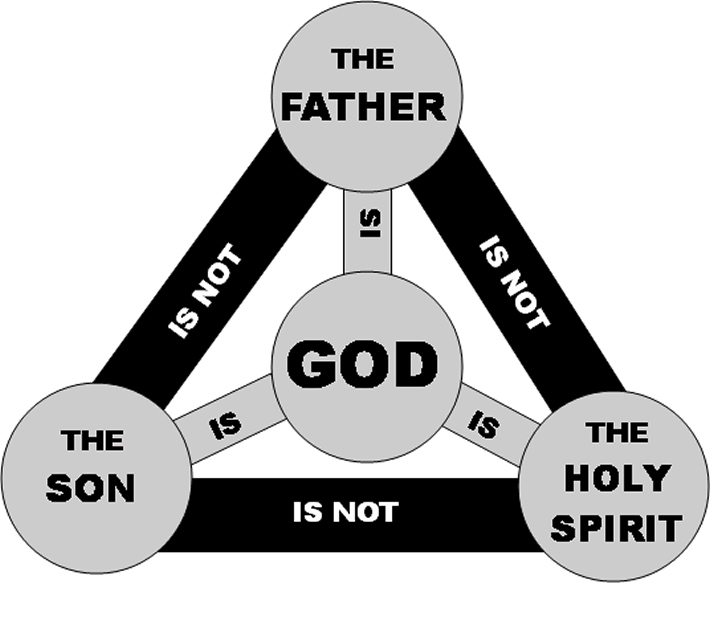
The Trinity (Matthew 28:19b) (Part 1)

The Statement

Matthew 28:19b “Baptizing them in the Name of the Father and of the Son and of the Holy Spirit.” Our God, the Three in One, with the term Trinity – while the term “Trinity,” as related to the three Persons (Father, Son & Holy Spirit – Matthew 28:19b) forming the Godhead – Romans 1:20b “Even His Eternal Power and Godhead,…..” is not found in the Scripture, yet the fact of it is clearly evident from the beginning (Book of Genesis) to the end (Book of Revelation). The number “three” has always been associated with the Godhead and Perfect Witness:

  • Matthew 28:19b “Baptizing them in the Name of the Father and of the Son and of the Holy Spirit.”
  • 2Corinthians 13:1b “By the mouth of two or three witnesses every word shall be established.”

Three times the Seraphim cried: “Holy, Holy, Holy” (Revelation 4:8; Isaiah 6:3) – Holy to God the Father, Holy to God the Son (Christ), Holy to God the Holy Spirit. To the “World,” the concept of the “Three-in-One” cannot be comprehended by natural reasoning, nevertheless, to the born-again Believer, accepts by faith and revelation.

Point 1: Divine Benediction

Also, three times the Divine Benediction is given by Moses in Numbers 6:24-27: “The LORD (the Father) bless you and keep you; The LORD (the Son) make His face shine upon you, and be gracious to you; The LORD (the Holy Spirit) lift up His countenance upon you, and give you peace. So, they shall put My Name on the children of Israel, and I will bless them.” This Divine Benediction is affirmed in the N.T – 2Corinthians 13:14 “The grace of the Lord Jesus Christ, and the love of God (the Father), and the communion of the Holy Spirit be with you all. Amen.”

Each of the Divine Benediction in the O.T (Numbers 6:24-26) is twofold: (1) God the Father “bless and keep us;” (2) God the Son “makes His face shine upon us, and be gracious to us;” and God the Holy Spirit “lifts up His countenance upon us, and give us peace;” so that there are two Members of the Godhead in each, while the Name Jehovah (The LORD) is mentioned three times. This marks the “blessing” as being Divine in its Source. No human merit draws forth the Divine Benediction; God’s Grace was the Divine Benediction’s Origin, and God’s Peace was the Divine Benediction’s Result.  

Point 2: Epistle of the Ephesians

A unique feature of the Epistle to the Ephesians is the way in which each chapter emphasises the Truth of the Trinity – the Three Persons of the Godhead are wrapped together in the verse:

  • Ephesians 1:17 “God….the Father of Glory……our Lord Jesus Christ, the Spirit of Wisdom and Revelation (imparted by God’s Spirit).”  
  • Ephesians 2:19-22 “God (the Father),…..Jesus Christ……of God in the Spirit.”
  • Ephesians 3:14, 16 “…The Father…..Lord Jesus Christ,……His Spirit….”
  • Ephesians 4:30, 32 “…Holy Spirit of God…….God (the Father) in Christ…..”
  • Ephesians 5:18, 20”…..the Spirit…..God the Father…..Lord Jesus Christ.”
  • Ephesians 6:6, 17 “….Christ,……God (the Father)……the Spirit….”

Point 3 – Book of Revelation

The Three-in-One Mystery of the Godhead united in the Glorious Work of Redemption – God the Father “Warning” (Revelation 22:18-19); God the Son “Witnessing” (Revelation 22:16); God the Holy Spirit “Wooing” (Revelation 22:17).  

Point 4 – Israel’s Flag

The Official Emblem of Israel’s flag is a “Six-Pointed-Star” known as “the Star of David,” or more correctly “the Shield of David.” The Emblem consists of two Triangles, one pointing upwards and the other Triangle pointing downwards. Many Hebrew Christians interpret this Emblem to Represent the Holy Trinity of the Father, Son and Holy Spirit (Matthew 28:19b), and the Human Trinity of man’s spirit, soul and body (1Thessalonians 5:23). In God’s Sight, “three” is the Perfect Number, expressive of Beginning, Middle and End, and therefore a symbol of Deity.

Point 5 – Operation of the Godhead

The Ministry of the Godhead Operates in three Beneficial Ways:

  • God the Father in the Past Eternity Conceived the Plan of Salvation for the World of Sinners, lost and ruined by Adam’s Fall (Genesis 2:17; Genesis 3:6; Romans 5:12; 1Corinthians 15:22a), yet the Fallen Humanity is loved by Him (the Father – John 3:16).
  • God the Son at Calvary Executed God the Father’s Divine Plan, and by doing so Manifested or Expressed that Love of God the Father’s Heart (1John 4:8 – “God is Love”).
  • God the Holy Spirit, sent by God the Father and God the Son, Reveals the Sacrificial Love of the Father and the Son to the hearts of men (1Corinthians 2:10-12), and He (Spirit) Operates the Divine Plan of Redemption in the lives of those who Repented of their sins and Received Jesus Christ as Lord and Saviour.  

How comforting to know that we are loved by the Three Persons (Father, Son & Holy Spirit) of the Godhead, and we are received as God’s children with Inheritance! (Romans 8:14-17).

Father into Your Hands I Commend My Spirit (Luke 23:46)

1.0 The Statement

Jesus Seventh Statement from the Cross reveals to us about Death and how Jesus died – Luke 23:46 “And when Jesus had cried out with a loud voice, He said, ‘Father, into Your hands I commit My spirit.’ Having said this, He breathed His last.” Five Characteristics of Christ’s Death encouraged us of our Salvation in our Lord Jesus:

1.1 Christ’s Death was Determined

The Death of Jesus Christ was determined for Him beforehand – Acts 2:23 “Him, being delivered by the determined purpose and foreknowledge of God, you have taken by wicked hands, have crucified and put to death.” (Acts 4:28). Jesus, the Lamb of God (John 1:29, 36) was slain from the Foundation of the World – Revelation 13:8b “The Lamb slain from the foundation of the world.” Thus, before Adam was created – the Fall of Adam was anticipated. Before Sin entered the world, Salvation from it had been planned by God (Acts 2:23).

In the Eternal Counsel of the Godhead, it was fore-ordained that Jesus Christ, will be the God-Man, the Saviour, that will die for Sinners (Philippians 2:6-8; Hebrews 5:8). Thus, Christ’s Death is the “Undergirding of the Cross.”

1.2 No Bones were Broken

Luke 23:46b “Father, into Your hands I commit My spirit.’ Having said this, He breathed His last.” – Some people taught that Jesus’ Death was an illusion, but this was not the case; Jesus died, as John recorded that the Roman Officials checked very carefully to be sure that Jesus had died. When the Soldiers came to look at the bodies on the crosses, they discovered that Jesus was already dead (John 19:330; thus, the Soldiers did not break His legs in fulfilment of the Prophecy: 

  • Psalm 34:20 “He guards all His bones; not one of them is broken.”
  • John 19:33, 36 “But when they (soldiers) came to Jesus and saw that He was already dead, they did not break His legs…..For these things were done that the Scripture should be fulfilled, ‘Not one of His bones shall be broken.’”
  • Exodus 12:46 “In one house it shall be eaten; you shall not carry any of the flesh outside the house, nor shall you break one of its bones.”
  • Numbers 9:12 “They shall leave none of it until morning, nor break one of its bones. According to all the ordinances of the Passover they shall keep it.”
  • Psalm 22:17a “I can count all My bones.”

When Joseph and Nicodemus wanted to get custody of Christ’s Body, to give Christ a decent burial, they must check with Pilate, and Pilate marvelled that Jesus was already dead (Mark 15:44). Thus, the official evidence of the Roman Empire was that Jesus had died. The evidence of the Gospel Writers is that Jesus had died; Jesus tasted death for every Person. Jesus tasted the full experience of death – Jesus confronted the last Enemy – Death – and courageously faced its sorrow, its trial, its pain and its finality – Jesus had victory over Death (2Timothy 1:10; Isaiah 25:8; Hosea 13:14; 1Corinthians 15:24-26; Hebrews 2:14; Revelation 20:14; Revelation 21:4; Luke 20:35-36; 2Corinthians 5:1-2; John 11:43-44; Romans 1:4; Revelation 1:18; John 5:28-29; 1Corinthians 15:25-26; Acts 2:27). Thus, our Eternity in Christ is Secured!

1.3 Christ Died Confidently

a. Jesus died confidently Luke 23:46b “Father, into Your hands I commit My spirit.’ Having said this, He breathed His last.” 

  • Father’s Presence – Jesus died confidently because He had the Father’s Presence – He addressed His Father, three times on the Cross:
  • Jesus’ First Word from the Cross: “Father, forgive them; for they know not what they do.” (Luke 23:34).
  • Jesus’ Fourth Word “My God, My God, why hast Thou forsaken Me?” (Matthew 27:46; Psalm 22:1).
  • Jesus’ Seventh Word: “Father, into Thy hands I commit My spirit.” (Luke 23:46). At the beginning, in the middle and at the end of His ordeal, our Lord Jesus addressed to His Father.

Jesus died confidently because He had the Father’s Presence – He addressed His Father, three times on the Cross:

b. Father’s Promise – Jesus had the Father’s Promise, as prophesied in Psalm 31:5 “Into Thine hand I commit My spirit: Thou hast redeemed Me, O Lord God of truth.” Psalm 31:5 is the O.T. Promise, Jesus applied it to Himself; but He (Jesus) changed it, and since He is the Author of the Word, He can do this. He added the address, “Father,” but He omitted the phrase about being redeemed: “Thou hast redeemed Me, O Lord God of truth.” – Jesus did not have to be redeemed because He never sinned, and it was not necessary for Him to be redeemed. When He died, He claimed God’s Word and entrusted Himself to His Father.

c. Father’s Fulfilment – Jesus fulfilled the Scripture – All of Jesus’ three Prayers from the Cross are tied to Prophecy of the Scripture:

  • When Jesus prayed: “Father, forgive them; for they know not what they do.” (Luke 23:34), was in fulfilment of Isaiah 53:12 “He….made intercession for the transgressors.”
  • When Jesus cried: “My God, My God, why hast Thou forsaken Me.” (Matthew 27:46). Jesus was quoting Psalm 22:1.
  • When Jesus cried out: “Father, into Thy hands I commit My spirit.” (Luke 23:46), Jesus was quoting part of Psalm 31:5.

Thus, Our Lord Jesus lived by God’s Word, and died by God’s Word. Jesus’ Assurance was His Father’s Promises in His Word.

d. Father’s Protection – Jesus has the Assurance and Protection of His Father – Luke 23:46b “Father, into Your hands I commit My spirit.’ Having said this, He breathed His last.” – For many hours our Lord Jesus had been in the hands of the Roman Soldiers, the Jewish Religious Leaders, and the People, experiencing their mocking (Luke 23:35-39; Matthew 27:49; Psalm 22:7-8). Jesus told His Disciples, “I am going to be delivered into the hands of the Sinners.” (Matthew 16:21; Luke 24:7; Matthew 26:45; Mark 14:41).

  • The Sinners took hold of Jesus and bound Him (Matthew 26:57; 27:2).
  • The Sinners stripped Him (Matthew 27:28).
  • The Sinners put a crown of thorns upon His head (Matthew 27:29).
  • The Sinners spit on Him and struck Him (Matthew 27:30; Isaiah 50:6).
  • The Sinners pulled out Jesus’ beard (Isaiah 50:6).
  • The Sinners nailed Him to the Cross, and crucified Him (Matthew 27:31, 35a).
  • The Sinners pierced His side (John 19:34).

But when He (Jesus) approached the End of His Ordeal of the Sacrificial Redemptive Work on the Cross, Jesus was no longer in the hands of the Sinner, but in His Father’s Hands – Luke 23:46b “Father, into Your hands I commit My spirit.’ Having said this, He breathed His last.” As prophesied in Psalm 31:8 “Thou hast not shut Me up into the hands of the enemy.” And Psalm 31:15 “My times are in Thy hand: deliver Me from the hands of Mine enemies, and from them that persecute me.” Thus, our security is in both, Jesus’ Hands, and the Father’s Hands – the double security – John 10:28-29 “And I give them Eternal Life, and they shall never perish; neither shall anyone snatched them out of My hand. My Father, who has given them to Me, is greater than all; and no one is able to snatch them out of My Father’s hand.”

1.4 Christ Died Willingly

Christ died Confidently, and Christ died Willingly – In one sense, Jesus was killed – Peter said: “Him…you have taken, by wicked hands have crucified and slain” (Acts 2:23); but in another sense, Christ was not killed, for He died willingly, laid down His Own Life:

  • Hebrews 5:8 “Though He (Jesus) was the Son, yet He learned obedience by the things which He suffered.”
  • Philippians 2:6-8 “Who (Jesus), being in the form of God, did not consider it robbery to be equal with God, but made Himself of no reputation, taking the form of a bondservant, and coming in the likeness of Man. And being found in appearance as a Man, He humbled Himself and became obedient to the point of death, even the death of the cross.”
  • John 10:17-18 “Therefore does My Father love Me, because I lay down My life, that I might take it again. No man takes it from Me, but I lay it down of Myself. I have power to take it again.”   

Thus, our Lord Jesus died willingly in obedient to the Father’s Will. This is an amazing event! No O.T. sacrifices ever died willingly. No lamb, goat, or sheep, birds, etc., ever willingly gave its life. But Jesus willing laid down His Life as God’s Lamb (John 1:29, 36). Jesus willingly laid down His Life on our behalf (John 3:16).

1.5 Christ Died Victoriously

Luke 23:46b “Father, into Your hands I commit My spirit.’ Having said this, He breathed His last.” Jesus Confidently, Jesus died Willingly, and Jesus died Victoriously, for He cried out: “Father, into Your hands I commit My spirit.’ Having said this, He breathed His last.” (Luke 23:46b). Our Lord Jesus Christ accomplished the Work that God the Father gave Him to do, and when He gave up His Spirit, several miracles took place:

  • The Veil of the Temple was torn in two, from top to bottom – Matthew 27:51a. “Then, behold, the veil of the temple was torn in two from the top to bottom.” – Thus, God opened the way for us into His Presence (Hebrews 10:19-20).
  • Some Graves were opened, and some of the Dead Saints were Resurrected (Matthew 27:52).
  • Satan and the Satanic Hosts were defeated – Colossians 2:15 “Having disarmed Principalities and Powers, He (Jesus) made a public spectacle of them, triumphing over them in it.”
  • The Mosaic Ordinances, Statutes, Feasts, Offerings, the Aaronic Priesthood and Sacrifices were abolished – Colossians 2:14 “Having wiped out the handwriting of requirements that was against us, which was contrary to us. And He (Jesus) has taken it out of the way, having nailed it to the Cross.”  
  • There was even an Earthquake in that Area (Matthew 27:51b) – the Earthquake reminds us of the Earthquake at Mount Sinai when God came down and gave the Law (Ten Commandments – Exodus 19:18). However, this Earthquake, did not announce the terror of the Law; it announced the Fulfilment of the Law by our Lord Jesus Christ – Romans 10:4 “For Christ is the end of the Law for righteousness to everyone who believes.”

Thus, our Lord Jesus Christ’s Sacrificial Redeeming Victorious Death – “It is Finished” (John 19:30) – And Luke 23:46b “Father, into Your hands I commit My spirit.’ Having said this, He breathed His last.” – Overcame Satan, Sin, Death, and Hell:

  • Satan is Defeated – Colossians 2:15 “Having disarmed principalities and powers, He (Jesus) made a public spectacle of them, triumphing over them in it.”
  • Sin is Defeated – Romans 6:23 “For the wages of sin is death, but the gift of God is Eternal Life in Christ Jesus our Lord.”
  • Death & Hell are Defeated – 1Corinthians 15:54b-55 “Death is swallowed up in victory, O Death, where is your sting? O Hades (Hell), where is your victory?”
  • Death & Hell will be Removed after the 1,000 Millennial Rule of Christ – Revelation 20:14 “The Death and Hades (Hell) were cast into the Lake of Fire. This is the Second Death.”

Our Lord Jesus died for the Sinners: He died Confidently, He died Willingly, and He died Victoriously! – Thus, we, who have received the Lord Jesus Christ as our Lord and Personal Saviour, our Salvation is Secured in Him (Christ) and in God the Father – John 10:28-29 “And I give them Eternal Life, and they shall never perish; neither shall anyone snatched them out of My hand. My Father, who has given them to Me, is greater than all; and no one is able to snatch them out of My Father’s hand.” 

It is Finished (John 19:30)

1.0 The Statement

Jesus’ Sixth Statement on the Cross: “It is Finished” (John 19:30) – John 19:30 “When Jesus therefore had received the vinegar, He said. It is finished: and He bowed His head and gave up the spirit.” – Most Christians have lost the understanding of the price that our Lord Jesus Christ paid for our sin, on the Cross. In the days of Christ, crucifixion meant shame, torture, and slow and agonizing death. Our Lord Jesus was “obedient unto death, even the death of the Cross.” (Philippians 2:8). The Sixth Statement of Jesus made on the Cross was: “It is Finished” (John 19:30). When we compared the Gospel Records, we discovered that Jesus shouted this Statement. With a loud voice He cried, “It is Finished Then He bowed His head, and He gave up His spirit.” (John 19:30).

Our Lord Jesus was able, at the end of His Ministry, to shout in Great Victory: “It is Finished.” (John 19:30); because of His (Christ’s) Sacrificial Redemptive Work on the Cross, we have the assurance of Eternal Salvation.

A. The Servant

“It is Finished” (John 19:30), “Telelestai,” is a familiar Greek Word used in the time of Christ. In that culture, when the Servant or Slave finished his work, he would come back and say to the Master: “Telelestai – I have finished the work that you gave me to do.” Jesus Christ, who is God’s Servant, has accomplished the Work of Salvation on the Cross and cried out: “It is Finished” (Gk: “telelestai” – John 19:30).

  • Philippians 2:6-8 “Who, being in the form of God, did not consider it robbery to be equal with God, but made Himself of no reputation, taking the form of a bond Servant, and coming in the likeness of men. And being found in appearance as a Man, He humbled Himself and became obedient to the point of death, even the death of the cross.”
  • Hebrews 5:8 “Though He was the Son, yet He learned obedience by the things which He suffered.

The Lord Jesus Christ came with a Special Mission on behalf of His Father – John 17:4 “I have finished the work which Thou gavest Me to do.” “It is Finished” (John 19:30).

B. The Priest

“It is Finished” (John 19:30). The Priest also used this Statement: “It is Finished.” (John 19:30). The Jewish people had to bring their sacrifices to the Priest to be examined because it was against the Law to offer imperfect sacrifice at God’s Altar. After the Priest had examined the sacrifice, he would declare: “It is Perfect.” The use of the Hebrew or the Aramaic word would be equivalent to “telelstai

Our Lord Jesus Christ, dying on the Cross, was God’s Perfect, faultless Sacrifice – “The Lamb of God who takes away the sin of the world.” (John 1:29, 36), as attested by His Father – “This is My Beloved Son, in whom I and well-pleased” (Matthew 3:17). God the Father put His Seal of Approval upon the Lord Jesus Christ, God’s Son (Matthew 3:17). The Holy Spirit came down as a Dove and rested on Jesus (Matthew 3:16-17). Thus, the Priest used the word “telelestai” to declare that the “sacrifice was perfect.” Jesus Christ dying on the Cross was God’s Perfect, Faultless Sacrifice – The Lamb of God,” as declared; (John 1:29, 36).

C. Artist

“It is Finished” (John 19:30) – (1) The Servant when the task is completed would declared to his Master: “Telelestai” (“It is Finished”); (2) The Priest, after examine the sacrifice, would declared: “Telelestai” (It is Finished); (3) The Artist, when he has completed his work, would declare: “Telelestai” – “It is Finished” of his (Artist’s) Master-Piece.

D. Merchant

It is Finished” (John 19:30). The term “It is Finished” (GK: “telelestai”) was also a common term used by the Merchant. To the Merchant, it means that “the debt has been paid in full,” (GK: “telelestai”).

E. Christ

“It is Finished” (John 19:30) – Christ, God’s Faithful Servant, came to do the Father’s Will – John 4:34 “Jesus said, ‘My meat is to do the will of Him that sent Me, and to finish His work.” (Also, Philippians 2:6-8; Hebrews 5:8) – Christ Priestly Prayer – John 17:4 “I have glorified Thee on the earth: I Have finished the work which Thou gavest Me to do.” – Christ completed His Father’s Work and declared on the Cross, with the declaration: “It is Finished (Telelestai).” (John 19:30).

1.1 Prophecies Fulfilled

When Jesus cried out “It is Finished” (John 19:30), He (Christ) brought about the completion and fulfilment of ALL the O.T. Prophecies, symbols, and foreshadowing about Himself. From Genesis to Malachi, there are about 300 detailed Prophecies His (Christ’s) First Coming and the Atoning Work of Redemption:

  • The Seed of the WomanGenesis 3:15 “And I will put enmity between you and the woman, and between your seed and her Seed (Christ); and He (Christ) shall bruise your head, and you shall bruise His heed (the crucifixion).” Also, Isaiah7:14 “Therefore the Lord Himself will give you a sign: behold, the virgin shall conceive and bear a Son, and shall call His Name Immanuel.” 
  •  Tabernacle & Offerings – All the Structures in the Tabernacle, the Priesthood, the Five-Offerings, the Furnishing – all foreshadowed Christ and His Works on Earth – Colossians 2:14 “Blotting out the handwriting of ordinances that was against us, which was contrary to us, and took it out of the way, nailing it to the cross.”
  • The Veil (Christ’s Body) – When Christ completed the Sacrificial Redemptive Work on the Cross and declared: “It is Finished” (John 19:30, the Veil (Christ’s Body), in the Temple was torn in two – Matthew 27:51a “Then, behold, the veil of the temple was torn in two from top to bottom.” – Opening the direct access of God to us (Hebrews 10:19-20).
  • The Law – The Righteousness of the Law was fulfilled through the Finished Work of the Lord Jesus Christ – Romans 10:4 “Christ is the end of the Law for righteousness to everyone who believes.”
  • God’s Wrath Appeased – God the Father uphold His own Holiness and yet fulfilled His own demands when Jesus died on the Cross, on our behalf – “It is Finished” (John 19:30). Thus, there is now no condemnation to them that are in Christ Jesus (Romans 8:1).
  • The Types and Prophecies in the Law were fulfilled in the Lord Jesus Christ’s Sacrificial Redemptive Work on the Cross – “It is Finished” (John 19:30), as in Hebrews 9:26-28; 10:4, 12 “Once in the end of the world (age) hath He appeared to put away sin by the sacrifice of Himself! And as it is appointed unto men once to die, but after this the judgement: So Christ was once offered to bear the sins of many….It is not possible that the blood of bulls and of goats should take away sin….But this Man (Jesus), after He had offered one Sacrifice for sin forever, sat down on the right hand of God.”

The Work of Salvation is completed – “It is Finished,” (John 19:30); Our Lord Jesus was buried, and He arose from the dead. He ascended to Heaven and sat down on God the Father’s Right-hand (Acts 2:22-36). Thus, Salvation established in Christ’s Death, Burial and Resurrection (1Corinthians 15:1-4), is completed; therefore, nothing should be added or taken away or substituted for the Salvation. Salvation is the Finished Work of the Lord Jesus Christ (John 19:30). – Jesus cried: “It is Finished” (Gk: “telelestai” – John 19:30)!

I Thirst (John 19:28-29)

1.0 The Statement

Jesus’ Fifth Statement on the Cross: “I Thirst.” (John 19:28). “After this, Jesus knowing that all things were now accomplished, that the Scripture might be fulfilled, saith, I thirst. Now there was set a vessel full of vinegar: and they filled a sponge with vinegar, and put it upon hyssop, and put it to His mouth, when Jesus therefore had received the vinegar, he said, It is Finished: and He bowed His head, and gave up the spirit.” (John 19:28-30). The first Three Statements of Jesus, on the Cross were centred on Others:

  • First Statement to His (Christ’s) Enemies – “Father forgive them, for they do not know what they do.” (Luke 23:33-34).
  • Second Statement to the Repentant Thief – “Today, you shall be with Me in Paradise” (Luke 23:42-43).
  • Third Statement to Mary, the mother of Jesus and to John, His (Christ’s) Disciple – “When Jesus therefore saw His mother, and the Disciples standing by, whom He loved, He saith unto His mother, “Woman, behold thy Son! Then saith He to the Disciple, Behold your mother! And from that hour that Disciples took her unto his own home.” (John 19:26-27).

1. Jesus’ Fourth Statement, “My God, My God, why has You forsaken Me?” (Matthew 27:46; Psalm 22:1), was made when the transaction between His Father and Himself (Jesus) took place, in the 3 hours of “deep-darkness that covered the whole earth,” from 12pm (Noon) to 3pm (Matthew 27:45; Amos 8:9) – God the Father laid “the Sin of the Whole Human-Race,” upon His Son (Jesus), and He (the Father) has to turn His Face from our Lord Jesus, and there was a temporarily broken relationship between the Father and the Son, because the Sin of the Whole Human Race was laid upon Jesus –2Corinthians 5:21 “For He (Father) made Him (Jesus) who knew no sin to be sin for us, that we might become the righteousness of God in Him (Jesus).”

2. Last Three Statements – But Jesus’ last three Statements focused on Himself – First, His body – “I thirst” (John 19:28); Second, His Soul: “It is Finished” (John 19:30; Isaiah 53:10); Third, His Spirit – “Father into Thy hands I commend My spirit.” (Luke 23:46). Christ’s Body, Soul and Spirit – all were offered by our Lord Jesus Christ in Perfect Obedience to His Father (Hebrews 5:8; Philippians 2:6-8).

1.1 Fifth Statement

Jesus’ Fifth Statement on the Cross, is the shortest “I thirst” (John 19:28b, 29) – This was in fulfilment of the Prophecy in Psalm 69:21b:

  • Psalm 69:21b “In my thirst they gave me vinegar to drink.
  • John 19:28b-29 “I thirst! Now a vessel full of sour wine was sitting there; and they filled a sponge with sour wine, put it on hyssop, and put it to His (Jesus’s) mouth.”

In the Greek N.T. it is one word of four letters. It is the only Statement in which Jesus referred to His physical need – “I thirst,” – which is part of His physical suffering. Crucifixion is an agonising form of death; as Jesus hung on the Cross, all His physical fluid was drained right out of Him, through His wounds.

Psalm 69 speaks about this when it describes His (Christ’s) Suffering: “Reproach hath broken My heart; I am full of heaviness: and I looked for some to take pity, but there was none; and for comforters, but I found none” (Psalm 69:20). “My throat is dried: mine eyes fail while I wait for My God” (Psalm 69:3). Psalm 69 sketches the portrait of our Suffering Saviour, the Lord Jesus Christ.  This simple Statement “I thirst” (John 19:28), reveals to us the heart of the Lord Jesus, and see His love in deeper way, due to His mental, physical, and spiritual sufferings showing forth the three Portraits of Christ:

  1. The Obedience Son of God. Jesus submitted Himself, completely to His Father’s Will – Hebrew 5:8 “Though He was a Son, yet He learned obedience by the things which He suffered.” (Philippians 2:6-8).
  2. The Suffering Son of Man – His physical torture, under the Romans; His rejection by the Nation of Israel; His torments under the Roman Soldiers, the Jewish Religious Leaders, and the People (Luke 23:35-39; Psalm 22:7-8); abandonment by His Father (Matthew 27:46; Psalm 22:1). When Jesus was on the Cross, He was offered the same narcotic (anaesthesia) that the two thieves were offered. Jesus refused to drink the wine that was mingled with myrrh because He did not want His senses to be stupefied; thus, He experienced the full-level-of-pains – Matthew 27:34 “They gave Him sour wine mingled with gall to drink. But when He has tasted it, He would not drink.” (Mark 15:23).   
  3. The Loving Saviour of Sinners (Luke 23:42-43; 2Corinthians 5:21). When Jesus completed that Great Transaction for our Salvation, in the three hours of “Deep-Darkness,” when He cried out: “My God, My God, why has You forsaken Me?” (Matthew 27:46; Psalm 22:1). There were several Cups of Calvary:
    • Cup of Charity – they offered Him wine mingled with myrrh, an opiate to deaden His (Christ’s) pain, but He rejected it (Matthew 27:34; Mark 15:23).
    • The Cup of Mockery – the Soldiers offered Him sour wine, in mockery – Luke 23:36-37 “The soldiers also mocked Him, coming and offering Him sour wine, and saying, ‘If You are the King of the Jews, save Yourself.”
    • Cup of Sympathy – somebody put some vinegar on a sponge and lifted it to His (Christ’s) dry lips (John 19:29).
    • Cup of Iniquity (Sin), on our behalf – Jesus said in the Garden, “The Cup which My Father hath given Me, shall I not drink of it?” (John 18:11b).
  4. Jesus is the “Living-Water,” of God, when we received Him as our Lord and Saviour, our spiritual thirst is fully quenched – John 7:37b-39 “If anyone thirsts, let him come to Me (Jesus) and drink. He who believes in Me, as the Scripture has said, out of his heart will flow Rivers of Living Water. But this He spoke concerning the Spirit, whom those believing in Him would receive; for the Holy Spirit was not yet given, because Jesus was not yet glorified.”  

My God, My God, Why Have You Forsaken Me?(Matthew 27:46)

1.0 Statement

Jesus’ Fourth Statement of Jesus on the Cross: “My God, My God, why have You Forsaken Me?” (Matthew 27:46; Psalm 22:1) – The first three Statements that Jesus spoke while hanging on the Cross were:

  • First, “Father, forgive them; for they know not what they do” (Luke 23:34). Jesus Pleaded for forgiveness to those who went against Him. Jesus came to bring God’s forgiveness; so, it is consistent with His (Christ’s) Nature and Teaching.
  • Second, He Assured the Repentant Thief: “Today, shalt thou be with Me in Paradise” (Luke 23:43). Jesus provides the Way of Salvation, and Reconciliation back to God the Father.
  • Third, Jesus Committed Mary, His mother to John, His Disciples: ““Woman, behold thy Son! Then saith He to the Disciple, Behold your mother! And from that hour that Disciples took her unto his own home.” John 19:26-27). The Fifth Commandment of The Law stated that we should honour our father and mother; and Jesus, fulfilled the Law, commended His mother, Mary to His Disciple, John.

But the Fourth Statement of Jesus on the Cross is the Cry of Jesus: “My God, My God, why have You Forsaken Me?” (Matthew 27:46; Psalm 22:1), was prophesied in Psalm 22:1, given about 1,030 years, earlier, by King David, under the Anointing of God’s Spirit. Some of the People that stood there, when they heard that Jesus, called out “Eli, Eli lama sabachthani?” (Matthew 27:46), thought that Jesus cried out for Elijah; and straightway one of them ran, and took a sponge, and filled it with vinegar, and put it on a reed, and gave Jesus to drink. The remaining of the People said, “Let be, let us see whether Elisha will come and save Him” (Matthew 27:45-49); failing to understand the cry of Jesus was in fulfilment of the Prophecy of Psalm 22:1.

1.1 The Mystery

The Three Great Mystery of God is wrapped up in Jesus’ Cry on the Cross – Matthew 27:45-49 “Now from the sixth hour (Noon – 12pm) there was darkness over all the land unto the ninth hour (3pm). And about the ninth hour (3pm), Jesus cried with a loud voice, saying ‘Eli, Eli, lama sabachthani?’ That is to say, ‘My God, My God, why hast Thou forsaken Me?’ Some of them that stood there, when they heard that, said, This Man called for Elias. And straightway one of them ran, and took a sponge, and filled it with vinegar, and put it on a reed, and gave Him (Jesus) to drink. The rest said, let be, let us see whether Elias will come to save Him.”   

1.1.1 The Mystery of Fulfilment

“The Three Hours of Darkness Across the Earth, from 12pm {Noon} to 3pm”(Matthew 27:45; Mark 15:33) – This was a Supernatural Darkness – this was not an eclipse. This Darkness was not something that people imagined. It was a Supernatural Darkness sent by God the Father.

  • Prophesied – The “Three Hours of Darkness Across the Earth,” was prophesied in Amos 8:9 (NKJV) “And it shall come to pass in that day, says the Lord God, ‘That I will make the sun go down at noon (12pm), and I will darken the earth in broad daylight.
  • Mourning – The Day of Israel’s Mourning of Crucifixion of God’s Only Son, the Lord Jesus Christ – Amos 8:10 (NKJV) “I will turn your Feasts into mourning, and all your songs into lamentation; I will bring sackcloth on every waist, and baldness on every head; I will make it like mourning for an Only Son, and its end like a bitter day.”  
  • Solemnity – The “Three-Hours of Darkness Across the Earth,” was associated with the Sacrificial Death of God’s Begotten Son, the Lord Jesus Christ – Amos 8:10 (NKJV) “I will turn your Feasts into mourning, and all your songs into lamentation; I will bring sackcloth on every waist, and baldness on every head; I will make it like mourning for an Only Son, and its end like a bitter day.”   
  • Secrecy – The “Three-Hours of Darkness Across the Earth,” was the “Darkness-of-Secrecy,” – in those “Three Hours of Darkness,” Jesus Christ was accomplishing a Great Work that He alone could accomplish. Jesus was carrying on an Eternal Transaction with His Father – When God the Father placed “the Sins of the Whole Human-Race,” upon Jesus, the Father has to turned His Face away from Jesus, and there was a temporary broken relationship between Him (Jesus) and the Father, that is why He (Christ) cried out: “My God, My God, Why Hast Thou Forsaken Me?” (Matthew 27:46; Psalm 22:1).

1.1.2 The Mystery of Loneliness

The “Mystery of Loneliness” on the Cross, because His (Christ’s) Father, turned His Face from Him (Christ), when He (God the Father) placed the “Sin of the Whole Huma-Race,” upon His Son; there was a temporary broken relationship between Christ and His Father; and He, Jesus, felt forsaken by His Father – “My God, My God, Why Hast Thou Forsaken Me?” (Matthew 27:46; Psalm 22:1).

1.1.3 The Mystery of Blindness

The “Mystery of People’s Blindness,” – There were many People – the Soldiers and others – before the Cross. They heard Jesus’ Cry, “My God, My God, why hast Thou forsaken Me?” (Matthew 27:46: Psalm 22:1).

  • People’s Blindness – The People were blinded, not knowing that the Scripture of Psalm 22:1, was being fulfilled; they said, “He is calling for Elijah” (Matthew 27:47).
  • People’s Sneer – Someone said, “Let’s wait to see if Elijah comes” (Matthew 27:49). Jesus was not calling for Elijah, but was speaking forth the Prophecy of Psalm 22:1-2 “My God, My God, why hast Thou forsaken Me?….I cry in the daytime, but Thou hearest not; and in the night season, and am not silent.”
  • People’s Attitude – The People have experienced, “the three hours of Darkness Across the Earth,” in fulfilment of the Prophecy of Amos 8:9, but yet their attitudes were described in the Prophecy given by King David 1,030 years ago in Psalm 22:7-8 “All they that see Me laugh me to scorn: they shoot out the lip, they shake the head, saying, He trusted on the LORD that He would deliver Him: let Him deliver Him, seeing He delighted in Him.” This was fulfilled in Matthew 27:39-43, 49).
  • People’s Action – Psalm 22:18 says: “They part my garments among them, and cast lots upon my vesture,” was fulfilled when Jesus was crucified – Luke 23:34b “And they divided His garments and cast lots.”

1.2 Summary

The people were blinded to the Fulfilment of the Scripture, blind to the Saving Work of Jesus on the Cross; they said: “Let’s see whether Elijah will come and save Him” (Matthew 27:49). At that hour, the Lord Jesus Christ was made sin for us (2Corinthians 5:21), and when He was made sin, he was forsaken by God the Father (Matthew 27:46; Psalm 22:1). Thus, we have the threefold Mystery of the Cross:

  • The Mystery of the “Three Hours of Darkness Across the Earth” (Amos 8:9; Matthew 27:45); the mourning of God’s Only Begotten Son (Amos 8:10; John 1:29, 36).
  • The Mystery of Loneliness,” when “the Sin of the Whole-Human-Race,” was placed upon the Lord Jesus Christ (Matthew 27:46; Psalm 22:1; 2Corinthians 5:21).
  • The Mystery of Ignorance of the People,” (Psalm 22:7-8; Matthew 27:39-43, 49); the Soldiers cast lots for Jesus’ garment (Psalm 22:18; Luke 23:34b).  

I trust that you are not blinded today, but that, by faith, received the Lord Jesus Christ, the Lamb of God (John 1:29, 36), as your Personal Lord and Saviour and be “Born-Again,” by His Word and Spirit (John 3:3-8; 1Peter 1:23; Titus 3:5); be assured that the assurance that Jesus gave to the Repentant Thief on the Cross: “Today, you shall be with Me in Paradise!” (Luke 23:43), is also our assurance from Him (Christ)!

Behold Your Son….Behold Your Mother (John 19:25-27)

1.0 The Statement

Jesus’ Third Statement on the Cross: “Behold your Son….Behold your Mother” (John 19:25-27) – God’s Word teaches that “Greater love has no man than this, that a man lay down his life for his friends.” (John 15:13). Jesus, on the Cross died not only for His friends but also for His Enemies – “While we were yet Sinners, Christ died for us.” (Romans 5:8).

“Now there stood by the Cross of Jesus His mother, and his mother’s sister, Mary the wife of Cleophas, and Mary Magdalene. When Jesus therefore saw His mother, and the Disciples standing by, whom He loved, He saith unto His mother, “Woman, behold thy Son! Then saith He to the Disciple (John), Behold your mother! And from that hour that Disciples took her unto his own home.” (John 19:25-27). Jesus’ Disciple was John, who wrote the Gospel of John and bears witness of these things.

The four Roman Soldiers were there, but they were there because of duty. The four women were there with the Apostle John; there were there out of devotion for Jesus; they loved Him. The four women were: (1) Mary, Jesus’ mother; (2) Mary Magdalene; (3) Salome (Jesus’ mother’s sister); (4) Mary, the wife of Cleophas; and John, the Apostle.

The Phrase: “Near the Cross,” has become an evangelical cliché; we prayed: “O Lord, keep me near the Cross;” and we sing about standing near the Cross. What does it mean to be near the Cross of Jesus? Obviously we are not speaking about literally in the place outside Jerusalem – the physical Cross of Jesus Christ was already gone; thus, we are speaking about the spiritual experience of Jesus’ Cross, the relationship with our Lord Jesus Christ – Galatians 2:20 “I have been crucified with Christ; it is no longer I who live, but Christ lives in me; and the life which I now live in the flesh, I live by faith in the Son of God, who loved me and gave Himself for me.”  The Revelation of what happened at the Cross helps us to understand what it means to be near the Cross of Jesus Christ.

1 Place of Redemption

The Cross of Jesus Christ is the Place of Redemption – Mary Magdalene was there as shown in John 19:25. Mary Magdalene has been delivered by the Lord Jesus Christ. It is not the Mary Magdalene of Luke 7:36-50, the woman who anointed Jesus with the costly perfume. The Mary Magdalene at the Cross was the woman mentioned in Luke 8:2 (Mark 16:9) as the woman out of whom Jesus had cast out seven-Demons in her. Mary Magdalene was not only at the Cross, but also early in the morning of the resurrection she came to Christ’s tomb. Mary Magdalene had been in bondage to Satan. Redemption was costly, and Mary Magdalene witnessed the first hand – Christ’s Broken Body and Shed Blood, on the Cross was the Price of her Redemption

2 Place of Forgiveness

Salome was at the Cross, she was Mary’s sister, the mother of James and John, and the wife of Zebedee. She was remembered as the woman who came with her sons, James and John asking for her sons to be seated on the right and left hand of the Lord Jesus Christ, judging Israel (Matthew 20:20-28). James was the first Apostle to be martyred and John was the last of the Apostles to be martyred. Although Salome, had made an unsuccessful request to Jesus for her sons, nevertheless, the Lord Jesus did not hold that against her. She was at the Cross, a changed person, having a deep devotion for the Lord Jesus Christ.   

3 Place of Grief (Luke 2:35)

Mary the Mother of Jesus and John the Apostle were at the Cross – the Cross was a Place of Pain as well as the Place of Reward of for Mary, the mother of Jesus, seeing her Son died, a cruel death, on the Cross for her Redemption and the Redemption for the World (John 3:16) – Luke 2:35 “(Yes, a sword will pierce through your own soul also), that the thoughts of many hearts may be revealed.”  We find Mary in John 2 and in John 19, and the two incidents are contrasted:

  • In John 2, Mary was attending a wedding and was involved in the joys of the feast witnessing Jesus turning the water into wine, when the Host ran out of wine (John 2:11). In John 19, Mary was at the Cross of Jesus Christ, nursing her grief and pain of seeing her Son on the Cross, His (Christ’s) broken Body and shed Blood, dying for the sin of the world (John 3:16).
  • In John 2 (2:11), Jesus demonstrated His Power of turning of the water into wine. In John 19, our Lord Jesus died, for the sin of the world, in submission and obedience to His Father’s Plan and Will (Philippians 2:6-8; Hebrews 5:8), to complete the Plan of Salvation.
  • In John 2, Mary was Rejoicing & speaking; in John 19, Mary was in grief and silence. 
  • What piercing of Mary’s heart must have been hers when she saw her Son despised and rejected of men – the Crowds were mocking, the Thieves were taunting, the Priests were jeering, the Soldiers were heartless and indifferent, the Son (Jesus) was bleeding and dying – and there is His mother beholding the horrible mockery (Luke 23:35-39).
  • What grief must have wrung her heart as she beheld her Son (Jesus) hated and persecuted by His own Nation (Matthew 27:22, 23).
  • She has experienced the Prophecy of “heart-rending” – “Yea, a sword shall pierce through thy own soul that the thoughts of many hearts may be revealed” (Luke 2:34-35).  
  • The Bible exhorts us to honour our Parents (Ephesians 6:1, 2).
  • Proverbs 23:22 “Despise not your mother when she is old.”
NoAt the Wedding Feast (John 2)At the Cross (John 19:25-27)
1Mary was Joyful at the WeddingMary was nursing her grief at the Cross
2Power of Christ (water turned into wine)Submission & Obedience of Christ.
3Mary was rejoiced in speakingMary was in grief and in silence
4Mary saw Jesus was accepted & honouredMary saw Jesus was despised and mocked
5Mary saw Jesus was accepted by His NationMary saw Jesus was rejected by His Nation
6Mary experienced the Prophecy of “Signs & Wonders & Miracles” as affirmed of Christ the Messiah (Heb.2:4).Mary experienced the Prophecy of “heart-rending” at the Cross (Luke 2:34-35).
7Lesson: “Honour our Parents” (Eph.6:1-2)
8Lesson: “Despise not your mother when she is old” (Prov.23:22).

4 Place of Responsibility

John came back after “all forsook Him (Jesus) and fled,” when Jesus was arrested (Matthew 26:56, 31). Jesus committed His mother, Mary to John, and said: “Behold thy mother!” (John 19:27); honouring His (Jesus’) Mother (Ephesians 6:1, 2) by committing her, to him (John) to be taken care of – thus, John at the Place of the Cross, received the responsibility of caring for Jesus’ mother, Mary.