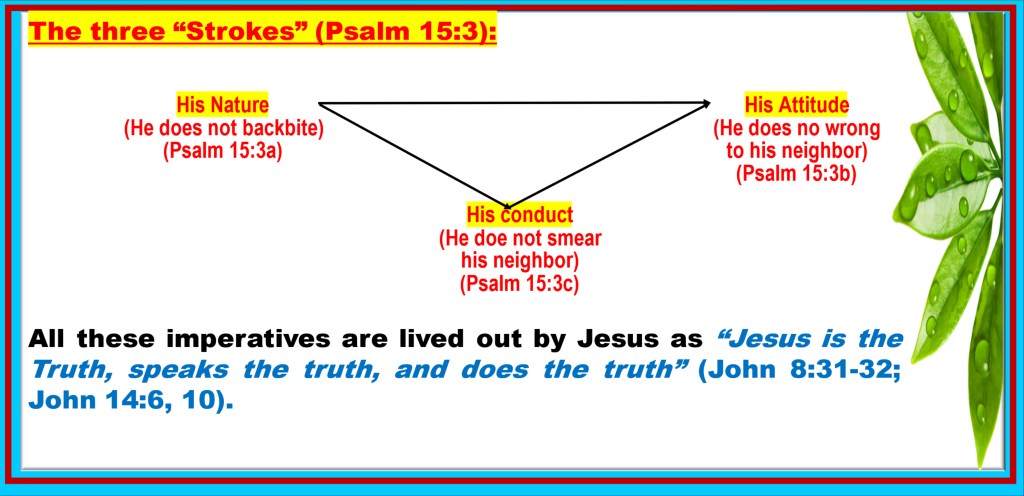
His Nature – He Does not Backbite – Psalm 15:3a “He who does not backbite with his tongue.”
First, David in Psalm 15:3a highlights the importance of controlling one’s tongue and avoiding hurtful and damaging speech:
- He who does not: The Hebrew Phrase “ʾăsher lōʾ” means he who does not, emphasizing the idea of refraining from or avoiding a particular behaviour.
- Backbite: The Hebrew word “rāgǎl” means to slander, defame, or speak evil of someone, often secretly or behind their back.
- With his tongue: The Hebrew Phrase “bələšōnō” means with his tongue, emphasizing the idea that the tongue is the instrument used for backbiting and slander.
Second, the themes of Psalm 15:3a “He who does not backbite with his tongue.”
- Control of the Tongue: Psalm 15:3a emphasizes the importance of controlling One’s tongue and avoiding hurtful and damaging speech.
- Avoiding slander and gossip: The Phrase “does not backbite” highlights the need to avoid speaking evil of others, whether secretly or openly.
- Qualifications for Worship: Psalm 15:3a is part of the larger Psalm that outlines the qualifications for Worshiping God, emphasizing the importance of living the life of integrity and moral uprightness.
Third, the Biblical Parallels of Psalm 15:3a “He who does not backbite with his tongue.”
- Proverbs 10:31-32 “The mouth of the righteous brings forth wisdom, but the perverse tongue will be cut out. The lips of the righteous know what is fitting, and their mouth speaks what is right.”
- James 1:26 “If anyone among you thinks he is religious and does not bridle his tongue but deceives his own heart, this one’s religion is useless.”
Fourth, the implications of Psalm 15:3a “He who does not backbite with his tongue.”
- Be mindful of our words: Believers should be mindful of our words and avoid speaking evil of others, recognizing the hurt and damage that can be caused by uncontrolled speech.
- Use our tongue for good: Psalm 15:3a encourages Believers to use their tongue for good, speaking words of wisdom, kindness, and encouragement that build up and edify others.
Fifth, the Person is not guilty of backbiting with his tongue – Psalm 15:3a “He who does not backbite with his tongue.” The term “backbiting” (SC7270) has the thought of “playing the spy” with the intention of slandering and tale bearing.
- The Person will not go about slyly exploring the lives of Others with a malicious intent.
- The Person would not take up or entertain Slander which has told him about his neighbour.
- The Person will neither give nor take stories about Others which would do harm or cause pain to his neighbour.
- The Person will not readily believe ill reports, nor trade in them. This is the wicked mischievousness which he will shun.
- The Person does not slander or speak against Others behind their backs – Psalm 101:5a (NIV) “Whosoever slanders his neighbour in secret, him will I (God) put to silence.”
- The Person does not injure others by words of mouth – James 1:26 “If anyone among you thinks he is religious and does not bridle his tongue but deceives his own heart, this one’s religion is useless.”
Sixth, the term “backbites” (Psalm 15:3a) is from a root signifying “to go about,” and convey the idea of the Person who goes about from house to house spreading an evil report of his neighbour. In Psalm 15:3, David is specific as to what the Person who “abides and dwells” in God’s Presence does. The Person resists Gossiper and Slanderer: “He does not backbite with his tongue.” (Psalm 15:3a), but “he speaks the truth with love.” (Ephesians 4:15a).
Seventh, the Person whose word is true is the Person who gives observance to the Ninth Commandment – Exodus 20:16 “You shall not bear false witness against your neighbour.” The Person does not slander, that is, he does not go about as a tell-tale. He is careful to avoid gossip (1Timothy 5:13):
- C.H Spurgeon: “All Slanderers are the Devil bellows to blow up contention, but those are worst which blow at the back of the fire.”
- Trapp: “The talebearer carries the Devil in his tongue, and the tale-Hearer carries the Devil in his ear.”
Personal Attitude
He Does no Evil to His Neighbour – Psalm 15:3b “Nor does evil to his neighbour.”
First, David in Psalm 15:3b highlights the importance of treating others with kindness, respect, and compassion:
- Nor: The Hebrew word “wəlōʾ” means nor or and not, emphasizing the idea of adding another characteristic to the list of qualifications.
- Does evil: The Hebrew Phrase “yəʿǎśeh rāʿ” means does evil or causes harm, highlighting the idea of intentionally causing harm or injury to someone.
- To his neighbour: The Hebrew Phrase “lərēʿēhû” means to his neighbour, emphasizing the idea of treating those around us with kindness, respect, and compassion.
Second, the themes of Psalm 15:3b “Nor does evil to his neighbour.”
- Love and kindness towards Others: Psalm 15:3b emphasizes the importance of treating others with love, kindness, and compassion, recognizing that we are all neighbours and fellow human beings.
- Avoiding harm and injury: The Phrase “nor does evil” highlights the need to avoid intentionally causing harm or injury to others, whether physically, emotionally, or spiritually.
- Qualifications for Worship: Psalm 15:3b is part of the larger Psalm that outlines the qualifications for Worshiping God, emphasizing the importance of living a life of love, kindness, and compassion towards others.
Third, the Biblical Parallels of Psalm 15:3b “Nor does evil to his neighbour.”
- Leviticus 19:18 “You shall not take vengeance, nor bear any grudge against the children of your people, but you shall love your neighbour as yourself: I am the LORD.”
- Matthew 22:39 “And the second is like it: ‘Love your neighbour as yourself.'”
Fourth, the implications of Psalm 15:3b “Nor does evil to his neighbour.”
- Treat others with kindness and respect: Believers should strive to treat others with kindness, respect, and compassion, recognizing that we are all neighbours and fellow human beings.
- Avoid causing harm or injury: Psalm 15:3b encourages Believers to avoid intentionally causing harm or injury to others, whether physically, emotionally, or spiritually.
- The Person, whose work is righteous does not do evil or being unkind to his Neighbour.
- The Person always seeks to fulfil the Second Commandment: “Thou shalt love your neighbour as yourself.” (Matthew 22:39).
- The Person does not despise but honour an Individual.
- The Person does not damage others of their good reputation.
Fifth, John Seldon: “What care me to see a man run after a Sermon, if he cozens and cheats as soon as he comes home? He that has not religion to govern his morality is not a dram better than moral mastiff; so long as you stroke him, and please him, an do not pinch him, he will play with you as finely as may be, he is a very good moral mastiff; but if you hurt him, he will fly in your face, and tear out your throat.”
Personal Conduct
He Does Not Smear Others – Psalm 15:3c “Nor does he take up a reproach (criticism) against his friend.”
First – David in Psalm 15:3c highlights the importance of loyalty, trust, and discretion in our relationships with others:
- Nor: The Hebrew word “wəlōʾ” means nor or and not, emphasizing the idea of adding another characteristic to the list of qualifications.
- Does he take up: The Hebrew Phrase “yāśāʾ” means does he take up or does he bring forth, highlighting the idea of initiating or perpetuating something.
- A reproach: The Hebrew word “chērəpāh” means a reproach or criticism, emphasizing the idea of speaking negatively or critically about someone.
- Against his friend: The Hebrew Phrase “ʿal rēʿēhû” means against his friend, highlighting the idea of betraying or harming someone with whom we have a close relationship.
Second, the themes of Psalm 15:3c “Nor does he take up a reproach (criticism) against his friend.”
- Loyalty and Discretion: Psalm 15:3c emphasizes the importance of being loyal and discreet in our relationships with others, avoiding criticism or reproach that could harm or betray our friends.
- Protecting others’ Reputations: The Phrase “nor does he take up a reproach” highlights the need to protect others’ reputations and avoid speaking negatively about them.
- Qualifications for Worship: Psalm 15:3c is part of the larger Psalm that outlines the qualifications for Worshiping God, emphasizing the importance of living the life of integrity, loyalty, and discretion.
Third, the Biblical Parallels of Psalm 15:3c “Nor does he take up a reproach (criticism) against his friend.”
- Proverbs 11:13 “A talebearer reveals secrets, but he who is of a faithful spirit conceals a matter.”
- Proverbs 17:9 “He who covers a transgression seeks love, but he who repeats a matter separates friends.”
Fourth, the implications of Psalm 15:3c “Nor does he take up a reproach (criticism) against his friend.”
- Be loyal and discreet in your relationships: Believers should strive to be loyal and discreet in their relationships with others, avoiding criticism or reproach that could harm or betray their friends.
- Protect others’ reputations: Psalm 15:3c encourages Believers to protect others’ reputations and avoid speaking negatively about them, recognizing the harm that can be caused by careless or critical words.
Fifth, the Person does not “take up a reproach against his friend (literally, ‘neighbour, the one near’).” That is, he does not pass on slur (smear) or lies about those close to him. He “speaks the truth, in love” (Ephesians 4:15a). Psalm 15:3, then, gives specific directions:

